 Back
BackMendelian Genetics and Extensions: Principles of Inheritance
Study Guide - Smart Notes
 Tailored notes based on your materials, expanded with key definitions, examples, and context.
Chapter 11: Mendel and the Gene Idea
Introduction to Mendelian Genetics
Gregor Mendel, an Austrian monk, established the basic principles of heredity through experiments with garden peas. His work laid the foundation for modern genetics by demonstrating how traits are inherited from one generation to the next.
Mendel’s Experimental System
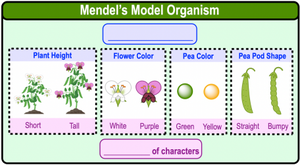
Model Organism: Mendel used Pisum sativum (garden pea) due to its many varieties with distinct, easily observable traits and the ability to control mating.
Characters and Traits: A character is a heritable feature (e.g., flower color), while a trait is a variant of a character (e.g., purple or white flowers).
Mendel’s Experimental Approach
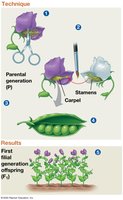
Hybridization: Mendel crossed true-breeding plants (P generation) with contrasting traits to produce hybrids (F1 generation).
Controlled Crosses: He removed stamens from one flower and transferred pollen from another to ensure controlled fertilization.
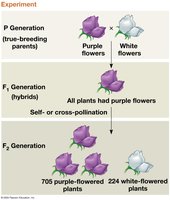
Generations: The offspring of the P generation are the F1 generation; self- or cross-pollination of F1 plants produces the F2 generation.
Quantitative Results and the Law of Segregation
True-breeding: Plants that produce offspring identical to themselves when self-pollinated.
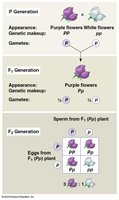
Dominant and Recessive Traits: In F1, only the dominant trait appears; the recessive trait reappears in F2 in a 3:1 ratio.
Gene Concept: Mendel’s “heritable factors” are now known as genes.
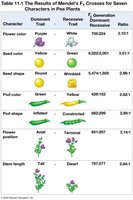
Character | Dominant Trait | Recessive Trait | F2 Generation (Dominant:Recessive) |
|---|---|---|---|
Flower color | Purple | White | 705:224 (3.15:1) |
Seed color | Yellow | Green | 6,022:2,001 (3.01:1) |
Seed shape | Round | Wrinkled | 5,474:1,850 (2.96:1) |
Pod shape | Inflated | Constricted | 882:299 (2.95:1) |
Pod color | Green | Yellow | 428:152 (2.82:1) |
Flower position | Axial | Terminal | 651:207 (3.14:1) |
Stem length | Tall | Dwarf | 787:277 (2.84:1) |
Mendel’s Model of Inheritance
Mendel proposed a model with four key concepts to explain the 3:1 inheritance pattern:
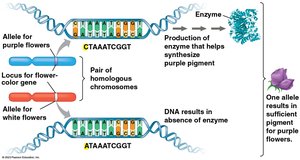
Alleles: Alternative versions of genes account for variations in inherited characters. Each gene is located at a specific locus on a chromosome.
Inheritance of Alleles: Each organism inherits two alleles for each gene, one from each parent.
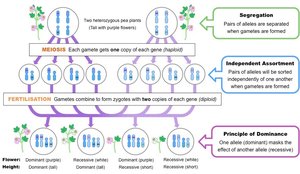
Dominance: If two alleles differ, the dominant allele determines the phenotype; the recessive allele is masked.
Law of Segregation: The two alleles for a heritable character segregate during gamete formation, so each gamete carries only one allele for each gene.
Punnett Squares and Genetic Ratios
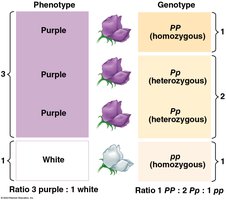
Punnett Square: A diagram used to predict the genetic makeup of offspring from a cross.
Genotype vs. Phenotype: Genotype refers to the genetic makeup (e.g., PP, Pp, pp), while phenotype refers to the observable trait (e.g., purple or white flowers).
The Testcross
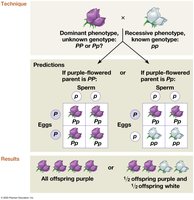
A testcross is used to determine the genotype of an individual with a dominant phenotype by crossing it with a homozygous recessive individual. The offspring phenotypes reveal the unknown genotype.
The Law of Independent Assortment
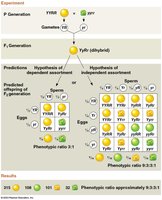
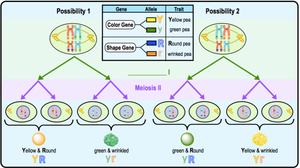
Mendel’s law of independent assortment states that each pair of alleles segregates independently of other pairs during gamete formation. This was demonstrated using dihybrid crosses, which track two characters simultaneously.
Monohybrid Cross: Involves one character; F1 offspring are monohybrids (heterozygous for one gene).
Dihybrid Cross: Involves two characters; F1 offspring are dihybrids (heterozygous for both genes).
Chromosomal Basis of Mendel’s Laws
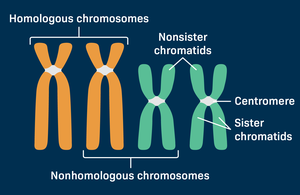
The law of segregation and the law of independent assortment are explained by the behavior of chromosomes during meiosis. Nonhomologous chromosomes assort independently, while homologous chromosomes segregate during gamete formation.
Extensions of Mendelian Genetics
Not all inheritance patterns follow simple Mendelian rules. Some genes exhibit more complex patterns, including incomplete dominance, codominance, multiple alleles, pleiotropy, epistasis, and polygenic inheritance.
Degrees of Dominance
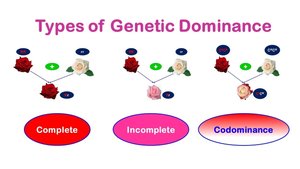
Complete Dominance: Heterozygote and dominant homozygote are phenotypically indistinguishable.
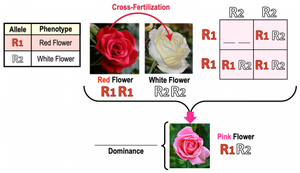
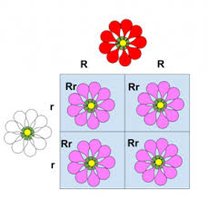
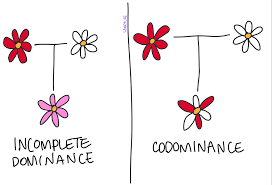
Incomplete Dominance: Heterozygote phenotype is intermediate between the two homozygotes.
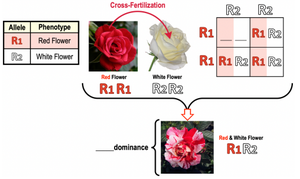
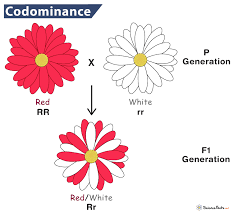
Codominance: Both alleles are fully expressed in the heterozygote.
Multiple Alleles
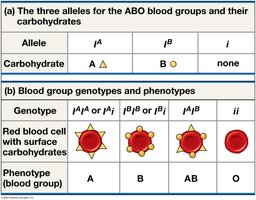
Many genes have more than two allelic forms. For example, the ABO blood group in humans is determined by three alleles: IA, IB, and i.
Pleiotropy
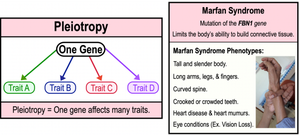
Pleiotropy occurs when one gene influences multiple phenotypic traits. Examples include cystic fibrosis and sickle-cell disease, where a single gene affects several body systems.
Epistasis
Epistasis is when the expression of one gene is affected by another gene at a different locus. For example, in Labrador retrievers, one gene determines pigment color and another determines whether pigment is deposited in the fur.
Polygenic Inheritance
Polygenic inheritance occurs when multiple genes contribute to a single trait, resulting in continuous variation. Examples include human height, skin color, and eye color.
Multifactorial Inheritance
Some traits are influenced by both genetic and environmental factors, known as multifactorial inheritance. For example, hydrangea flower color depends on soil pH as well as genotype.
Mendelian Inheritance in Humans
Many human traits follow Mendelian patterns, but studying human genetics is challenging due to long generation times and ethical considerations. Pedigree analysis is used to study inheritance patterns in families.
Recessively Inherited Disorders
Recessive Disorders: Only expressed in individuals homozygous for the recessive allele. Heterozygotes are carriers.
Cystic Fibrosis: Autosomal recessive; defective chloride channels cause mucus buildup and organ dysfunction.
Sickle-Cell Disease: Autosomal recessive; abnormal hemoglobin causes red blood cells to sickle, leading to various health issues. Heterozygotes are resistant to malaria.
Dominantly Inherited Disorders
Dominant Disorders: Rare, often lethal before reproductive age. Huntington’s disease is a notable exception, with symptoms appearing later in life.
Multifactorial Disorders
Many diseases, such as heart disease, diabetes, and cancer, have both genetic and environmental components.
Lifestyle choices can significantly affect the risk and expression of these diseases.
Additional info: This summary integrates Mendel’s foundational work with modern genetic concepts, providing a comprehensive overview suitable for college-level biology students.
