 Back
BackMetabolic Pathways and Cellular Respiration: Introduction to Energy Production
Study Guide - Smart Notes
 Tailored notes based on your materials, expanded with key definitions, examples, and context.
Metabolic Pathways: Introduction to Energy Production
Overview of Metabolism
Metabolism encompasses all chemical reactions occurring within an organism, enabling it to maintain life, grow, and reproduce. These reactions are organized into metabolic pathways, which are sequences of enzymatically catalyzed steps that transform substrates into final products in a controlled and predictable manner.
Metabolic Pathways: Can be classified as linear or cyclic based on their structure and flow of intermediates.
Linear Pathways: The product of one reaction becomes the substrate for the next, proceeding in a straight sequence.
Cyclic Pathways: The pathway regenerates one of the initial substrates, allowing the cycle to repeat continuously.
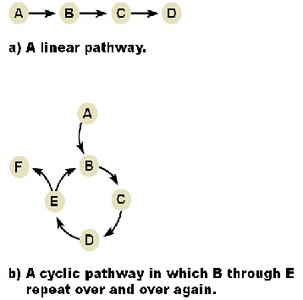
Types of Metabolic Pathways
Metabolic pathways are broadly divided into two categories based on their function and energy requirements:
Anabolic Pathways: Involve the synthesis of complex molecules from simpler ones, requiring energy input. Example: Protein synthesis from amino acids.
Catabolic Pathways: Involve the breakdown of complex molecules into simpler ones, releasing energy. Example: Breakdown of glucose into carbon dioxide, water, and energy.
Enzymes and Co-enzymes in Metabolism
Enzymes are biological catalysts essential for the progression of metabolic pathways. They lower the activation energy required for reactions and are highly specific to their substrates. Co-enzymes are non-protein molecules that assist enzymes, often by transporting chemical groups or electrons between reactions.
Enzymes: Not consumed in reactions; can be reused.
Co-enzymes: Examples include NAD+ and FADH, which play critical roles in cellular respiration by carrying electrons and hydrogen ions.
Energy Production in Cells
ATP: The Energy Currency
Adenosine triphosphate (ATP) is the primary energy carrier in cells. Energy is stored in the high-energy phosphate bonds of ATP. When ATP is hydrolyzed to ADP and inorganic phosphate (Pi), energy is released for cellular work. The reaction is reversible, allowing ATP to be regenerated by phosphorylation.
ATP Hydrolysis:
ATP Synthesis (Phosphorylation):
Sources of Cellular Fuel
Cells primarily use glucose as a fuel source, obtained from food or stored glycogen. When glucose is unavailable, cells can metabolize fats and proteins. The catabolism of glucose is the most immediate and efficient source of ATP for most cells.
Overview of Cellular Respiration
Cellular respiration is the process by which cells extract energy from glucose to produce ATP. It consists of four main stages:
Glycolysis
Preparatory Step
Citric Acid Cycle
Electron Transport System
Glycolysis occurs in the cytoplasm, while the remaining steps take place in the mitochondria. Oxygen is required for the complete oxidation of glucose (aerobic respiration).
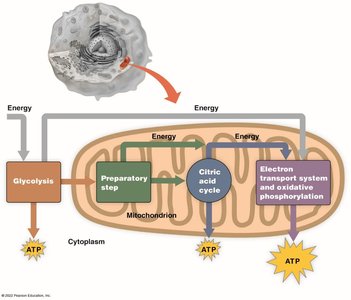
Detailed Steps of Cellular Respiration
Stage #1: Glycolysis
Glycolysis is the first step in cellular respiration, occurring in the cytoplasm of all living cells. It involves the breakdown of one glucose molecule (6 carbons) into two pyruvate molecules (3 carbons each) through a series of enzyme-catalyzed reactions. Glycolysis is divided into two phases:
Energy Investment Phase: Two ATP molecules are used to phosphorylate glucose, splitting it into two molecules of glyceraldehyde-3-phosphate (G3P).
Energy Yielding Phase: Each G3P is converted into pyruvate, producing four ATP molecules (net gain of two ATP) and two NADH molecules by substrate-level phosphorylation and reduction of NAD+.
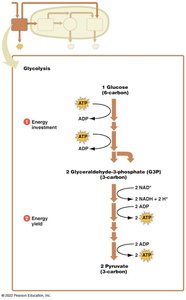
Net ATP Gain: 2 ATP per glucose molecule
Coenzyme Activity: 2 NAD+ are reduced to 2 NADH
End Products: 2 pyruvate molecules proceed to the next stage
Stage #2: Preparatory Step
In the presence of oxygen, pyruvate molecules enter the mitochondria for further processing. Each pyruvate is converted into a two-carbon acetyl group, releasing one molecule of carbon dioxide as waste. The acetyl group is then attached to coenzyme A, forming acetyl CoA, which enters the citric acid cycle. Additionally, NAD+ is reduced to NADH during this step.
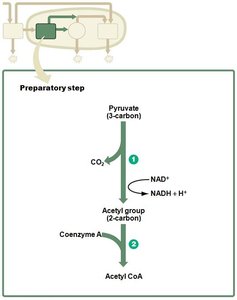
ATP Produced: None in this step
Coenzyme Activity: 2 NAD+ are reduced to 2 NADH
End Products: 2 acetyl CoA (for the citric acid cycle), 2 CO2 (waste)
Summary Table: Glycolysis and Preparatory Step
Stage | Main Events | ATP Produced | NADH Produced | Other Products |
|---|---|---|---|---|
Glycolysis | Glucose → 2 Pyruvate | 2 (net) | 2 | None |
Preparatory Step | 2 Pyruvate → 2 Acetyl CoA + 2 CO2 | 0 | 2 | 2 CO2 (waste) |
Key Terms and Concepts
Metabolism: The sum of all chemical reactions in an organism.
Metabolic Pathway: A series of enzyme-catalyzed reactions transforming a substrate into a final product.
Anabolism: Building up complex molecules from simpler ones (requires energy).
Catabolism: Breaking down complex molecules into simpler ones (releases energy).
Enzyme: Protein catalyst that speeds up chemical reactions without being consumed.
Co-enzyme: Non-protein molecule that assists enzymes, often by carrying electrons or chemical groups.
ATP: Main energy currency of the cell.
NAD+: Electron carrier reduced to NADH during glycolysis and the preparatory step.
Pyruvate: End product of glycolysis, substrate for the preparatory step.
Acetyl CoA: Entry molecule for the citric acid cycle, formed from pyruvate and coenzyme A.
