 Back
BackMetabolic Pathways and Energy Production in Cells
Study Guide - Smart Notes
 Tailored notes based on your materials, expanded with key definitions, examples, and context.
Metabolic Pathways: Introduction to Energy Production
Overview of Metabolism
Metabolism encompasses all chemical reactions occurring within an organism, enabling the maintenance of life. These reactions are organized into metabolic pathways, which are sequences of enzymatically catalyzed steps that transform substrates into final products.
Metabolic Pathways: Ordered series of reactions where the product of one reaction becomes the substrate for the next.
Types of Pathways:
Linear Pathways: The product of each reaction serves as the substrate for the next, forming a straight sequence.
Cyclic Pathways: The substrate enters a cycle, and the pathway regenerates the starting molecule, allowing the cycle to repeat.
Anabolic and Catabolic Pathways
Metabolic pathways are classified based on their function in cellular processes:
Anabolic Pathways: Build larger molecules from smaller ones, requiring energy input (e.g., protein synthesis from amino acids).
Catabolic Pathways: Break down complex molecules into simpler ones, releasing energy (e.g., breakdown of glucose to carbon dioxide and water).
Enzymes and Co-enzymes in Metabolism
Enzymes are biological catalysts essential for metabolic reactions. Co-enzymes are non-protein molecules that assist enzymes, often by transferring electrons or functional groups.
Enzymes: Speed up reactions without being consumed; can be reused.
Co-enzymes: Help enzymes by carrying molecules or electrons; examples include NAD+ and FADH.
Energy Production and ATP
ATP: The Energy Currency
Adenosine triphosphate (ATP) stores energy in its phosphate bonds. Hydrolysis of ATP releases energy for cellular work, while phosphorylation regenerates ATP from ADP and inorganic phosphate (Pi).
ATP Hydrolysis:
ATP Synthesis (Phosphorylation):
Sources of Cellular Fuel
Cells primarily use glucose for ATP production, but can also metabolize fats and proteins when glucose is scarce. Glycogen serves as a storage form of glucose.
Glucose: Main fuel for ATP synthesis; obtained from diet or glycogen stores.
Alternative Fuels: Fats and proteins are used when glucose is unavailable.
Cellular Respiration: Overview and Stages
General Overview
Cellular respiration is a catabolic process that converts glucose into ATP, with carbon dioxide and water as byproducts. It consists of four main stages:
Glycolysis (cytoplasm)
Preparatory Step (mitochondria)
Citric Acid Cycle (mitochondria)
Electron Transport System (mitochondria)
Overall, one glucose molecule yields approximately 36 ATP molecules.
Stage #1: Glycolysis
Glycolysis is the breakdown of glucose into two pyruvate molecules, occurring in the cytoplasm. It consists of two phases:
Energy Investment Phase: 2 ATP are used to phosphorylate glucose, splitting it into two 3-carbon molecules (G3P).
Energy Yielding Phase: Each G3P is converted to pyruvate, producing 4 ATP (net gain of 2 ATP) and 2 NADH.
Summary of Glycolysis:
ATP: 2 invested, 4 produced, net gain = 2 ATP
Coenzyme Activity: 2 NAD+ reduced to 2 NADH
Products: 2 pyruvate molecules
Coenzyme NAD+ in Glycolysis
Nicotinamide adenine dinucleotide (NAD+) acts as an electron carrier. During glycolysis, it is reduced to NADH by accepting hydrogen ions and electrons:
2 NAD+ + 2 H+ + 4 e- → 2 NADH
Stage #2: Preparatory Step
The preparatory step links glycolysis to the citric acid cycle. In the presence of oxygen, pyruvate enters the mitochondria and is converted to acetyl CoA.
Each pyruvate (3C) is decarboxylated to form a 2-carbon acetyl group and CO2 (waste).
NAD+ is reduced to NADH.
Coenzyme A binds the acetyl group, forming acetyl CoA, which enters the citric acid cycle.
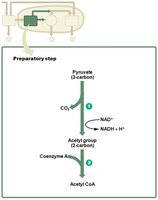
Summary of Preparatory Step:
ATP: None produced
Coenzyme Activity: 2 NAD+ reduced to 2 NADH
Products: 2 acetyl CoA, 2 CO2 (waste)
Table: Comparison of Anabolic and Catabolic Pathways
Pathway Type | Function | Energy Requirement | Example |
|---|---|---|---|
Anabolic | Builds larger molecules from smaller ones | Requires energy | Protein synthesis |
Catabolic | Breaks down molecules into smaller units | Releases energy | Glucose breakdown |
Key Points and Applications
Metabolic pathways are essential for energy production and biosynthesis in cells.
ATP is the universal energy currency, produced mainly by cellular respiration.
Enzymes and co-enzymes are crucial for the regulation and efficiency of metabolic reactions.
Glucose is the primary fuel, but cells can adapt to use fats and proteins as needed.
Additional info: The citric acid cycle and electron transport system, which follow the preparatory step, further oxidize acetyl CoA and generate the majority of ATP during aerobic respiration.
