 Back
BackMetabolic Pathways and Enzyme Function
Study Guide - Smart Notes
 Tailored notes based on your materials, expanded with key definitions, examples, and context.
Metabolic Pathways
Overview of Metabolism
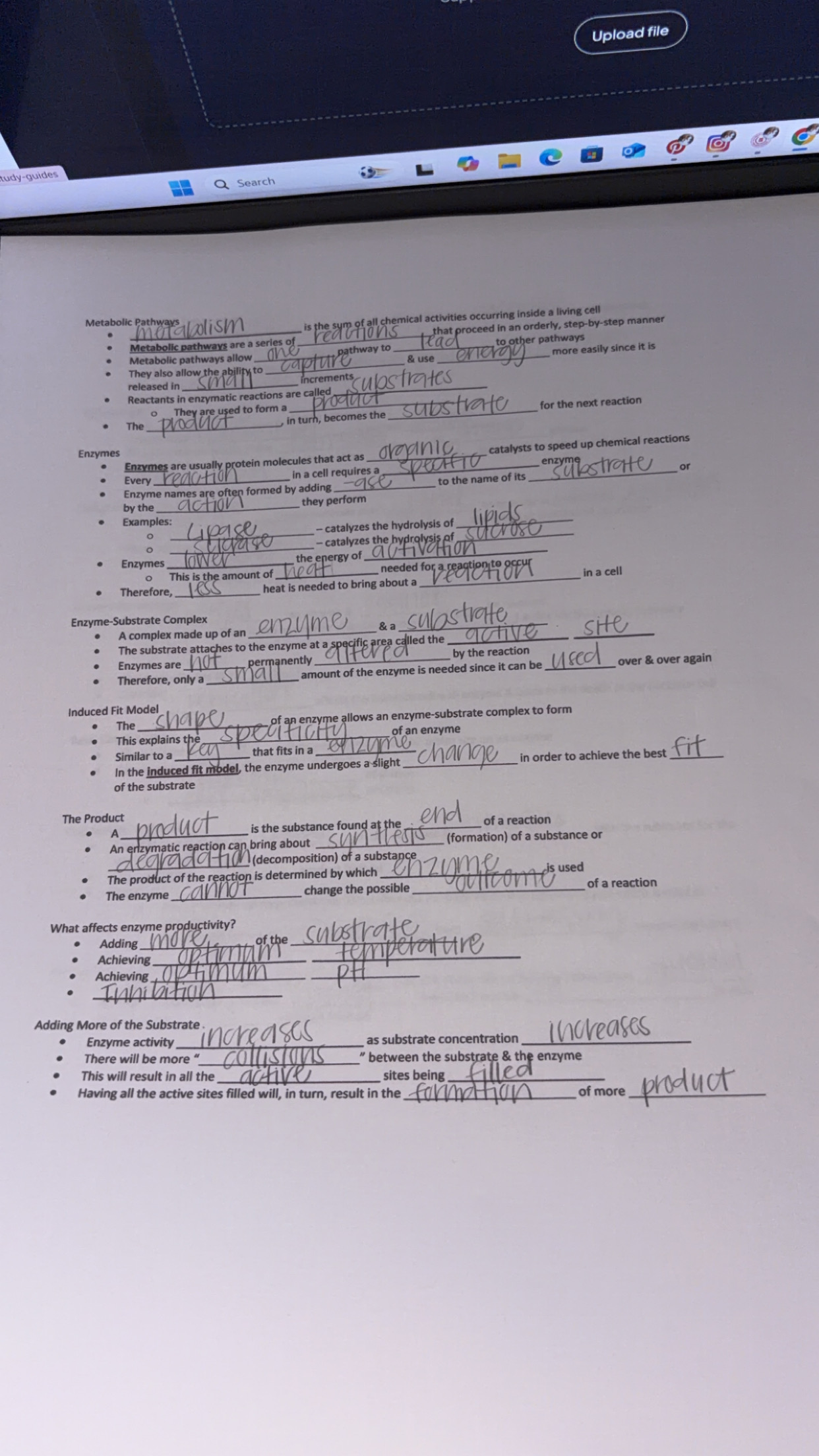
Metabolism is the sum of all chemical activities occurring inside a living cell. These activities are organized into metabolic pathways, which are series of chemical reactions that proceed in an orderly, step-by-step manner. Metabolic pathways allow one pathway to capture and use energy released in increments, making energy management more efficient for the cell.
Reactants in enzymatic reactions are called substrates.
The product of one reaction becomes the substrate for the next reaction in the pathway.
Enzymes
Nature and Function of Enzymes
Enzymes are usually protein molecules that act as organic catalysts to speed up chemical reactions. Every reaction in a cell requires a specific enzyme. Enzyme names are often formed by adding the suffix -ase to the name of its substrate or the reaction they perform.
Lipase – catalyzes the hydrolysis of lipids.
Sucrase – catalyzes the hydrolysis of sucrose.
Enzymes lower the activation energy needed for a reaction to occur, allowing reactions to proceed at cellular temperatures without the need for excessive heat.
Enzyme-Substrate Complex
Formation and Function
An enzyme-substrate complex is formed when an enzyme binds to its substrate at a specific region called the active site. The substrate attaches to the enzyme at this site, and the enzyme is not permanently altered by the reaction. Therefore, only a small amount of enzyme is needed since it can be used repeatedly.
Induced Fit Model
Mechanism of Enzyme Action
The induced fit model of an enzyme allows an enzyme-substrate complex to form by slightly altering the shape of the enzyme to achieve the best fit with the substrate. This explains the specificity of enzyme action and is similar to a key fitting into a lock, but with the enzyme undergoing a slight change in shape for optimal binding.
The Product
Outcomes of Enzymatic Reactions
The product is the substance found at the end of a reaction.
An enzymatic reaction can bring about synthesis (formation) or catabolism (decomposition) of a substance.
The product of the reaction is determined by which enzyme/substrate is used.
Enzymes cannot change the possible outcomes of a reaction; they only speed up the process.
What Affects Enzyme Productivity?
Factors Influencing Enzyme Activity
Adding more of the substrate increases enzyme activity.
Achieving optimum temperature and optimum pH is crucial for maximum enzyme activity.
Inhibition can decrease enzyme productivity by blocking the active site or altering enzyme structure.
Adding More of the Substrate
Substrate Concentration and Enzyme Activity
Enzyme activity increases as substrate concentration increases.
There will be more collisions between the substrate and the enzyme.
This will result in all the active sites being filled.
Having all the active sites filled will, in turn, result in the formation of more product.
Summary Table: Enzyme Function and Regulation
Concept | Definition/Explanation | Example |
|---|---|---|
Metabolism | Sum of all chemical activities in a cell | Cellular respiration, photosynthesis |
Enzyme | Protein catalyst that speeds up reactions | Lipase, sucrase |
Substrate | Reactant in an enzymatic reaction | Sucrose for sucrase |
Active Site | Region on enzyme where substrate binds | Binding pocket of sucrase |
Induced Fit | Enzyme changes shape for optimal substrate binding | Hexokinase with glucose |
Activation Energy | Energy needed to start a reaction | Lowered by enzymes |
Optimum Conditions | Best temperature and pH for enzyme activity | Pepsin in stomach (acidic pH) |
Key Equations
Activation Energy (Ea):
is the minimum energy required for a chemical reaction to proceed.
General Enzyme Reaction:
Where E = enzyme, S = substrate, ES = enzyme-substrate complex, P = product.
