 Back
BackMetabolism: Energy, Enzymes, and Regulation
Study Guide - Smart Notes
 Tailored notes based on your materials, expanded with key definitions, examples, and context.
Metabolism: Energy, Pathways, and Thermodynamics
Overview of Metabolism
Metabolism refers to all chemical reactions occurring within a living organism. These reactions are organized into metabolic pathways, where each step is catalyzed by a specific enzyme. Metabolic pathways are essential for acquiring and utilizing energy in biological systems.
Catabolic Pathways: Break down complex molecules into simpler ones, releasing energy (e.g., cellular respiration).
Anabolic Pathways: Build complex molecules from simpler ones, consuming energy (e.g., protein synthesis).
Energy is the capacity to cause change. It exists mainly as:
Kinetic Energy: Energy of motion (e.g., muscle contraction, heat).
Potential Energy: Stored energy (e.g., chemical bonds in food).
Thermodynamics and Metabolism
Thermodynamics studies energy transformations. Two fundamental laws apply to biological systems:
First Law (Conservation of Energy): Energy can be transferred or transformed, but not created or destroyed.
Second Law: Every energy transfer increases the entropy (disorder) of the universe; some energy is lost as heat.
Living organisms are open systems, exchanging energy and matter with their environment, preventing equilibrium and allowing continuous work.
Free Energy and Spontaneous Reactions
Gibbs Free Energy (ΔG)
Free energy (G) is the portion of a system's energy available to do work under constant temperature and pressure. The change in free energy (ΔG) predicts whether a reaction is spontaneous.
The equation for Gibbs free energy is:
ΔH: Change in enthalpy (total energy)
T: Temperature in Kelvin
ΔS: Change in entropy
Alternatively, (final minus initial free energy).
Spontaneous vs. Nonspontaneous Processes
Spontaneous: Occur without energy input; ΔG is negative (exergonic).
Nonspontaneous: Require energy input; ΔG is positive or zero (endergonic).
Equilibrium: Maximum stability; no net change in free energy.
Exergonic and Endergonic Reactions
Exergonic: Release free energy (ΔG < 0); spontaneous.
Endergonic: Absorb free energy (ΔG > 0); nonspontaneous.
Example Calculation:
Given ΔH = -50.0 kJ/mol, ΔS = -0.150 kJ/mol·K, T = 300 K:
Since ΔG is negative, the reaction is spontaneous and exergonic.
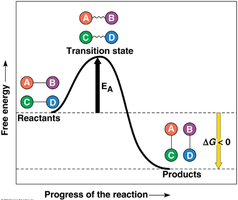
This diagram shows the energy profile of an exergonic reaction, with reactants at higher free energy than products. The activation energy (EA) is the energy barrier that must be overcome for the reaction to proceed.
ATP and Energy Coupling
ATP: The Energy Currency of the Cell
ATP (Adenosine Triphosphate) is the primary energy carrier in cells. Its three phosphate groups are negatively charged and unstable, making ATP hydrolysis highly exergonic.
ATP Hydrolysis: ATP + H2O → ADP + Pi + energy
Energy released is used to power cellular work.
Energy Coupling
Cells use energy coupling to drive endergonic reactions by pairing them with exergonic ATP hydrolysis.
Phosphorylation: Transfer of a phosphate group from ATP to another molecule, making it more reactive.
The ATP Cycle
ATP is regenerated from ADP and Pi using energy from catabolic reactions.
This cycle links energy-releasing and energy-consuming processes.
Enzymes: Catalyzing Metabolic Reactions
Enzyme Function
Enzymes are biological catalysts, usually proteins, that speed up reactions by lowering the activation energy (EA), without being consumed in the process.
Substrate: The reactant an enzyme acts upon.
Active Site: The region on the enzyme where the substrate binds.
Induced Fit: The enzyme changes shape to fit the substrate more closely.
Activation Energy (EA)
Activation energy is the initial energy required to start a reaction.
Enzymes lower EA, allowing reactions to proceed rapidly at cellular temperatures.
Factors Affecting Enzyme Activity
Temperature: Each enzyme has an optimal temperature; too high or too low can denature the enzyme.
pH: Each enzyme has an optimal pH (e.g., pepsin at pH 2, trypsin at pH 8).
Cofactors: Nonprotein helpers (inorganic ions like Zn2+, Fe2+, or organic coenzymes derived from vitamins).
Regulation of Enzyme Activity
Enzyme Inhibitors
Competitive Inhibitors: Bind to the active site, blocking the substrate. Can be overcome by increasing substrate concentration.
Noncompetitive Inhibitors: Bind elsewhere on the enzyme, changing its shape and reducing activity.
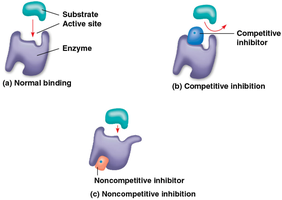
This figure illustrates normal enzyme-substrate binding, competitive inhibition (inhibitor blocks the active site), and noncompetitive inhibition (inhibitor binds elsewhere, altering enzyme shape).
Allosteric Regulation
A regulatory molecule binds to an allosteric site (not the active site), stabilizing either the active or inactive form of the enzyme.
Cooperativity: Binding of a substrate to one active site increases activity at other sites.
Feedback Inhibition
The end product of a metabolic pathway inhibits an enzyme early in the pathway, preventing overproduction.
Compartmentalization
Enzymes are localized within specific organelles, optimizing metabolic efficiency and regulation.
Additional info: Feedback inhibition and compartmentalization are essential for maintaining metabolic balance and preventing resource waste in cells.
