 Back
BackMitosis and the Cell Cycle: Structure, Regulation, and Function
Study Guide - Smart Notes
 Tailored notes based on your materials, expanded with key definitions, examples, and context.
Mitosis and the Cell Cycle
Overview of Cell Division
Cell division is a fundamental process in biology, enabling organisms to grow, repair tissues, and reproduce. There are two main types of cell division: mitosis (producing genetically identical daughter cells) and meiosis (producing gametes with half the chromosome number).
Reproduction: Single-celled organisms reproduce via cell division (binary fission), while multicellular organisms use cell division for gamete production.
Growth and Development: Multicellular organisms develop from a single cell through repeated rounds of mitosis.
Tissue Renewal and Repair: Mitosis replaces old or damaged cells, such as skin or gut lining cells.
Genetic Distribution: Ensures each new cell receives a complete copy of genetic information.
Genome and Chromosomes
The cell's genetic information is organized to ensure accurate replication and expression. The genome is the complete set of DNA, organized into chromosomes in eukaryotes. Chromosomes contain specific genes at defined loci.
Genome: All DNA in a cell; prokaryotes have a single circular DNA, eukaryotes have multiple linear chromosomes.
Chromosomes: DNA packaged with proteins (histones) into chromatin; each chromosome contains many genes.
Locus (plural loci): Physical location of a gene on a chromosome.
Chromatin: Complex of DNA and histone proteins, facilitating DNA packaging and regulation.
Example: The gene for red/green color blindness is always located at the same locus on the X chromosome in humans.
Types of Cells
Multicellular organisms have two main cell types based on their role and division method:
Somatic Cells: Non-reproductive cells (e.g., skin, muscle); diploid (two sets of chromosomes); divide by mitosis.
Gametes: Reproductive cells (sperm, egg); haploid (one set of chromosomes); produced by meiosis.
Cell Cycle Overview
Main Phases of the Cell Cycle
The cell cycle describes the life of a cell from formation to division. It consists of two main parts:
Interphase: The longest phase, including cell growth, normal functions, and DNA replication.
Mitotic (M) Phase: Includes mitosis (nuclear division) and cytokinesis (cytoplasmic division).
Interphase Sub-Phases
Interphase is divided into three sub-phases, each with distinct functions:
G1 Phase (Gap 1): Cell grows and increases organelles and proteins; intense metabolic activity.
S Phase (Synthesis): DNA replication occurs; each chromosome now consists of two sister chromatids.
G2 Phase (Gap 2): Final growth and preparation for mitosis; synthesis of mitotic spindle components.
Genome Copies: G1 - 1 copy; S - 2 copies; G2 - 2 copies.
Mitosis Stages
Mitosis is the process of nuclear division, ensuring each daughter cell receives a full set of chromosomes. It is divided into four main stages:
Prophase: Chromatin condenses; mitotic spindle forms.
Prometaphase: Nuclear envelope breaks down; kinetochores form.
Metaphase: Chromosomes align at the metaphase plate; spindle fully formed.
Anaphase: Sister chromatids separate; move to opposite poles.
Telophase: Chromosomes de-condense; nuclear envelope reforms.
Cytokinesis
Cytokinesis divides the cytoplasm, resulting in two genetically identical daughter cells. The process differs between animal and plant cells:
Animal Cells: Cleavage furrow forms via contractile ring of microfilaments.
Plant Cells: Cell plate forms, developing into a new cell wall.
Mitotic Spindle
The mitotic spindle organizes and separates chromosomes during mitosis. It is composed of microtubules and associated structures:
Centrosome: Microtubule-organizing center in animal cells.
Aster: Star-like arrangement of microtubules from the centrosome.
Kinetochores: Protein complexes on chromosomes for microtubule attachment.
Prokaryotic Division (Binary Fission)
Prokaryotes divide by binary fission, a simpler process than mitosis:
Cell grows to support two new cells.
Single, circular genome replicates.
Genomes migrate to opposite ends.
Cell elongates and splits, producing two identical daughter cells.
Cell Cycle Control System
Checkpoints and Regulation
The cell cycle is regulated by checkpoints to ensure proper timing and accuracy. There are three major checkpoints:
G1 Checkpoint: Most important; determines if cell will proceed or enter G0 (non-dividing state).
G2 Checkpoint: Ensures successful DNA replication before mitosis.
M Checkpoint: Ensures all chromosomes are properly attached to spindle before anaphase.
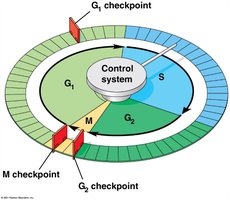
Additional info: The diagram visually represents the cell cycle phases and the location of checkpoints, reinforcing the concept of regulated progression through the cycle.
Regulatory Molecules
Internal control is managed by regulatory molecules, primarily proteins:
Cyclins and CDKs (Cyclin-Dependent Kinases): CDKs must bind to cyclins to become active; cyclin levels fluctuate to control timing.
MPF (Maturation-Promoting Factor): Cyclin-CDK complex that triggers passage from G2 to mitosis.
Example: MPF concentration peaks during G2 phase, enabling the cell to pass the G2 checkpoint.
External Signals for Division
External factors also influence cell division:
Growth Factors: Proteins stimulating cell division (e.g., PDGF for wound healing).
Density-Dependent Inhibition: Cells stop dividing when crowded; resume if space is available.
Anchorage Dependence: Animal cells must be attached to a surface to divide.
Cancer and Loss of Control
Cancer results from loss of cell cycle control, leading to uncontrolled cell division:
Cells may produce their own growth factors or bypass normal signals.
Ignore checkpoints and divide with damaged DNA.
Lack density-dependent inhibition and anchorage dependence.
Transformation: Process by which a normal cell becomes cancerous.
Tumors: Abnormal mass of cells; benign (localized) or malignant (invades tissues, metastasizes).
