 Back
BackMolecular Biology of the Gene: Structure, Function, and Genetic Information Flow
Study Guide - Smart Notes
 Tailored notes based on your materials, expanded with key definitions, examples, and context.
Chapter 10: Molecular Biology of the Gene
The Structure of the Genetic Material
The molecular basis of inheritance is encoded in the structure of DNA, which carries genetic information in all living organisms. Early experiments established DNA as the genetic material responsible for heredity.
Frederick Griffith's Experiment (1928): Demonstrated transformation, where harmless bacteria became pathogenic when mixed with heat-killed pathogenic bacteria, suggesting a "transforming principle."
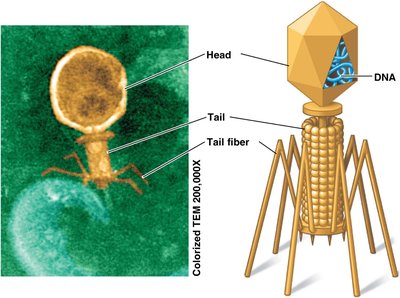
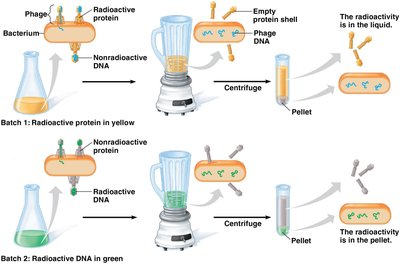
Hershey-Chase Experiment (1952): Used bacteriophages to show that DNA, not protein, is the genetic material injected into bacteria to direct viral replication.
DNA and RNA: Polymers of Nucleotides
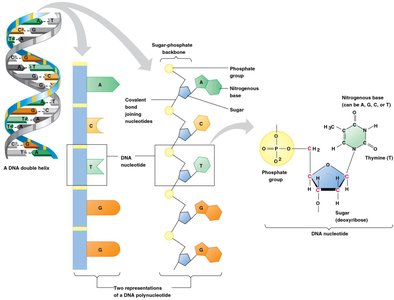
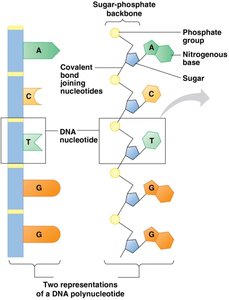
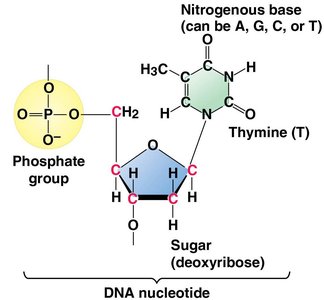
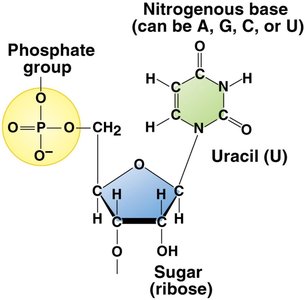
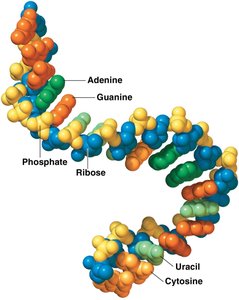
DNA and RNA are nucleic acids composed of long chains of nucleotides. Each nucleotide consists of a nitrogenous base, a five-carbon sugar, and a phosphate group.
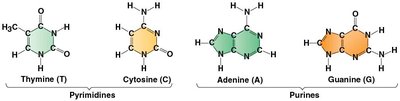
DNA Nucleotides: Adenine (A), Cytosine (C), Thymine (T), Guanine (G)
RNA Nucleotides: Adenine (A), Cytosine (C), Guanine (G), Uracil (U) (replaces Thymine)
Sugar: DNA contains deoxyribose; RNA contains ribose.
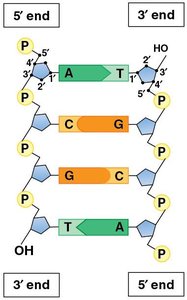
Backbone: Nucleotides are joined by covalent bonds between the sugar of one nucleotide and the phosphate of the next, forming a sugar-phosphate backbone.
Comparison of DNA and RNA
Feature | DNA | RNA |
|---|---|---|
Nitrogenous Bases | A, T, C, G | A, U, C, G |
Sugar | Deoxyribose | Ribose |
Strands | Double-stranded | Single-stranded |
DNA Is a Double-Stranded Helix
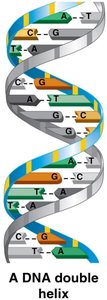
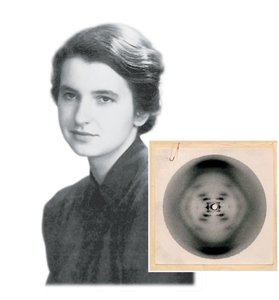
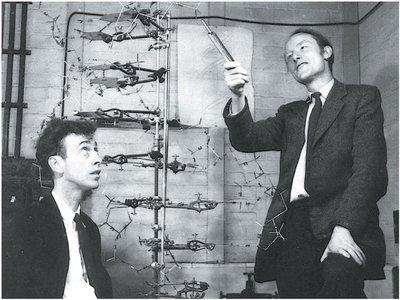
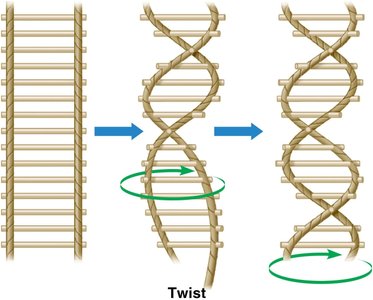
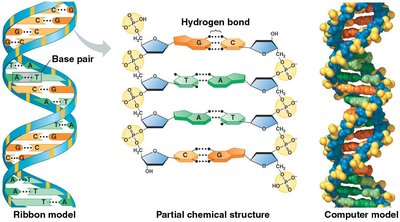
The three-dimensional structure of DNA was elucidated by Watson and Crick, who described it as a double helix with two polynucleotide strands held together by hydrogen bonds between complementary bases (A-T, G-C).
Base Pairing: Adenine pairs with Thymine; Guanine pairs with Cytosine.
Hydrogen Bonds: Hold the two strands together, enabling the double helix structure.
Genetic Information: Encoded in the sequence of nucleotides along the DNA strand.
DNA Replication
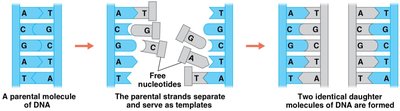
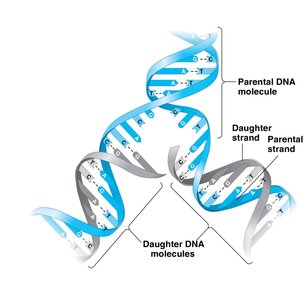
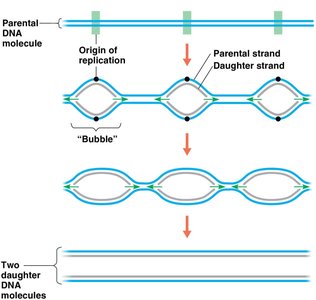
DNA replication is the process by which a cell copies its DNA before cell division. It is semiconservative, meaning each new DNA molecule consists of one old strand and one new strand.
Initiation: DNA strands separate, and each serves as a template for new strand synthesis.
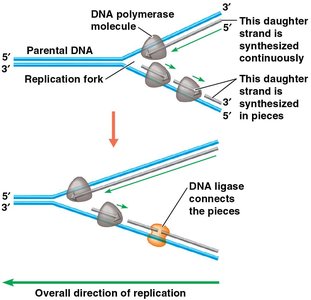
Enzymes: DNA polymerase synthesizes new DNA; DNA ligase joins short fragments on the lagging strand.
Directionality: Replication proceeds in both directions from multiple origins, forming replication bubbles.
The Flow of Genetic Information: DNA → RNA → Protein
Genetic information flows from DNA to RNA to protein through the processes of transcription and translation. This is known as the central dogma of molecular biology.
Transcription: Synthesis of RNA from a DNA template.
Translation: Synthesis of a polypeptide (protein) from an mRNA template.
Gene: A region of DNA that can be expressed to produce a functional product (polypeptide or RNA molecule).
Codons and the Genetic Code
The genetic code consists of codons—triplets of nucleotides in mRNA—that specify amino acids in a protein. The code is nearly universal among organisms.
Codon: A sequence of three nucleotides that codes for a specific amino acid.
Start Codon: Marks the beginning of translation (usually AUG).
Stop Codons: Signal the end of translation (UAA, UAG, UGA).
Transcription and RNA Processing
During transcription, RNA polymerase binds to a promoter and synthesizes RNA until it reaches a terminator sequence. In eukaryotes, the primary RNA transcript (pre-mRNA) undergoes processing before becoming mature mRNA.
RNA Splicing: Removal of introns (noncoding regions) and joining of exons (coding regions).
Modification: Addition of a 5' cap and a 3' poly-A tail to protect mRNA and facilitate translation.
Translation: From mRNA to Protein
Translation occurs in the cytoplasm and involves ribosomes, mRNA, and tRNA. tRNA molecules serve as adaptors, matching amino acids to codons in mRNA via their anticodons.
Ribosomes: Complexes of rRNA and proteins that facilitate the coupling of tRNA anticodons with mRNA codons.
Phases of Translation: Initiation, elongation, and termination.
Polypeptide Synthesis: Amino acids are added one by one to the growing chain until a stop codon is reached.
Mutations: Changes in Genetic Information
Mutations are changes in the nucleotide sequence of DNA. They can result from errors in replication, recombination, or exposure to mutagens. Types of mutations include substitutions, insertions, and deletions, which can have varying effects on gene function.
Point Mutation: Substitution of a single nucleotide.
Frameshift Mutation: Insertion or deletion that alters the reading frame.
Consequences: Can be silent, missense, nonsense, or cause genetic diseases (e.g., sickle cell anemia).
The Genetics of Viruses and Bacteria
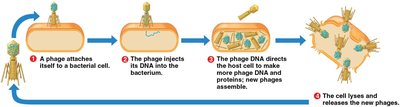
Viruses are infectious particles consisting of nucleic acid (DNA or RNA) enclosed in a protein coat. Bacteriophages infect bacteria and can follow lytic or lysogenic cycles. Bacteria can exchange genetic material through transformation, transduction, and conjugation.
Lytic Cycle: Virus replicates and lyses the host cell.
Lysogenic Cycle: Viral DNA integrates into the host genome as a prophage.
Gene Transfer in Bacteria: Transformation (uptake of DNA), transduction (phage-mediated), conjugation (direct transfer via pilus).
Plasmids: Small, circular DNA molecules that can carry genes, including antibiotic resistance genes (R plasmids).
Summary Table: DNA, RNA, and Protein Synthesis
Process | Location | Reactants | Products |
|---|---|---|---|
Replication | Nucleus | DNA, nucleotides, enzymes | Two identical DNA molecules |
Transcription | Nucleus | DNA, RNA nucleotides, RNA polymerase | mRNA |
Translation | Cytoplasm | mRNA, tRNA, amino acids, ribosomes | Polypeptide (protein) |
Additional info: The chapter also covers the role of prions (infectious proteins), the structure and replication of viruses (including HIV), and the impact of mutations and gene transfer on evolution and disease.
