 Back
BackMolecular Tools and Techniques in Biotechnology: Restriction Enzymes, Gel Electrophoresis, Plasmids, and Genetic Engineering
Study Guide - Smart Notes
 Tailored notes based on your materials, expanded with key definitions, examples, and context.
Biotechnology: Tools & Techniques
Overview of Molecular Tools
Biotechnology utilizes a range of molecular tools to manipulate and study DNA for purposes such as investigating genetic disorders, producing useful products (e.g., insulin), analyzing DNA evidence, and tracing ancestry. The primary tools are living organisms or biological molecules that cut, join, and replicate DNA, enabling the creation of recombinant DNA.
Restriction endonucleases: Enzymes that cut DNA at specific sequences.
DNA ligase: Enzyme that joins DNA fragments.
Plasmids: Small, circular DNA molecules used as vectors.
Gel electrophoresis: Technique to separate DNA fragments by size.
Restriction Endonucleases
Function and Recognition Sites
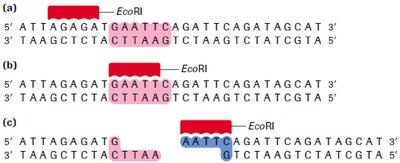
Restriction endonucleases (restriction enzymes) act as molecular scissors, cutting double-stranded DNA at specific base-pair sequences called recognition sites. Each enzyme recognizes a unique sequence, often 4-8 base pairs long and typically palindromic.
Palindromic sequence: Reads the same forward and backward on complementary strands (e.g., GAATTC and CTTAAG).
Enzymes disrupt phosphodiester bonds via hydrolysis.
Enzymes produce either sticky ends (overhangs) or blunt ends (fully base-paired).
Sticky ends are preferred for recombinant DNA due to easier fragment joining.
Probability and Frequency of Cuts
The probability of finding a specific recognition site depends on its length:
For a 6-base-pair site: (1 in every 4096 nucleotides)
For a 2-base-pair site: (1 in every 16 nucleotides)
Longer sites result in fewer cuts, important for excising entire genes.
Biological Role and Commercial Use
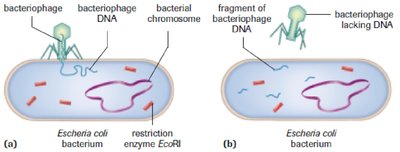
Restriction enzymes are isolated from bacteria, where they serve as a defense mechanism against foreign DNA (e.g., viruses). Over 2500 restriction endonucleases have been identified, with about 200 available commercially.
Types of Restriction Enzymes and Their Effects
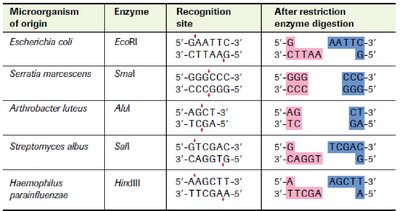
Different enzymes produce different types of ends:
Microorganism of origin | Enzyme | Recognition site | After restriction enzyme digestion |
|---|---|---|---|
Escherichia coli | EcoRI | 5'-GAATTC-3' | Sticky ends |
Serratia marcescens | SmaI | 5'-CCCGGG-3' | Blunt ends |
Arthrobacter luteus | AluI | 5'-AGCT-3' | Blunt ends |
Streptomyces albus | SalI | 5'-GTCGAC-3' | Sticky ends |
Haemophilus parainfluenzae | HindIII | 5'-AAGCTT-3' | Sticky ends |
Protection Against Self-Cleavage
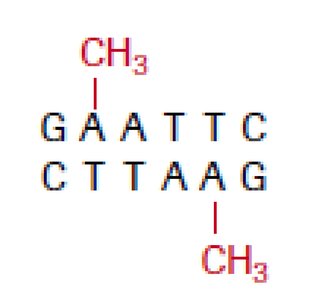
Bacteria protect their own DNA from restriction enzymes using methylases, which add methyl groups to recognition sites, preventing cleavage.
Gel Electrophoresis
Principle and Procedure
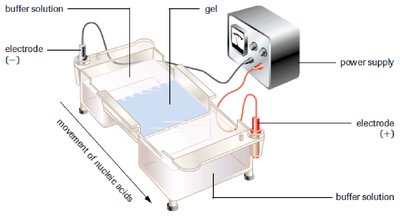
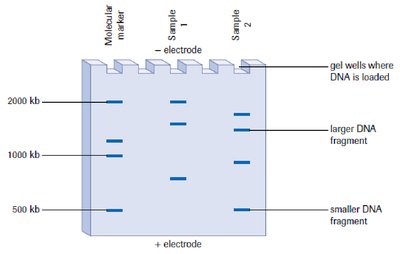
Gel electrophoresis separates DNA fragments by size using an electric field. DNA is negatively charged due to its phosphate backbone and migrates toward the positive electrode. Smaller fragments move faster through the gel matrix.
Gel is made of agarose or polyacrylamide.
Buffer solution conducts electricity.
Loading dye helps visualize DNA samples.
Molecular markers are used to estimate fragment sizes.
Plasmids
Structure and Function
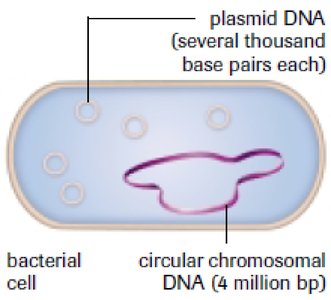
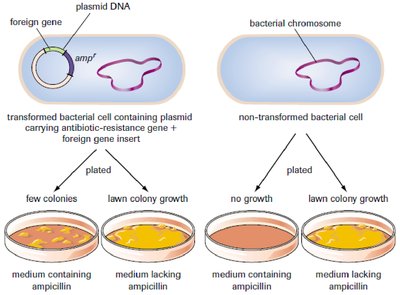
Plasmids are small, circular, double-stranded DNA molecules found in bacteria, independent of chromosomal DNA. They often carry genes for antibiotic resistance or breakdown of toxic substances.
Plasmids can replicate and express genes using bacterial machinery.
Used as vectors to carry foreign genes into host cells.
Recombinant DNA and Transformation
Restriction enzymes are used to splice foreign genes into plasmids. If both the plasmid and the foreign gene are cut with the same enzyme, their sticky ends will anneal, and DNA ligase will seal the fragments, creating recombinant DNA.
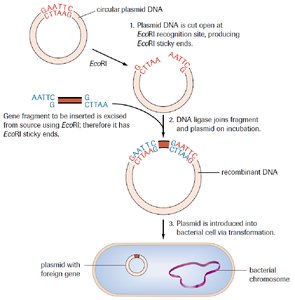
Bacteria that take up recombinant plasmids are called transformed. Plasmids are used as vectors to carry genes into host cells. Transformation can be induced chemically, electrically, or mechanically.
Genetic Engineering: Production of Somatropin
Human Growth Hormone Production
Genetic engineering enables the production of human growth hormone (somatropin) by inserting the gene into E. coli. The gene is excised using restriction enzymes, inserted into a plasmid after the lac promoter, and induced by IPTG to produce somatropin.
Somatropin consists of 191 amino acids.
Bacteria produce the hormone, which is harvested for medical use.
Controversy exists due to its use in sports and agriculture.
Summary Table: Molecular Tools in Biotechnology
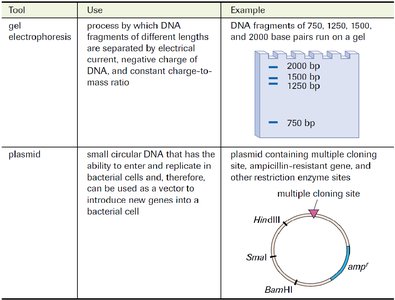
Tool | Use | Example |
|---|---|---|
Restriction endonuclease | Cleaves DNA at specific sites | BamHI: 5'-GGATCC-3' |
Methylase | Adds methyl group to protect DNA | Methylated BamHI site |
DNA ligase | Joins DNA fragments | EcoRI sticky ends joined |
Gel electrophoresis | Separates DNA fragments by size | Fragments of 750, 1250, 1500, 2000 bp |
Plasmid | Vector for gene transfer | Plasmid with multiple cloning site |
Practice and Application
Restriction enzymes produce predictable fragments for genetic analysis.
Gel electrophoresis is used to analyze DNA fragments and confirm successful gene insertion.
Plasmids and transformation are essential for cloning and expressing foreign genes in bacteria.
Additional info:
Restriction enzymes are critical for genetic engineering, forensic analysis, and molecular cloning.
Gel electrophoresis is a fundamental technique for DNA fingerprinting and gene mapping.
Plasmids are widely used in biotechnology for gene therapy, protein production, and research.
