 Back
BackPhotosynthesis: Mechanisms and Adaptations
Study Guide - Smart Notes
 Tailored notes based on your materials, expanded with key definitions, examples, and context.
Photosynthesis: Mechanisms and Adaptations
Overview of Photosynthesis
Photosynthesis is the process by which plants, algae, and some prokaryotes convert light energy into chemical energy stored in sugars and other organic molecules. This process is essential for life on Earth, as it forms the foundation of most food webs and recycles atmospheric carbon dioxide.
Location: In eukaryotes, photosynthesis occurs in chloroplasts, primarily within the mesophyll cells of leaves.
General Equation:
Autotrophs are organisms that produce their own food from inorganic substances (producers).
Heterotrophs obtain organic food by consuming other organisms (consumers).
Chloroplast Structure and Function
Chloroplasts are specialized organelles that capture light energy and convert it into chemical energy. They are believed to have originated from photosynthetic prokaryotes via endosymbiosis.
Double membrane: Separates the chloroplast from the cytoplasm.
Stroma: The dense fluid inside the chloroplast where the Calvin cycle occurs.
Thylakoids: Flattened sacs containing chlorophyll; organized into stacks called grana.
Stomata: Pores on the leaf surface for gas exchange (CO2 in, O2 out).
Redox Chemistry of Photosynthesis
Photosynthesis is a series of redox reactions. Water is oxidized (loses electrons), and carbon dioxide is reduced (gains electrons), powered by light energy. This is an endergonic process.
The Two Stages of Photosynthesis
Light Reactions
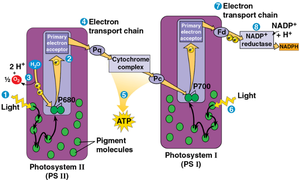
The light reactions occur in the thylakoid membranes and convert solar energy into chemical energy (ATP and NADPH). These reactions require light and produce O2 as a by-product.
Key steps:
Splitting of water to release O2
Reduction of NADP+ to NADPH
Generation of ATP via photophosphorylation
The Nature of Light and Pigments
Light is electromagnetic energy, traveling in waves (wavelength determines color).
Visible light (380–700 nm) drives photosynthesis.
Photosynthetic pigments absorb specific wavelengths:
Chlorophyll a: Main pigment, absorbs violet-blue and red, appears green.
Chlorophyll b: Accessory pigment, broadens absorption spectrum.
Carotenoids: Accessory pigments, absorb excess light, appear yellow/orange.
Photosystems
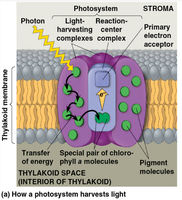
A photosystem is a complex of proteins and pigments that harvest light and initiate electron transfer. There are two types: Photosystem II (PS II) and Photosystem I (PS I).
Photosystem II (PS II): Functions first, reaction center called P680.
Photosystem I (PS I): Functions second, reaction center called P700.
Electron Flow in Light Reactions
Linear Electron Flow: The main pathway, producing both ATP and NADPH.
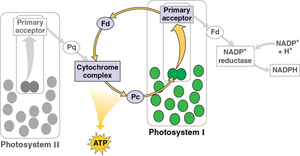
Cyclic Electron Flow: Electrons cycle within PS I, producing ATP but not NADPH or O2; used when the cell needs more ATP.
Chemiosmosis and Photophosphorylation
Electron transport chains pump protons (H+) into the thylakoid space, creating a proton gradient.
ATP synthase uses this gradient to convert ADP to ATP (photophosphorylation).
The Calvin Cycle (Dark Reactions)
The Calvin cycle occurs in the stroma and uses ATP and NADPH from the light reactions to fix CO2 and produce sugars. It does not require light directly.
Three main phases:
Carbon Fixation: CO2 is attached to a five-carbon sugar (RuBP) by the enzyme RuBisCO, forming two three-carbon molecules.
Reduction: ATP and NADPH are used to reduce the three-carbon molecules to glyceraldehyde-3-phosphate (G3P).
Regeneration: Some G3P is used to regenerate RuBP, allowing the cycle to continue.
Net Output: For every three CO2 molecules, one G3P exits the cycle; two G3P are needed to make one glucose.
Alternative Mechanisms of Carbon Fixation
Photorespiration
On hot, dry days, plants close their stomata to conserve water, leading to low CO2 and high O2 inside the leaf. RuBisCO may bind O2 instead of CO2, resulting in photorespiration, a process that consumes ATP but does not produce sugar.
C4 Plants
Use PEP carboxylase to initially fix CO2 into a four-carbon compound in mesophyll cells.
The four-carbon compound is transported to bundle-sheath cells, where CO2 is released for the Calvin cycle, minimizing photorespiration.
CAM Plants (Crassulacean Acid Metabolism)
Open stomata at night to take in CO2, storing it as organic acids.
During the day, stomata close to conserve water, and CO2 is released from the acids for use in the Calvin cycle.
This adaptation allows survival in arid environments.
