 Back
BackPhotosynthesis: Mechanisms, Structures, and Adaptations
Study Guide - Smart Notes
 Tailored notes based on your materials, expanded with key definitions, examples, and context.
Photosynthesis: Overview and Importance
Introduction to Photosynthesis
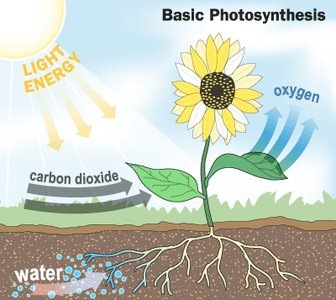
Photosynthesis is the process by which plants, algae, and certain bacteria convert solar energy into chemical energy, producing organic molecules and oxygen from carbon dioxide and water. This process is fundamental to life on Earth, as it provides the energy and organic matter necessary for most living organisms.
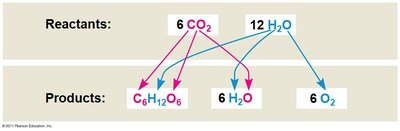
Photosynthesis Equation: The general equation for photosynthesis is:
CO2 is reduced to form glucose, while H2O is oxidized to produce O2.
Endergonic Reaction: Energy from sunlight drives this process, making it endergonic (energy-consuming).
Photosynthesis and the Biosphere
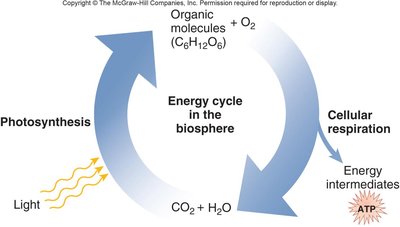
Photosynthesis powers the biosphere by cycling energy and matter. Autotrophs (producers) synthesize organic molecules from inorganic sources, while heterotrophs (consumers) rely on these molecules for energy.
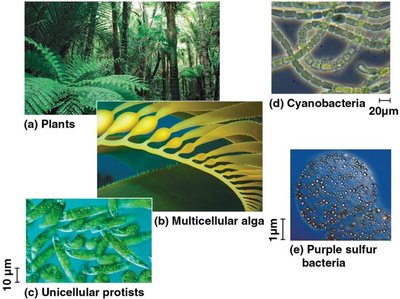
Autotrophs: Include green plants, algae, unicellular protists, cyanobacteria, and purple sulfur bacteria.
Heterotrophs: Obtain organic molecules by consuming other organisms.
Chloroplast Structure and Function
Chloroplast Anatomy
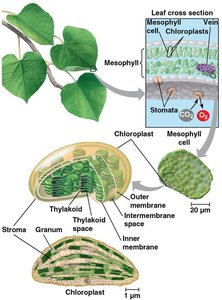
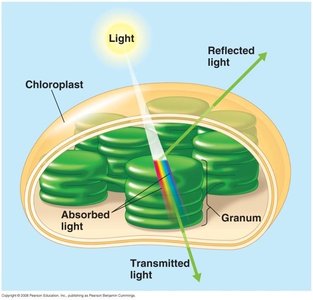
Chloroplasts are the organelles responsible for photosynthesis in plants and algae. They contain the pigment chlorophyll, which absorbs light energy.
Key Structures: Outer and inner membranes, intermembrane space, thylakoid membrane (containing pigment molecules), thylakoids (stacked into grana), and stroma (fluid-filled space).
Mesophyll Cells: Most photosynthesis occurs in these cells, which contain numerous chloroplasts.
Stomata: Pores that allow gas exchange (CO2 in, O2 out).
Photosynthesis as a Redox Process
Redox Reactions in Photosynthesis
Photosynthesis is a redox process where water is oxidized and carbon dioxide is reduced. The energy required for this endergonic reaction is provided by sunlight.
Water Splitting: Chloroplasts split water, releasing O2 as a byproduct and incorporating hydrogen into sugar molecules.
Comparison with Cellular Respiration: Photosynthesis stores energy in glucose, while cellular respiration releases energy by oxidizing glucose.
Stages of Photosynthesis
Light Reactions
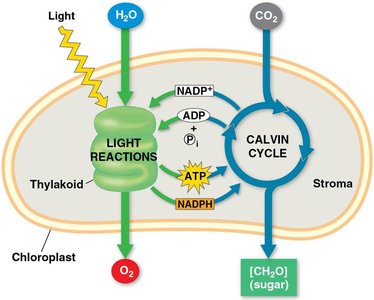
The light reactions occur in the thylakoid membranes and convert solar energy into chemical energy (ATP and NADPH), releasing O2 as a byproduct.
Key Steps: Splitting of water, release of O2, reduction of NADP+ to NADPH, and generation of ATP by photophosphorylation.
Calvin Cycle (Light-Independent Reactions)
The Calvin cycle occurs in the stroma and uses ATP and NADPH to convert CO2 into carbohydrates (G3P), which can be used to form glucose and other organic molecules.
Phases: Carbon fixation, reduction, and regeneration of the CO2 acceptor (RuBP).
Enzyme: Rubisco catalyzes the fixation of CO2.
Light and Photosynthetic Pigments
Properties of Light
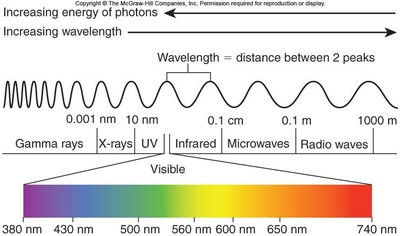
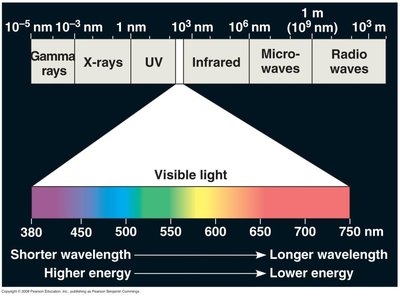
Light is a form of electromagnetic radiation, traveling in waves and behaving as particles (photons). The energy of light is inversely proportional to its wavelength.
Visible Light: The portion of the electromagnetic spectrum used in photosynthesis (about 380–740 nm).
Shorter Wavelengths: Higher energy; Longer Wavelengths: Lower energy.
Photosynthetic Pigments
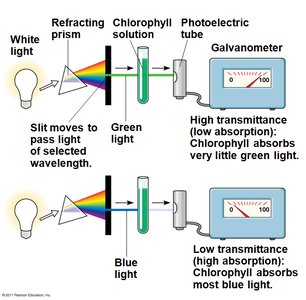
Pigments are substances that absorb visible light. Different pigments absorb different wavelengths, and the wavelengths not absorbed are reflected or transmitted, giving plants their color.
Chlorophyll a: Main photosynthetic pigment.
Chlorophyll b and Carotenoids: Accessory pigments that broaden the spectrum of light used for photosynthesis and protect against excess light.
Absorption and Action Spectra
The absorption spectrum shows the wavelengths of light absorbed by each pigment, while the action spectrum shows the effectiveness of different wavelengths in driving photosynthesis.
Chlorophyll a: Absorbs violet-blue and red light most effectively.
Action Spectrum: Peaks correspond to wavelengths where photosynthesis is most efficient.
Mechanisms of Light Absorption and Electron Excitation
Excitation of Chlorophyll
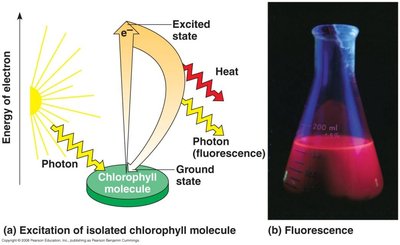
When a pigment absorbs light, an electron is elevated from its ground state to an excited state. This excited electron can return to the ground state, releasing energy as heat or light (fluorescence), or it can be transferred to another molecule.
Energy Transfer: Excited electrons in pigments can be captured by primary electron acceptors in the photosystems.
Photosystems and Electron Flow
Photosystems I and II
Photosystems are complexes of proteins and pigments in the thylakoid membrane that capture light energy and initiate electron transport.
Photosystem II (PSII): Functions first, absorbs light best at 680 nm (P680).
Photosystem I (PSI): Absorbs light best at 700 nm (P700).
Linear (Noncyclic) Electron Flow: Involves both photosystems, produces ATP and NADPH.
Cyclic Electron Flow: Involves only PSI, produces ATP but not NADPH or O2.
ATP Synthesis and Chemiosmosis
Generation of ATP
ATP is produced in the chloroplast by chemiosmosis, driven by a proton gradient across the thylakoid membrane. The flow of protons back into the stroma through ATP synthase powers the synthesis of ATP.
Source of Protons: Splitting of water, electron transport chain, and formation of NADPH.
The Calvin Cycle: Carbon Fixation and Sugar Production
Phases of the Calvin Cycle
The Calvin cycle uses ATP and NADPH to convert CO2 into glyceraldehyde-3-phosphate (G3P), a three-carbon sugar. The cycle consists of three main phases:
Carbon Fixation: CO2 is attached to RuBP by rubisco, forming 3-phosphoglycerate (3PG).
Reduction: ATP and NADPH are used to convert 3PG into G3P.
Regeneration: Some G3P is used to regenerate RuBP, enabling the cycle to continue.
Adaptations and Variations in Photosynthesis
Photorespiration and C4/CAM Pathways
Photorespiration is a process where rubisco adds O2 instead of CO2 to RuBP, leading to the release of CO2 and decreased efficiency. Plants in hot, dry environments have evolved alternative mechanisms:
C4 Plants: Use a two-cell system to concentrate CO2 and minimize photorespiration (e.g., maize, sugarcane).
CAM Plants: Open stomata at night to fix CO2 as malate, which is used during the day for the Calvin cycle (e.g., cacti, succulents).
Summary Table: Comparison of Photosynthetic Pathways
Pathway | CO2 Fixation | Adaptation | Examples |
|---|---|---|---|
C3 | Directly by rubisco | Most efficient in cool, moist environments | Wheat, rice, soybeans |
C4 | PEP carboxylase in mesophyll, Calvin cycle in bundle-sheath | Reduces photorespiration, efficient in hot, dry climates | Maize, sugarcane |
CAM | Night: CO2 fixed as malate; Day: Calvin cycle | Water conservation, adaptation to arid environments | Cacti, succulents |
Concept Checks
Where is oxygen produced during photosynthesis? In the thylakoid lumen by the oxidation of water by PSII.
What high energy molecule is the final product of photosynthesis? Glucose (C6H12O6).
How many ATP and NADPH are required to make one glucose? 18 ATP and 12 NADPH.
What is the function of Rubisco? Carbon fixation in the Calvin cycle.
The end product of photosynthesis is the starting material of cellular respiration. This is true.
