 Back
BackPlant Evolution, Structure, Nutrition, and Reproduction: Study Guide for BIOL 191A (Chapters 26–31)
Study Guide - Smart Notes
 Tailored notes based on your materials, expanded with key definitions, examples, and context.
Plant Evolution and the Colonization of Land
Evidence for Plant Descent from Green Algae
Plants are believed to have evolved from green algae, specifically charophytes, based on similarities in cell wall composition, chloroplast structure, and the presence of the polymer sporopollenin that protects zygotes from desiccation. Key derived traits of plants include multicellular, dependent embryos, alternation of generations, walled spores produced in sporangia, multicellular gametangia, and apical meristems.
Embryophytes: All land plants share the trait of multicellular, dependent embryos.
Cuticle: A waxy covering that prevents water loss.
Stomata: Pores that allow gas exchange.
Alternation of Generations
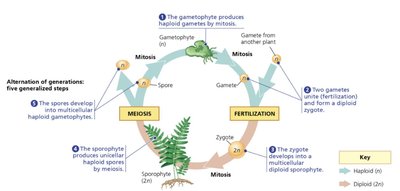
Plants exhibit a life cycle known as alternation of generations, which includes both multicellular haploid (gametophyte) and diploid (sporophyte) stages. The sporophyte produces haploid spores by meiosis, which develop into gametophytes. Gametophytes produce gametes by mitosis; fertilization produces a diploid zygote that grows into a new sporophyte.
Sporophyte (2n): Multicellular diploid form; produces spores by meiosis.
Gametophyte (n): Multicellular haploid form; produces gametes by mitosis.
Spore: Haploid cell that can develop into a gametophyte without fusing with another cell.
Key Adaptations for Life on Land
Seeds: Protect and nourish the embryo, allowing for dormancy and dispersal.
Pollen grains: Enable fertilization without water by protecting male gametophytes.
Flowers and fruits: Enhance reproductive success and seed dispersal in angiosperms.
Major Groups of Plants
Nonvascular Plants (Bryophytes)
Nonvascular plants, such as mosses, liverworts, and hornworts, lack vascular tissue and are typically small and found in moist environments. They rely on diffusion for water and nutrient transport and have a dominant gametophyte generation.
Seedless Vascular Plants
These plants, including ferns and their relatives, possess vascular tissue (xylem and phloem) but do not produce seeds. The sporophyte is the dominant generation, and reproduction still requires water for sperm motility.
Seed Plants: Gymnosperms and Angiosperms
Gymnosperms: Vascular plants that produce "naked" seeds not enclosed in an ovary (e.g., conifers).
Angiosperms: Flowering plants that produce seeds enclosed within a fruit (mature ovary).
Plant Structure and Organization
Root and Shoot Systems
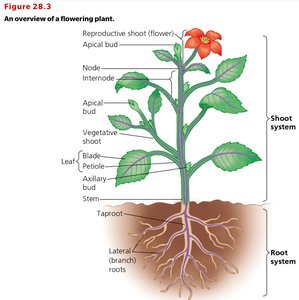
The plant body is organized into two main systems: the root system (anchors the plant and absorbs water and minerals) and the shoot system (stems, leaves, and flowers for photosynthesis and reproduction).
Roots: Anchor the plant, absorb water and minerals, and store food.
Shoots: Include stems (support and transport), leaves (photosynthesis), and reproductive structures (flowers).
Major Plant Organs and Tissues
Roots, stems, leaves: Main organs with specialized functions.
Dermal tissue: Protective outer covering (epidermis, cuticle).
Vascular tissue: Xylem (water/mineral transport), phloem (sugar transport).
Ground tissue: Functions in storage, support, and photosynthesis.
Plant Cell Types
Parenchyma cells: Metabolism, storage, photosynthesis.
Collenchyma cells: Flexible support for growing tissues.
Sclerenchyma cells: Rigid support, thick secondary walls with lignin.
Tracheids and vessel elements: Water-conducting cells in xylem.
Sieve-tube elements: Sugar-conducting cells in phloem.
Meristems and Plant Growth
Meristems are regions of undifferentiated cells that allow for indeterminate growth. Apical meristems enable primary growth (lengthening), while lateral meristems (vascular cambium, cork cambium) enable secondary growth (thickening).
Plant Nutrition and Resource Acquisition
Essential Elements and Mineral Nutrition
Macronutrients: Required in large amounts (e.g., N, P, K, Ca, Mg, S).
Micronutrients: Required in trace amounts (e.g., Fe, Mn, Zn, Cu, B, Mo, Cl, Ni).
Resource Acquisition Adaptations
Root hairs: Increase surface area for absorption.
Mycorrhizae: Mutualistic associations with fungi that enhance nutrient uptake.
Cation exchange: Roots release H+ ions to displace mineral cations from soil particles, making them available for absorption.
Role of Bacteria and Fungi
Nitrogen fixation: Conversion of atmospheric N2 to ammonia by bacteria (e.g., Rhizobium in root nodules).
Mycorrhizae: Fungi that increase water and mineral absorption.
Plant Reproduction
Angiosperm Reproductive Structures
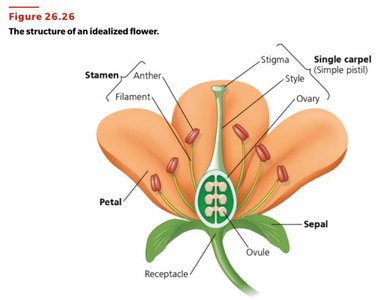
Flowers are the reproductive organs of angiosperms, typically consisting of four types of organs: sepals, petals, stamens, and carpels.
Stamen: Male organ (anther + filament) produces pollen grains.
Carpel (pistil): Female organ (stigma, style, ovary) produces ovules.
Petals: Attract pollinators.
Sepals: Protect flower bud.
Angiosperm Life Cycle
Double fertilization: Two sperm cells fertilize the egg and central cell, forming a zygote and endosperm.
Seed development: Ovule develops into a seed; ovary develops into a fruit.
Pollination: Transfer of pollen to the stigma, can be abiotic (wind, water) or biotic (animals).
Sexual vs. Asexual Reproduction
Sexual reproduction: Increases genetic diversity but requires pollination and fertilization.
Asexual reproduction: Offspring are genetically identical to parent; efficient but less genetic variation.
Plant Responses to Internal and External Signals
Plant Hormones and Their Functions
Auxin: Cell elongation, root formation, fruit growth.
Cytokinins: Stimulate cell division, delay aging.
Gibberellins: Stem elongation, seed germination, fruit development.
Abscisic acid (ABA): Promotes dormancy, closes stomata during stress.
Ethylene: Fruit ripening, response to mechanical stress, leaf abscission.
Plant Sensory Responses
Phototropism: Growth toward light (mediated by blue-light receptors).
Gravitropism: Growth in response to gravity (roots positive, shoots negative).
Thigmomorphogenesis: Growth response to mechanical stimulation (e.g., wind).
Photoperiodism: Flowering response to day length (short-day, long-day, day-neutral plants).
Circadian rhythms: Internal biological clocks with ~24-hour cycles.
Defense and Senescence
Senescence: Programmed cell or organ death (e.g., leaf fall, fruit ripening).
Systemic acquired resistance: Whole-plant defense response to pathogens.
Comparison of Major Plant Groups
Group | Vascular Tissue | Seeds | Flowers | Dominant Generation |
|---|---|---|---|---|
Nonvascular (Bryophytes) | No | No | No | Gametophyte |
Seedless Vascular | Yes | No | No | Sporophyte |
Gymnosperms | Yes | Yes (naked) | No | Sporophyte |
Angiosperms | Yes | Yes (enclosed in fruit) | Yes | Sporophyte |
Additional info: Academic context and definitions were expanded for clarity and completeness. Images were included only where directly relevant to the explanation of alternation of generations, plant structure, and flower anatomy.
