 Back
BackProkaryotes, Cell Types, and Prokaryotic Metabolism: Structured Study Notes
Study Guide - Smart Notes
 Tailored notes based on your materials, expanded with key definitions, examples, and context.
Introduction to Prokaryotes
Prokaryotic and Eukaryotic Cells
All living organisms are classified into two fundamental cell types: prokaryotic and eukaryotic. These categories represent the broadest and most distinct groupings of life.
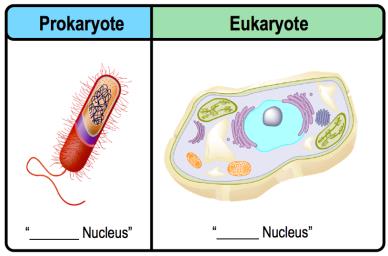
Prokaryotic Cells: Do not have a nucleus. Includes both Bacteria and Archaea.
Eukaryotic Cells: Have a nucleus and other membrane-bound organelles.
Example: Prokaryotic cells include bacteria and archaea; eukaryotic cells include plants, animals, fungi, and protists.
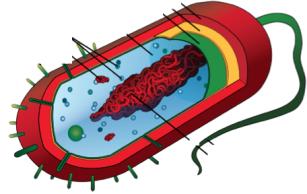
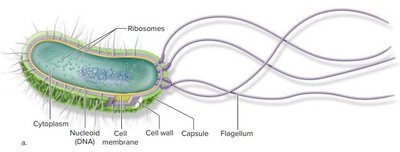
Domains of Life and Cell Classification
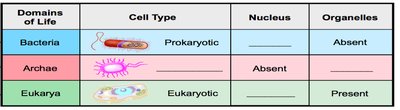
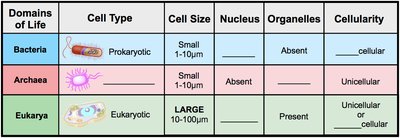
The three domains of life are Bacteria, Archaea, and Eukarya. Bacteria and Archaea are classified as prokaryotes, while Eukarya are eukaryotes.
Bacteria: Prokaryotic, no nucleus, no membrane-bound organelles.
Archaea: Prokaryotic, no nucleus, no membrane-bound organelles.
Eukarya: Eukaryotic, nucleus present, membrane-bound organelles present.
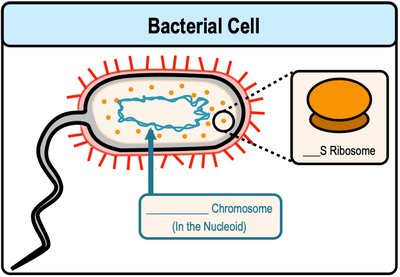
Features of Bacterial Cells
Bacteria are the most abundant and diverse organisms on Earth. Their cellular structure is distinct from eukaryotes.
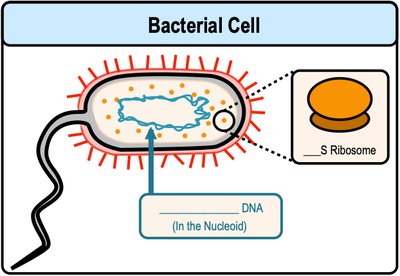
Bacterial DNA: Circular in shape, found in a region called the nucleoid.
Ribosomes: Small (70S), responsible for protein synthesis.
Cell Division: Occurs by binary fission.
Prokaryotic vs. Eukaryotic Cells: Key Differences
Prokaryotic and eukaryotic cells differ in several fundamental ways:
Cell Size: Prokaryotes are smaller (1-10 μm); eukaryotes are larger (10-100 μm).
Nucleus: Prokaryotes lack a nucleus; eukaryotes have a nucleus.
Organelles: Prokaryotes lack membrane-bound organelles; eukaryotes possess them.
Ribosome Size: Prokaryotes have 70S ribosomes; eukaryotes have 80S ribosomes.
Motility: Prokaryotes may use flagella; eukaryotes have more complex motility structures.
Introduction to Archaea
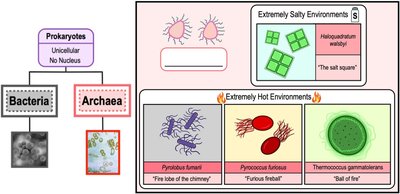
Archaea (singular: archaeon) are prokaryotic organisms with unique features distinguishing them from bacteria.
Archaea have unique ribosomal RNA (rRNA) sequences.
Cell walls lack peptidoglycan, unlike bacteria.
Many archaea are extremophiles, thriving in extreme environments (e.g., high salinity, temperature, acidity).
Prokaryotic Metabolism
Nutritional Factors of Microbial Growth
Microbes are classified based on three key nutritional factors:
Energy Source: The source of energy used for metabolic pathways.
Electron Source: The molecule supplying electrons to the Electron Transport Chain (ETC).
Carbon Source: The molecule supplying carbon for cell components.
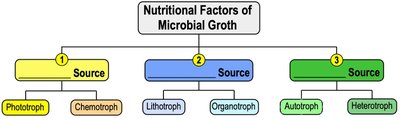
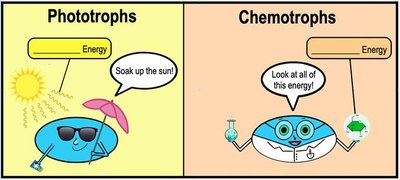
Energy Source: Phototrophs vs. Chemotrophs
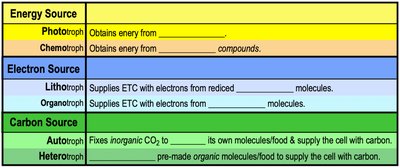
Organisms are classified by their energy source:
Phototrophs: Obtain energy from sunlight.
Chemotrophs: Obtain energy from chemical compounds.
Electron Source: Lithotrophs vs. Organotrophs
Organisms are categorized by their electron source:
Lithotrophs: Supply ETC with electrons from reduced inorganic molecules (e.g., H2O, Fe2+).
Organotrophs: Supply ETC with electrons from organic molecules (e.g., glucose).
Example: Plants are lithotrophs because they harvest electrons from splitting water during photosynthesis.

Carbon Source: Heterotrophs vs. Autotrophs
Microorganisms are classified by their carbon source:
Autotrophs: Use carbon fixation to capture carbon (CO2) for making their own food and cell components.
Heterotrophs: Consume and use organic molecules to supply carbon for cell components.

Nutritional Diversity Among Microbes
Microbes are categorized based on combinations of energy, electron, and carbon sources. All combinations are theoretically possible, though some have no known organisms.
Energy Source | Electron Source | Carbon Source | Example Organism |
|---|---|---|---|
Sunlight (Phototroph) | Inorganic (Lithotroph) | CO2 (Autotroph) | Cyanobacteria |
Chemicals (Chemotroph) | Organic (Organotroph) | Organic (Heterotroph) | Humans |
Sunlight (Phototroph) | Organic (Organotroph) | Organic (Heterotroph) | Some photosynthetic bacteria |
Chemicals (Chemotroph) | Inorganic (Lithotroph) | CO2 (Autotroph) | Nitrifying bacteria |
Sunlight (Phototroph) | Inorganic (Lithotroph) | Organic (Heterotroph) | Rare/unknown |
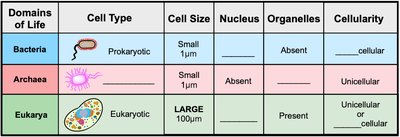
Summary Table: Cell Types and Domains of Life
Domain | Cell Type | Nucleus | Organelles | Cell Size | Cellularity |
|---|---|---|---|---|---|
Bacteria | Prokaryotic | Absent | Absent | Small (1-10 μm) | Unicellular |
Archaea | Prokaryotic | Absent | Absent | Small (1-10 μm) | Unicellular |
Eukarya | Eukaryotic | Present | Present | Large (10-100 μm) | Unicellular or multicellular |
Practice Questions and Applications
Which domains of life are classified as prokaryotes? Bacteria and Archaea.
Where is DNA found in bacteria? In the nucleoid region.
What is a primary difference between prokaryotes and eukaryotes? Prokaryotes have DNA that floats freely in the cytoplasm and are significantly smaller.
Which feature is not common to all cells? Presence of a nucleus (only eukaryotes have a nucleus).
Additional info: These notes expand on the original content by providing definitions, examples, and structured tables for clarity and completeness.
