Back
BackProperties of Life, History of Life, Viruses, Bacteria, Archaea, and Protists: Study Guide
Study Guide - Smart Notes
 Tailored notes based on your materials, expanded with key definitions, examples, and context.
Module Overview
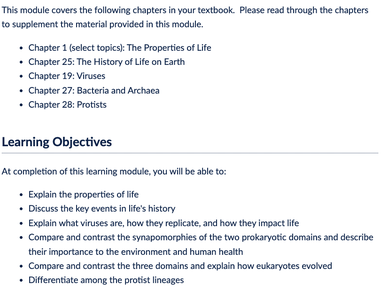
This module introduces foundational concepts in biology, focusing on the properties of life, the history of life on Earth, viruses, prokaryotic domains (Bacteria and Archaea), and protists. The content aligns with the following textbook chapters:
Chapter 1: The Properties of Life (select topics)
Chapter 25: The History of Life on Earth
Chapter 19: Viruses
Chapter 27: Bacteria and Archaea
Chapter 28: Protists
Learning Objectives
Explain the properties of life: Describe the characteristics that define living organisms, such as cellular organization, metabolism, growth, reproduction, response to stimuli, and adaptation.
Discuss the key events in life's history: Summarize major milestones in the evolution of life, including the origin of cells, multicellularity, and the diversification of life forms.
Explain what viruses are, how they replicate, and how they impact life: Define viruses, outline their replication cycles (lytic and lysogenic), and discuss their effects on organisms and ecosystems.
Compare and contrast the synapomorphies of the two prokaryotic domains and describe their importance: Identify unique features (synapomorphies) of Bacteria and Archaea, and explain their roles in environmental and human health.
Compare and contrast the three domains and explain how eukaryotes evolved: Distinguish among Bacteria, Archaea, and Eukarya, and describe theories of eukaryotic evolution (e.g., endosymbiosis).
Differentiate among the protist lineages: Classify protists based on their evolutionary relationships, morphology, and ecological roles.