 Back
BackBio Chapter 3 part 1
Study Guide - Smart Notes
 Tailored notes based on your materials, expanded with key definitions, examples, and context.
Ch 3 - Properties of Water
Introduction
Water is a tasteless, odorless, and colorless substance that constitutes approximately 70% of the human body and is essential for all life on Earth. Its unique molecular structure and properties make it indispensable in biological systems.
Basic Structure of Water: Polarity & Shape
Molecular Structure and Polarity
The water molecule (H2O) consists of two hydrogen atoms covalently bonded to one oxygen atom. The oxygen atom is more electronegative, resulting in a polar covalent bond and a bent molecular shape. - Polarity: The unequal sharing of electrons creates a partial negative charge (δ-) near the oxygen and partial positive charges (δ+) near the hydrogens. - Hydrogen Bonding: Water molecules form hydrogen bonds with each other, which are weak interactions but collectively strong due to their abundance. - Shape: The bent shape (angle ~104.5°) is crucial for water's properties. 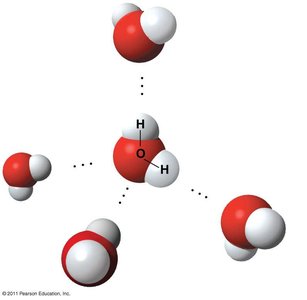
Covalent Bonding in Water and Other Molecules
Covalent bonds involve electron sharing between atoms. Water, ammonia, hydrogen, and methane all exhibit covalent bonding, but water's polarity is unique. 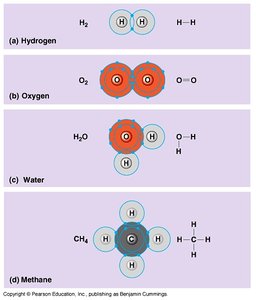
Hydrogen Bonds Between Molecules
Hydrogen bonds form between the hydrogen atom of one water molecule and the oxygen atom of another, contributing to water's cohesion and other properties. 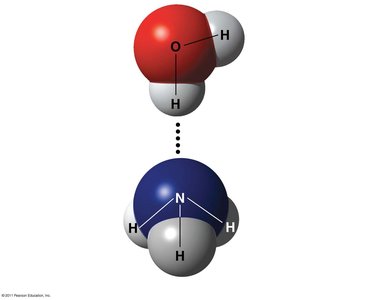
Four Important Properties of Water
Cohesion and Adhesion
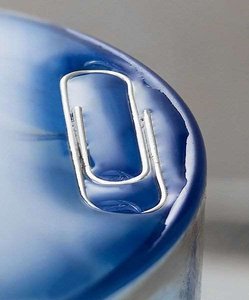
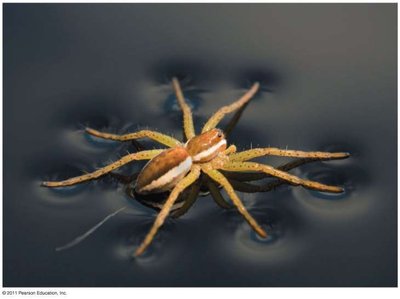
Water molecules are "sticky" due to hydrogen bonding, leading to cohesion (attraction between water molecules) and adhesion (attraction between water and other substances). - Cohesion: Responsible for surface tension, allowing small objects or organisms to rest on water's surface. - Adhesion: Enables capillary action, important for water transport in plants. 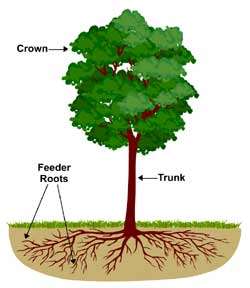

Water and Heat: High Specific Heat & High Heat of Vaporization
Water has a high specific heat and high heat of vaporization, which stabilize temperatures in organisms and environments. - Specific Heat: The amount of heat required to change the temperature of 1 g of water by 1°C. Water's specific heat is 1 cal/g/°C, which is high compared to most substances. - Heat of Vaporization: The heat required for 1 g of water to convert from liquid to gas. - Evaporative Cooling: As water evaporates, the surface cools, helping regulate temperature in organisms (e.g., sweating). (where is heat, is mass, is specific heat, is temperature change) 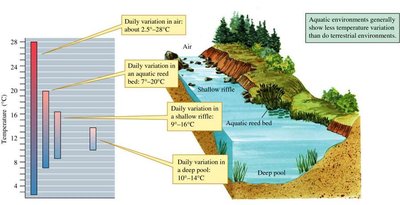

Density of Water: Greatest Density at 4°C and Floating of Ice
Water reaches its maximum density at 4°C. Ice floats because its hydrogen bonds are more ordered, making it less dense than liquid water. - Implications: Floating ice insulates aquatic life in winter and prevents bodies of water from freezing solid. 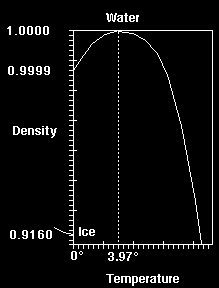
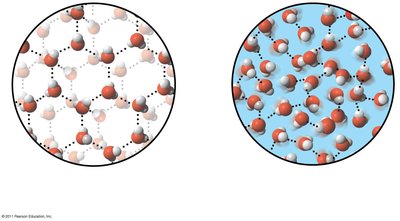
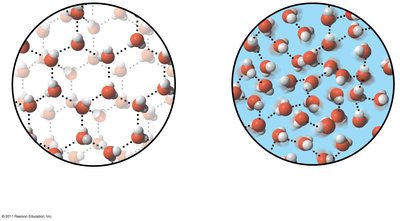
Water as a Solvent
Water is a versatile solvent due to its polarity, allowing it to dissolve ionic and polar substances. - Solution: Homogeneous mixture of substances. - Solvent: The dissolving agent (water in aqueous solutions). - Solute: The substance dissolved. - Aqueous Solution: Solution where water is the solvent. - Hydration Shell: Water molecules surround ions, stabilizing them in solution. 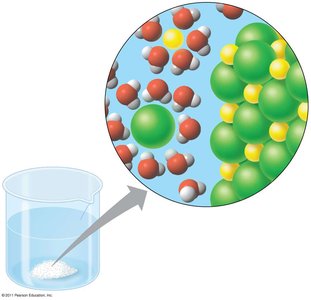 - Water can also dissolve large polar molecules, such as proteins, if they have ionic and polar regions.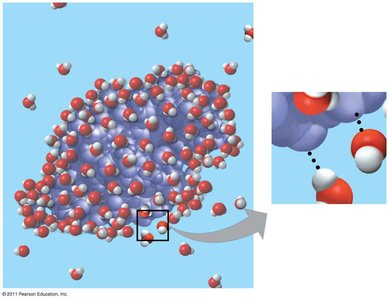
Hydrophilic and Hydrophobic Substances
- Hydrophilic: Substances that have an affinity for water (e.g., salts, sugars, proteins). - Hydrophobic: Substances that repel water (e.g., oils, fats).
Summary Table: Properties of Water
Property | Description | Biological Importance |
|---|---|---|
Cohesion & Adhesion | Water molecules stick to each other and to other surfaces | Capillary action in plants, surface tension |
High Specific Heat | Resists temperature changes | Stabilizes organism and environmental temperatures |
High Heat of Vaporization | Requires much energy to evaporate | Evaporative cooling (sweating, transpiration) |
Density Anomaly | Ice is less dense than liquid water | Ice floats, insulates aquatic life |
Solvent Properties | Dissolves ionic and polar substances | Facilitates biochemical reactions |
Conclusion
Water's unique structure and properties are fundamental to life. Its polarity, hydrogen bonding, and resulting physical characteristics enable essential biological processes, from temperature regulation to nutrient transport and cellular function. Understanding water's properties is crucial for studying biology at all levels.
