 Back
BackProtein Synthesis: Transcription, Translation, and Protein Structure
Study Guide - Smart Notes
 Tailored notes based on your materials, expanded with key definitions, examples, and context.
Protein Synthesis
Overview of Protein Synthesis
Protein synthesis is the process by which cells generate proteins, the essential molecules for life’s functions. This process involves two main steps: transcription and translation. - Transcription: The genetic code from DNA is copied into messenger RNA (mRNA) within the nucleus. - Translation: The mRNA code is used to assemble amino acids into a protein in the cytoplasm. 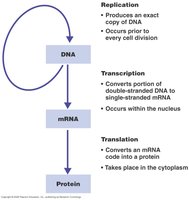
Genes and Their Role
Genes are short segments of DNA that contain the instructions for producing specific proteins. - Gene: The smallest functional unit of DNA, located at precise positions on chromosomes. - Gene Expression: Occurs when a gene is activated and its protein product is synthesized. - Humans have approximately 20,000 genes distributed across 46 chromosomes.
Transcription
Transcription Process
Transcription is the first step in protein synthesis, occurring in the nucleus. It involves copying a segment of DNA into a complementary strand of RNA. - DNA Unwinding: The DNA double helix unwinds at the gene region. - RNA Polymerase: An enzyme that synthesizes a single-stranded RNA molecule by pairing complementary nucleotides to the DNA template. - The resulting RNA is called the RNA primary transcript. 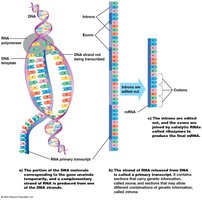
RNA Editing: Introns and Exons
The RNA primary transcript undergoes editing before it becomes functional mRNA. - Introns: Non-coding regions removed by ribozymes (catalytic RNA molecules). - Exons: Coding regions joined together to form the final mRNA. - mRNA: The edited RNA that carries the genetic message to the ribosome.
Codons
- Codon: A sequence of three mRNA bases that codes for a specific amino acid. - There are 64 possible codons, but only 20 amino acids; some amino acids are coded by multiple codons.
Translation
Players in Translation
Several types of RNA and ribosomal structures are involved in translation: - mRNA: Carries the genetic code from the nucleus to the ribosome. - rRNA (Ribosomal RNA): Forms ribosomal subunits, provides binding sites for mRNA and tRNA, and catalyzes peptide bond formation. - tRNA (Transfer RNA): Carries amino acids and matches its anticodon to the mRNA codon.
Stages of Translation
Translation occurs in three stages: 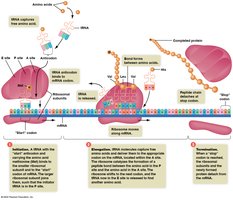
Initiation: The ribosome assembles around the mRNA, and the first tRNA binds to the start codon (AUG).
Elongation: tRNA brings amino acids to the ribosome, and enzymes form peptide bonds, creating a polypeptide chain.
Termination: When a stop codon is reached, the ribosome releases the polypeptide and disassembles.
Codon Translation Table
The codon translation table is used to determine which amino acid corresponds to each mRNA codon. 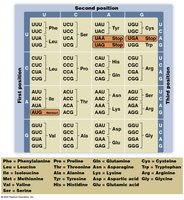
Protein Structure
Levels of Protein Structure
The function of a protein depends on its structure, which is organized into four levels:
Primary Structure: The specific sequence of amino acids held together by peptide bonds. Errors in this sequence can cause diseases (e.g., sickle cell anemia).
Secondary Structure: The spatial arrangement of the polypeptide chain, including alpha-helices (right-handed spirals stabilized by hydrogen bonds) and beta-sheets (side-by-side chains joined by hydrogen bonds).
Tertiary Structure: The three-dimensional folding of the protein, determined by interactions such as disulfide bonds and amino acid polarity.
Quaternary Structure: The association of multiple polypeptide chains to form a functional protein.
Examples and Applications
- Example: Hemoglobin is a protein with quaternary structure, composed of four polypeptide chains. - Application: Understanding protein synthesis is essential for biotechnology, genetic engineering, and medical research.
Key Terms
DNA: Deoxyribonucleic acid, the genetic material of cells.
RNA: Ribonucleic acid, includes mRNA, tRNA, and rRNA.
Polypeptide: A chain of amino acids linked by peptide bonds.
Ribosome: The cellular machinery for protein synthesis.
Relevant Equations
- Peptide Bond Formation: - Transcription: - Translation:
Summary Table: Players in Protein Synthesis
Component | Function |
|---|---|
DNA | Contains genetic instructions |
mRNA | Transmits genetic code to ribosome |
rRNA | Forms ribosome, catalyzes peptide bond formation |
tRNA | Brings amino acids to ribosome |
Additional info:
Some context and examples were expanded for clarity and completeness, including the importance of protein structure and applications in biotechnology.
