Back
BackSmall Molecules and the Chemistry of Life: Foundations for Biological Macromolecules
Study Guide - Smart Notes
 Tailored notes based on your materials, expanded with key definitions, examples, and context.
Small Molecules and the Chemistry of Life
Introduction to Chemical Elements in Living Systems
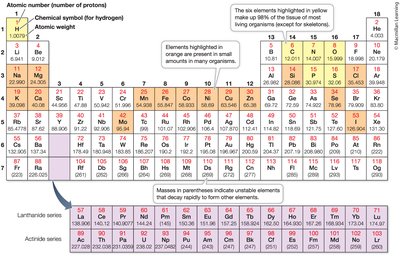
Living organisms are composed of a limited set of chemical elements, with only a few making up the majority of biological matter. These elements interact through chemical bonds to form the molecules essential for life.
Key Elements: Carbon (C), Hydrogen (H), Oxygen (O), Nitrogen (N), Phosphorus (P), and Sulfur (S) are the most abundant in living systems.
Trace Elements: Other elements are present in smaller amounts but are still essential for biological function.
Atoms, Molecules, and Macromolecules
Atoms combine to form molecules, which can further assemble into macromolecules. The structure and function of these molecules are determined by the types of atoms involved and the bonds that connect them.
Atoms: The smallest units of matter, consisting of protons, neutrons, and electrons.
Molecules: Combinations of two or more atoms held together by chemical bonds.
Macromolecules: Large, complex molecules such as proteins, nucleic acids, carbohydrates, and lipids.
Chemical Bonds in Biological Molecules
Types of Chemical Bonds
Chemical bonds are the forces that hold atoms together in molecules. The nature of these bonds determines the properties and functions of biological molecules.
Covalent Bonds: Atoms share electrons. Can be nonpolar (equal sharing) or polar (unequal sharing).
Ionic Bonds: Electrons are transferred from one atom to another, creating charged ions that attract each other.
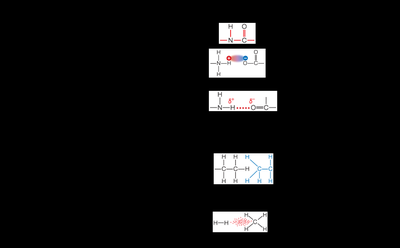
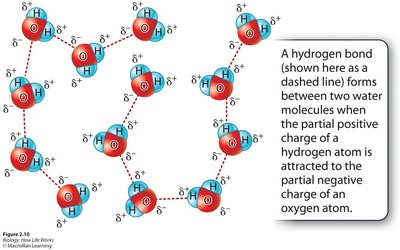
Hydrogen Bonds: Weak attractions between a hydrogen atom covalently bonded to an electronegative atom (like O or N) and another electronegative atom.
Van der Waals Interactions: Weak, transient attractions between molecules due to temporary charge differences.
Hydrophobic Interactions: Nonpolar molecules aggregate to avoid contact with water.
Polar and Nonpolar Covalent Bonds
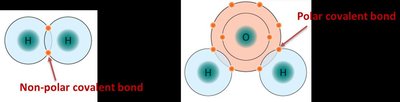
The polarity of a covalent bond depends on the difference in electronegativity between the atoms involved.
Nonpolar Covalent Bonds: Electrons are shared equally (e.g., H2 molecule).
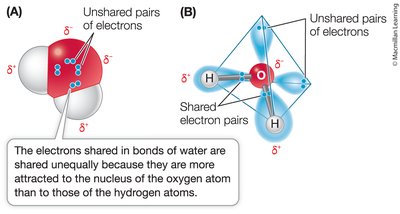
Polar Covalent Bonds: Electrons are shared unequally, resulting in partial charges (e.g., H2O molecule).
Water: Structure, Properties, and Biological Importance
Structure and Polarity of Water
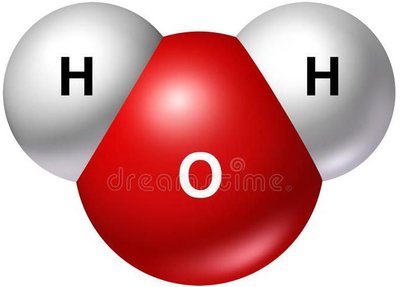
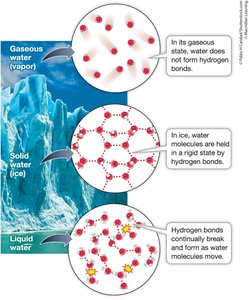
Water is a polar molecule, with oxygen being more electronegative than hydrogen, resulting in a partial negative charge near the oxygen and partial positive charges near the hydrogens.
Hydrogen Bonding: The polarity of water allows it to form hydrogen bonds with other water molecules or polar substances.
Hydrophilic and Hydrophobic Substances
Substances can be classified based on their interaction with water:
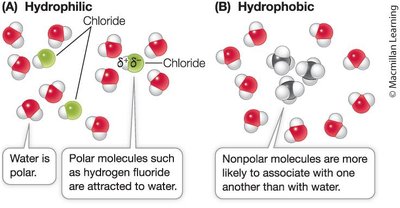
Hydrophilic (water-loving): Polar or charged substances that dissolve easily in water.
Hydrophobic (water-fearing): Nonpolar substances that do not dissolve in water and tend to aggregate together.
Unique Properties of Water
Hydrogen bonding gives water several unusual properties that are essential for life:
Excellent Solvent: Dissolves many ionic and polar substances.
Cohesion: Water molecules stick together, aiding transport in plants.
High Specific Heat: Absorbs heat without large temperature changes, stabilizing environments.
High Heat of Vaporization: Requires significant energy to evaporate, allowing for cooling mechanisms.
Lower Density as a Solid: Ice floats, insulating aquatic environments.
Acids, Bases, and pH
Acids, Bases, and the pH Scale
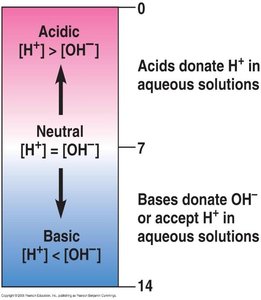
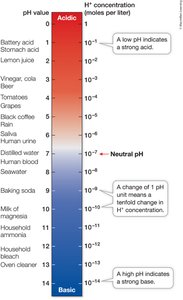
The concentration of hydrogen ions ([H+]) in a solution determines its acidity or basicity, measured by the pH scale.
Acids: Substances that increase [H+] in solution.
Bases: Substances that decrease [H+] or increase [OH-].
pH Scale: Ranges from 0 (most acidic) to 14 (most basic), with 7 being neutral.
Calculating pH and [H+]
The pH of a solution is calculated using the formula:
To find [H+] from pH:
Example: If [H+] = 1 × 10⁻⁵ M, then pH = 5.
Buffers
Buffers are substances that minimize changes in pH when acids or bases are added. They are crucial for maintaining stable conditions in biological systems.

Functional Groups and Isomerism in Biomolecules
Common Functional Groups
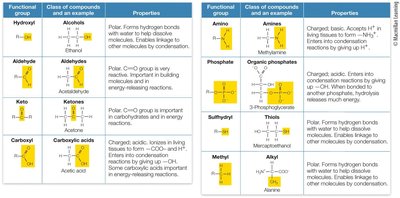
Functional groups are specific groups of atoms within molecules that have characteristic properties and reactivities. They determine the chemical behavior of biomolecules.
Functional Group | Class of Compounds | Properties |
|---|---|---|
Hydroxyl (-OH) | Alcohols | Polar, forms hydrogen bonds, increases solubility |
Carbonyl (C=O) | Aldehydes, Ketones | Polar, reactive, important in energy-releasing reactions |
Carboxyl (-COOH) | Carboxylic acids | Charged, acidic, donates H+ |
Amino (-NH2) | Amines | Charged, basic, accepts H+ |
Sulfhydryl (-SH) | Thiols | Forms disulfide bonds |
Phosphate (-PO4) | Organic phosphates | Charged, involved in energy transfer |
Methyl (-CH3) | Alkyl groups | Nonpolar, affects gene expression |
Isomers
Isomers are molecules with the same molecular formula but different structures, leading to different properties.
Structural Isomers: Differ in the covalent arrangement of atoms.
Cis-Trans Isomers: Differ in spatial arrangement around double bonds.
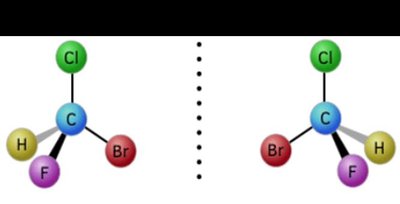
Optical Isomers (Enantiomers): Mirror images due to chiral carbons.
Biological Macromolecules
Overview of Macromolecules
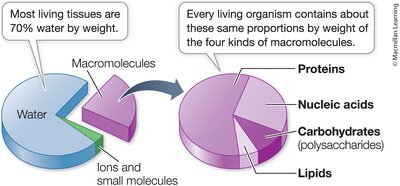
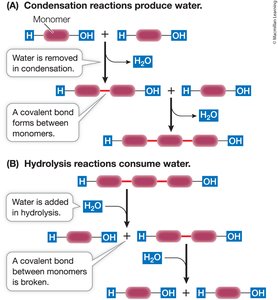
Macromolecules are large, complex molecules essential for life. They are typically polymers, formed by linking monomers through condensation reactions and broken down by hydrolysis.
Macromolecule | Polymer | Monomer | Main Functions |
|---|---|---|---|
Carbohydrate | Polysaccharide | Monosaccharide | Energy storage, structural support |
Nucleic Acid | Polynucleotide | Nucleotide | Genetic information storage and transmission |
Protein | Polypeptide | Amino acid | Catalysis, structure, transport |
Lipid | Diverse | Diverse | Energy storage, membranes |
Proteins: Structure and Function
Proteins are polymers of amino acids, each with a unique sequence and structure. The properties of proteins are determined by their amino acid composition and sequence.
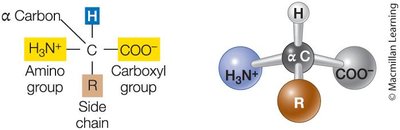
Amino Acid Structure: Central carbon bonded to an amino group, carboxyl group, hydrogen, and variable R group (side chain).
Ionizable Groups: Each amino acid has at least two ionizable groups (amino and carboxyl).
Classification: Amino acids can be hydrophobic or hydrophilic based on their R groups.
Levels of Protein Structure
Proteins have four levels of structure:
Primary: Sequence of amino acids.
Secondary: Local folding (α-helix, β-sheet) stabilized by hydrogen bonds.
Tertiary: Overall 3D shape, stabilized by interactions among R groups.
Quaternary: Association of multiple polypeptide chains.
Protein Denaturation
Denaturation is the loss of a protein's native structure due to external stress (e.g., heat, pH changes), resulting in loss of function. Primary structure remains intact, but secondary, tertiary, and quaternary structures are disrupted.
Carbohydrates: Structure and Classification
Carbohydrates are organic molecules with the general formula (CH2O)n. They serve as energy sources and structural materials.
Monosaccharides: Simple sugars (e.g., glucose, ribose).
Disaccharides: Two monosaccharides linked by glycosidic bonds (e.g., sucrose, lactose).
Polysaccharides: Long chains of monosaccharides (e.g., starch, cellulose, glycogen).
Aldoses and Ketoses: Classified by the presence of an aldehyde or ketone group.
Lipids: Structure and Types
Lipids are hydrophobic molecules that include fats, phospholipids, and steroids. They are important for energy storage, membrane structure, and signaling.
Triglycerides: Glycerol esterified with three fatty acids; main energy storage form.
Phospholipids: Major component of cell membranes; amphipathic structure.
Steroids: Four fused carbon rings; include cholesterol and hormones.
Saturated vs. Unsaturated Fatty Acids: Saturated have no double bonds (solid at room temp), unsaturated have one or more double bonds (liquid at room temp).
Nucleic Acids: DNA and RNA
Nucleic acids store and transmit genetic information. They are polymers of nucleotides, each consisting of a sugar, phosphate group, and nitrogenous base.
DNA: Double-stranded, deoxyribose sugar, bases A, T, C, G.
RNA: Single-stranded, ribose sugar, bases A, U, C, G.
Phosphodiester Bonds: Link nucleotides in a chain.
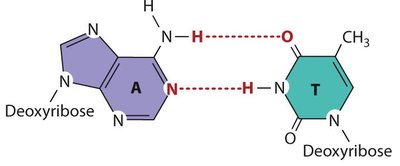
Complementary Base Pairing: Stabilized by hydrogen bonds (A-T, G-C in DNA).