 Back
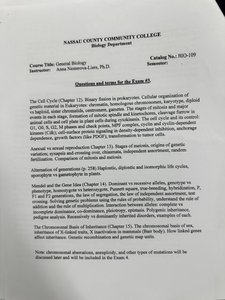
BackStudy Guidance for General Biology Exam Topics
Study Guide - Smart Notes
 Tailored notes based on your materials, expanded with key definitions, examples, and context.
Q1. What are the key stages and regulatory mechanisms of the cell cycle in prokaryotes and eukaryotes?
Background
Topic: Cell Cycle Regulation
This question tests your understanding of the cell cycle, including binary fission in prokaryotes and the phases (G1, S, G2, M) in eukaryotes. It also covers the role of checkpoints, cyclins, and kinases in controlling cell division.
Key Terms and Concepts:
Binary fission: A simple cell division process in prokaryotes.
Cell cycle phases: G1 (growth), S (DNA synthesis), G2 (preparation for mitosis), M (mitosis).
Checkpoints: Control points (G1, G2, M) where the cell assesses readiness to proceed.
Cyclins and kinases: Proteins that regulate progression through the cell cycle.
Step-by-Step Guidance
Describe the process of binary fission in prokaryotes, including DNA replication and cell division.
List and explain the main phases of the eukaryotic cell cycle (G1, S, G2, M).
Identify the major checkpoints and their functions in preventing errors during cell division.
Discuss the roles of cyclins and cyclin-dependent kinases (CDKs) in regulating the cell cycle.
Try solving on your own before revealing the answer!
Q2. How do mutations and genetic recombination contribute to genetic diversity?
Background
Topic: Genetics and Genetic Variation
This question focuses on the mechanisms that generate genetic diversity, including mutations, crossing over, and independent assortment during meiosis.
Key Terms and Concepts:
Mutation: A change in DNA sequence that can introduce new traits.
Genetic recombination: The exchange of genetic material during meiosis (crossing over).
Independent assortment: Random distribution of chromosomes during meiosis.
Step-by-Step Guidance
Define mutation and explain how it can affect genetic information.
Describe the process of crossing over during meiosis and its impact on genetic diversity.
Explain independent assortment and how it contributes to variation in offspring.
Discuss why genetic diversity is important for populations.
Try solving on your own before revealing the answer!
Q3. What are the differences between mitosis and meiosis, and why are they important?
Background
Topic: Cell Division
This question tests your ability to compare and contrast mitosis and meiosis, including their outcomes and biological significance.
Key Terms and Concepts:
Mitosis: Cell division resulting in two identical daughter cells.
Meiosis: Cell division producing four genetically unique gametes.
Diploid vs. haploid: Chromosome number differences in mitosis and meiosis.
Step-by-Step Guidance
Outline the stages of mitosis and meiosis, noting key differences.
Compare the chromosome numbers in daughter cells produced by each process.
Explain the biological significance of mitosis (growth, repair) and meiosis (genetic diversity, reproduction).
Discuss how errors in these processes can lead to genetic disorders.
Try solving on your own before revealing the answer!
