 Back
BackStudy Guide: Life’s Organizational Hierarchy & Emergent Properties
Study Guide - Smart Notes
 Tailored notes based on your materials, expanded with key definitions, examples, and context.
Q1. What is the correct order of life’s organizational hierarchy from smallest to largest?
Background
Topic: Life’s Organizational Hierarchy
This question tests your understanding of how biological systems are organized, from the smallest units (atoms) to the largest (biosphere). Recognizing this hierarchy is foundational in biology, as it helps explain how complex living systems are built from simpler components.
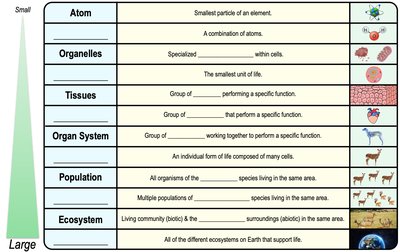
Key Terms and Concepts:
Atom: The smallest particle of an element.
Molecule: A combination of atoms.
Organelle: Specialized structures within cells.
Cell: The smallest unit of life.
Tissue: Group of cells performing a specific function.
Organ: Group of tissues that perform a specific function.
Organ System: Group of organs working together to perform a specific function.
Organism: An individual form of life composed of many cells.
Population: All organisms of the same species living in the same area.
Community: Multiple populations of different species living in the same area.
Ecosystem: Living community (biotic) & the nonliving surroundings (abiotic) in the same area.
Biosphere: All of the different ecosystems on Earth that support life.
Step-by-Step Guidance
Start by identifying the smallest unit in the hierarchy (atom) and the largest (biosphere).
List the intermediate levels in order, using the definitions above to help you place each term correctly.
Check your sequence by ensuring each level is made up of the previous one (e.g., molecules are made of atoms, organelles are made of molecules, etc.).
Use the provided word bank to fill in any missing terms in the pyramid or chart.
Try solving on your own before revealing the answer!
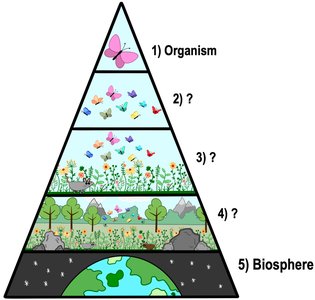
Q2. Which of the following shows the correct order for 2-4 in the pyramid of life’s organizational hierarchy?
Background
Topic: Hierarchical Levels in Biology
This question asks you to identify the correct sequence of organizational levels between an individual organism and the biosphere, using a visual pyramid as a guide.
Key Terms:
Population: All individuals of one species in an area.
Community: All populations of different species in an area.
Ecosystem: All living things plus their physical environment in an area.
Step-by-Step Guidance
Recall the order of levels from organism to biosphere using the definitions above.
Match each level in the pyramid (2, 3, 4) to the correct term based on what is depicted (e.g., groups of the same species, groups of different species, inclusion of the environment).
Compare the options given (a–e) to your sequence to find the correct answer.
Try solving on your own before revealing the answer!
Q3. Which of the following options has the correct order in terms of the hierarchy of the organization?
Background
Topic: Hierarchical Organization in Biology
This question tests your ability to recognize the correct sequence of biological organization from the largest to the smallest or vice versa.
Key Terms:
Biosphere
Ecosystem
Community
Population
Organism
Step-by-Step Guidance
Review the definitions of each term in the hierarchy.
Arrange the terms from largest (biosphere) to smallest (organism), or as specified in the question.
Compare your sequence to the answer choices to determine which is correct.
Try solving on your own before revealing the answer!
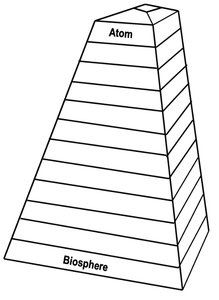
Q4. Use the word bank to complete the pyramid of life’s organizational hierarchy below.
Background
Topic: Life’s Organizational Hierarchy
This exercise helps you practice placing the correct biological terms in the proper order from smallest to largest, reinforcing your understanding of the hierarchy.
Key Terms:
Population, Organelles, Organ System, Cell, Tissues, Ecosystem, Organ, Community, Molecules, Multicellular Organism
Step-by-Step Guidance
Start at the bottom (atom) and work your way up, filling in each blank with the appropriate term from the word bank.
Use the definitions and your knowledge of biology to determine the correct order.
Double-check that each level is logically built from the previous one.
Try solving on your own before revealing the answer!
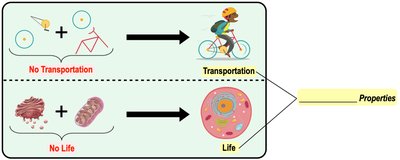
Q5. Which of the following is the best example of an emergent property?
Background
Topic: Emergent Properties
This question tests your understanding of emergent properties—characteristics that arise when simpler components combine to form more complex systems, where the whole exhibits properties the parts alone do not.
Key Terms:
Emergent Property: A property that appears when individual components interact in a system, but is not present in the individual parts alone.
Step-by-Step Guidance
Review the definition of emergent properties and consider examples from biology (e.g., life emerging from non-living molecules).
Analyze each answer choice to see which one describes a property that only appears when smaller parts are combined.
Eliminate choices that describe properties of individual parts rather than the whole system.
Try solving on your own before revealing the answer!
Q6. At which point of the organizational hierarchy does life emerge?
Background
Topic: Origin of Life in the Hierarchy
This question asks you to identify the level at which the property of life first appears in the organizational hierarchy.
Key Terms:
Cellular Level: The first level where all characteristics of life are present.
Molecular Level: Composed of molecules, but not alive on their own.
Population, Multicellular Organism, Atomic Level: Higher or lower levels, but not where life first emerges.
Step-by-Step Guidance
Recall the definition of life and the characteristics that define living things.
Consider which level in the hierarchy first meets all criteria for life (e.g., metabolism, reproduction, response to stimuli).
Compare the answer choices to your understanding of where life begins in the hierarchy.
Try solving on your own before revealing the answer!
