 Back
BackThe Cell Cycle and DNA Structure: Study Notes
Study Guide - Smart Notes
 Tailored notes based on your materials, expanded with key definitions, examples, and context.
The Cell Cycle
Overview of Cell Growth and Division
The cell cycle is a fundamental process in eukaryotic cells, enabling growth, development, and reproduction. It consists of a series of phases that ensure the accurate duplication and division of cellular components. - Cell Growth: Cells reproduce continuously, a defining characteristic of life. In humans, cell replication begins with fertilization and continues throughout development. - Cell Theory: New cells are created from existing cells, supporting the concept that all living organisms are composed of cells.
Phases of the Cell Cycle
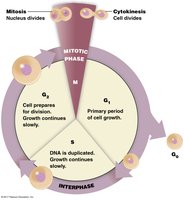
The cell cycle is divided into two main phases: Interphase and the Mitotic Phase. Interphase is further subdivided into G1, S, and G2 phases.
Interphase: Period of cell growth and DNA duplication. Subdivided into:
G1 Phase (First Gap): Primary period of cell growth after division and before DNA replication. Most cell growth occurs here (6–9 hours).
S Phase (Synthesis): DNA is replicated, chromosomes are duplicated. Growth continues slowly (7–8 hours).
G2 Phase (Second Gap): Cell prepares for division, growth continues (6–9 hours).
Mitotic Phase: Nucleus and cytoplasm divide. Subdivided into:
Mitosis: Duplicated DNA is divided into two sets and the nucleus divides.
Cytokinesis: Cytoplasm divides, forming two new cells.
G0 Phase: Non-dividing, non-growing stage. Many cells enter G0 permanently (e.g., neurons, osteocytes).
Duration of the Cell Cycle
- Actively dividing cells complete the cycle in approximately 18–24 hours. - The mitotic phase is much shorter, lasting about 30–45 minutes.
DNA Structure and Organization
DNA: The Genetic Material
DNA (deoxyribonucleic acid) is the hereditary material found in the nucleus of every cell. It consists of billions of nucleotide pairs arranged in a double helix. - Nucleotides: The building blocks of DNA, composed of adenine (A), thymine (T), cytosine (C), and guanine (G). - Base Pairs: A-T and C-G pairs form the rungs of the DNA helix.
Chromosomes
Chromosomes are structures that organize and package DNA within the nucleus. - Human Chromosomes: 46 chromosomes (23 pairs) in humans. - Species Variation: Number of chromosomes varies by species (e.g., blue whale: 44, fruit fly: 8).
Chromatin and Histones
During interphase, chromosomes are not visible and exist as long, thin strands called chromatin. - Histones: Proteins that act as spools for DNA, helping to compact and organize it. - Chromatin is duplicated during S-phase, doubling the chromosome content.
Chromosomes During Mitosis
Prior to nuclear division, chromosomes condense and become visible as identical sister chromatids held together by a centromere.
Genes
Genes are short segments of DNA that encode instructions for making proteins. - Functional Unit: Smallest unit of DNA with a specific function. - Human Genome: Approximately 20,000–21,000 genes distributed across 46 chromosomes. - Gene Location: Each gene occupies a specific locus on a chromosome.
Summary Table: Cell Cycle Phases
Phase | Main Activity | Duration |
|---|---|---|
G1 | Cell growth | 6–9 hours |
S | DNA replication | 7–8 hours |
G2 | Preparation for division | 6–9 hours |
Mitotic Phase | Nucleus and cytoplasm divide | 30–45 minutes |
G0 | Non-dividing stage | Variable |
Key Equations
DNA Base Pairing
Chromosome Number
Example
- Neurons: After adolescence, neurons enter G0 phase and do not divide again. - DNA Replication: During S-phase, each chromosome is duplicated, resulting in two sister chromatids.
Additional info:
The cell cycle is tightly regulated to ensure proper growth and division. Errors in DNA replication or cell cycle control can lead to diseases such as cancer.
