 Back
BackThe Cell Cycle and Mitosis: Structured Study Notes
Study Guide - Smart Notes
 Tailored notes based on your materials, expanded with key definitions, examples, and context.
The Cell Cycle and Mitosis
Overview of the Cell Cycle
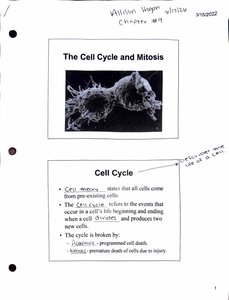
The cell cycle is a fundamental process in biology, describing the sequence of events that occur in a cell from its formation to its division into two daughter cells. This cycle ensures the continuity of life and the maintenance of genetic integrity across generations.
Cell Theory: All cells arise from pre-existing cells, a principle central to biology.
Cell Cycle Events: Includes cell growth, DNA replication, and cell division.
Cell Division: Produces two new cells, essential for growth, repair, and reproduction.
Cycle Breakdown:
Apoptosis: Programmed cell death, important for development and homeostasis.
Necrosis: Premature cell death due to injury.
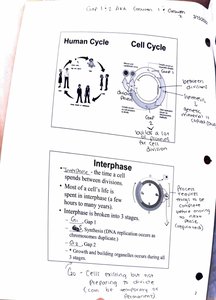
Human Life Cycle vs. Cell Cycle
The human life cycle and the cell cycle are analogous in their cyclical nature, but the cell cycle specifically refers to the process of cellular growth and division.
Cell Cycle Diagram: Shows stages of cell growth, DNA replication, and division.
Purpose: Ensures genetic material is accurately passed to daughter cells.
Interphase
Interphase is the period between cell divisions, where the cell prepares for mitosis. It is subdivided into three stages:
G1 (Gap 1): Cell grows and performs normal functions.
S (Synthesis): DNA replication occurs, doubling the genetic material.
G2 (Gap 2): Cell continues to grow and prepares for division.
Cell Division: Mitosis and Cytokinesis
The "M" Phase
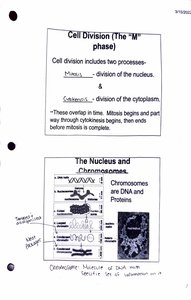
The M phase of the cell cycle includes two main processes: mitosis (division of the nucleus) and cytokinesis (division of the cytoplasm). These processes ensure that each daughter cell receives a complete set of genetic material.
Mitosis: Division of the nucleus.
Cytokinesis: Division of the cytoplasm.
These processes overlap; cytokinesis often begins during mitosis and finishes after nuclear division.
The Nucleus and Chromosomes
The nucleus contains chromosomes, which are composed of DNA and proteins. Chromosomes are the vehicles of genetic information.
Chromosomes: DNA molecules tightly coiled around proteins (histones).
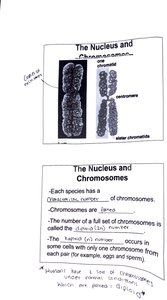
Chromosome Structure: Includes centromere and sister chromatids.
Chromosome Number and Types
Each species has a characteristic number of chromosomes. Chromosomes can be paired (diploid) or single (haploid).
Diploid (2n): Two sets of chromosomes, typical of somatic cells.
Haploid (n): One set of chromosomes, found in gametes (egg and sperm).
Chromosome Number: Varies by species; humans have 46 chromosomes (23 pairs).
Mitosis: Phases and Key Events
Phases of Mitosis
Mitosis is divided into five distinct phases, each characterized by specific events in the cell.
Prophase
Prometaphase
Metaphase
Anaphase
Telophase
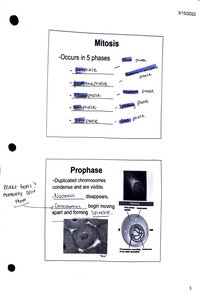
Prophase
During prophase, duplicated chromosomes condense and become visible. The nuclear envelope begins to disintegrate, and spindle fibers start to form.
Chromosomes: Condense and become visible.
Nucleolus: Disappears.
Spindle fibers: Begin to form and move chromosomes.
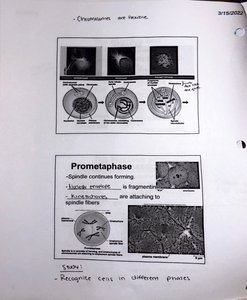
Prometaphase
In prometaphase, the spindle continues to form, and the nuclear envelope fragments. Chromosomes attach to spindle fibers via kinetochores.
Nuclear envelope: Fragments.
Kinetochores: Attach chromosomes to spindle fibers.
Metaphase
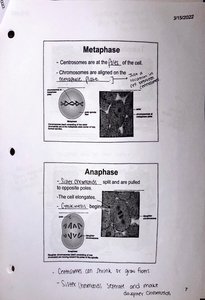
Chromosomes align at the center (metaphase plate) of the cell, preparing for separation.
Centrosomes: At opposite poles.
Chromosomes: Aligned at metaphase plate.
Anaphase
Sister chromatids split and are pulled to opposite poles of the cell. The cell elongates as spindle fibers shorten.
Sister chromatids: Separate and move to poles.
Cell elongation: Occurs as spindle fibers contract.
Telophase
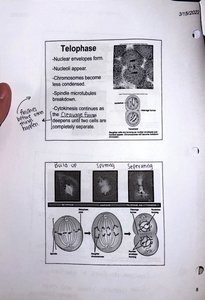
Nuclear envelopes reform around the separated chromosomes, which decondense. Spindle microtubules break down, and cytokinesis begins.
Nuclear envelope: Reforms.
Chromosomes: Decondense.
Cytokinesis: Continues, separating the two cells.
Cytokinesis: Animal and Plant Cells
Cytokinesis in Animal Cells
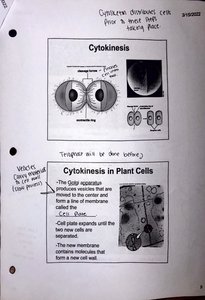
Cytokinesis divides the cytoplasm, resulting in two distinct daughter cells. In animal cells, this occurs via a cleavage furrow.
Cleavage furrow: Contractile ring pinches the cell in two.
Cytokinesis in Plant Cells
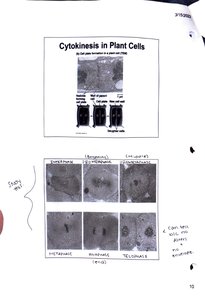
In plant cells, cytokinesis occurs through the formation of a cell plate, which eventually becomes the new cell wall.
Cell plate: Formed by vesicles from the Golgi apparatus.
New cell wall: Develops from the cell plate.
Microscopic Views of Mitosis
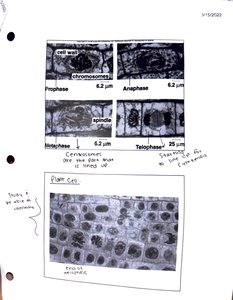
Microscopic images allow identification of cells in different mitotic phases, aiding in understanding cell division visually.
Phases visible: Prophase, Metaphase, Anaphase, Telophase.
Plant cells: Show clear stages of mitosis under the microscope.
Cell Division in Prokaryotes
Binary Fission
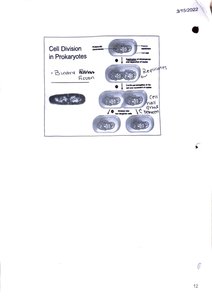
Prokaryotes divide by binary fission, a simpler process than mitosis. The cell replicates its DNA, elongates, and splits into two daughter cells.
DNA replication: Occurs before division.
Cell elongation: Precedes division.
Division: Produces two genetically identical cells.
Summary Table: Mitosis Phases and Key Events
Phase | Main Events |
|---|---|
Prophase | Chromosomes condense, spindle forms, nuclear envelope breaks down |
Prometaphase | Spindle attaches to chromosomes, nuclear envelope fragments |
Metaphase | Chromosomes align at metaphase plate |
Anaphase | Sister chromatids separate, move to poles |
Telophase | Nuclear envelope reforms, chromosomes decondense, cytokinesis begins |
Key Terms and Concepts
Cell cycle: Sequence of events in cell life
Mitosis: Nuclear division
Cytokinesis: Cytoplasmic division
Chromosome: DNA-protein complex
Diploid: Two sets of chromosomes
Haploid: One set of chromosomes
Binary fission: Prokaryotic cell division
Example: In humans, somatic cells undergo mitosis for growth and repair, while gametes are produced by meiosis (not covered here).
Additional info: Academic context was added to clarify cell cycle stages, chromosome structure, and the distinction between mitosis and binary fission.
