 Back
BackThe Cell Cycle: Mechanisms and Regulation
Study Guide - Smart Notes
 Tailored notes based on your materials, expanded with key definitions, examples, and context.
Chapter 12: The Cell Cycle
Introduction to the Cell Cycle
The cell cycle is a fundamental process by which cells grow, replicate their DNA, and divide to produce new cells. This process is essential for reproduction, growth, development, and tissue renewal in both unicellular and multicellular organisms.
Key Roles of Cell Division
Reproduction: In unicellular organisms, cell division produces two identical offspring, ensuring the survival of the species.
Growth and Development: In multicellular organisms, cell division enables the organism to grow from a single cell (zygote) to a complex multicellular adult.
Tissue Renewal: Cell division replaces old, damaged, or dead cells, maintaining tissue health and function.
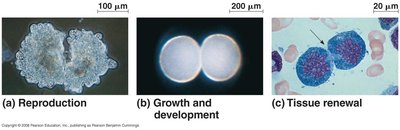
Cellular Organization of Genetic Material
Genome: The complete set of genetic information in a cell.
Prokaryotes: Possess a single, circular DNA molecule (chromosome).
Eukaryotes: Contain multiple, linear DNA molecules organized into chromosomes.
Cell division requires both DNA replication and accurate distribution of genetic material to daughter cells.
Somatic Cells vs. Gametes
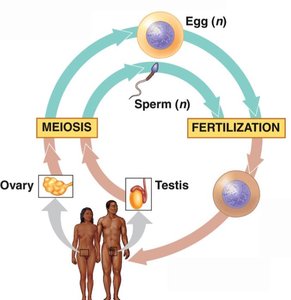
Somatic Cells: All body cells except reproductive cells; diploid (2n), containing two sets of chromosomes.
Gametes: Reproductive cells (egg and sperm); haploid (n), containing one set of chromosomes.
In humans: Somatic cells have 46 chromosomes (2n = 46); gametes have 23 chromosomes (n = 23).
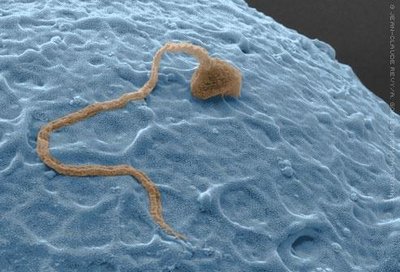
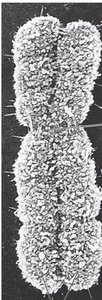
Chromosome Structure and Terminology
Chromosome: A DNA molecule with associated proteins (chromatin).
Chromatin: The complex of DNA and proteins that forms chromosomes.
Chromatid: Each of the two identical halves of a duplicated chromosome.
Sister Chromatids: Two identical chromatids joined at the centromere.
Cohesins: Protein complexes that hold sister chromatids together.
Centromere: The region where sister chromatids are most closely attached.
Kinetochore: Protein structure on the centromere where spindle fibers attach during cell division.
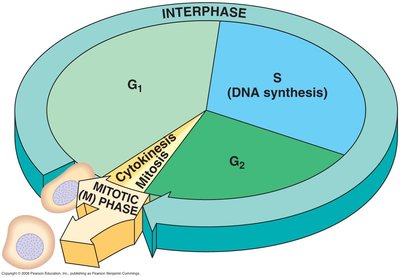
Overview of the Cell Cycle
The cell cycle consists of two main phases: Interphase and M phase (mitosis and cytokinesis).
Interphase: Accounts for about 90% of the cell cycle and includes three subphases:
G1 phase (First Gap): Cell growth and normal functions.
S phase (Synthesis): DNA replication occurs.
G2 phase (Second Gap): Further growth and preparation for division.
M phase: Includes mitosis (division of the nucleus) and cytokinesis (division of the cytoplasm).
Mitosis vs. Meiosis
Mitosis: Occurs in somatic cells; produces two genetically identical diploid daughter cells (2n → 2n).
Meiosis: Occurs in germ cells; produces four genetically unique haploid gametes (2n → n).
Cytokinesis: Division of the cytoplasm, distinct from nuclear division.
Phases of Mitosis
Mitosis is divided into five stages, each with distinct chromosomal and cellular events:
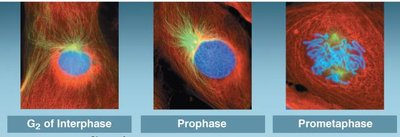
Prophase: Chromatin condenses into visible chromosomes; mitotic spindle begins to form; centrosomes move apart.
Prometaphase: Nuclear envelope fragments; spindle microtubules attach to kinetochores.
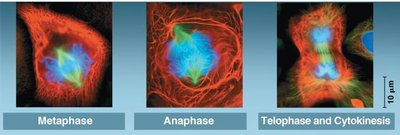
Metaphase: Chromosomes align at the metaphase plate; spindle fibers attach to kinetochores.
Anaphase: Cohesins are cleaved; sister chromatids separate and move toward opposite poles.
Telophase: Nuclear envelopes reform; chromosomes decondense; cytokinesis often begins.
Mitotic Spindle and Chromosome Movement
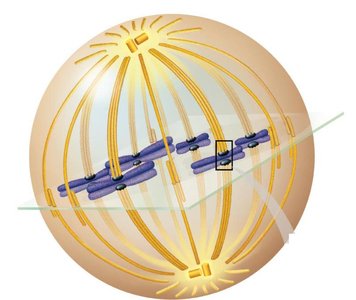
Mitotic Spindle: Structure made of microtubules that orchestrates chromosome movement.
Centrosomes: Microtubule-organizing centers that duplicate during interphase and move to opposite poles during mitosis.
Kinetochore Microtubules: Attach to kinetochores and pull chromosomes apart.
Nonkinetochore Microtubules: Overlap at the cell center and elongate the cell during anaphase.
Asters: Radial arrays of short microtubules that help anchor the spindle to the cell membrane.
Cytokinesis in Animal Cells
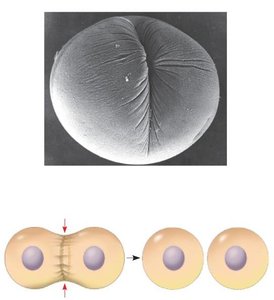
Cleavage Furrow: A contractile ring of actin microfilaments and myosin forms at the cell equator, pinching the cell in two.
Each daughter cell receives its own nucleus and a share of cytoplasm and organelles.
Regulation of the Cell Cycle
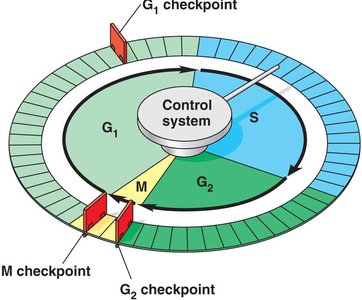
Cell Cycle Control System: A set of regulatory molecules that coordinate the timing and progression of the cell cycle.
Checkpoints: Critical control points where stop and go signals regulate the cycle. The three major checkpoints are:
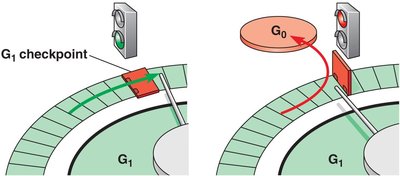
G1 Checkpoint (Restriction Point): Determines if the cell will proceed with division or enter a non-dividing state (G0 phase).
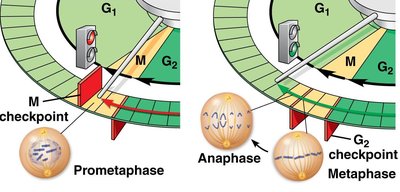
G2 Checkpoint: Ensures all DNA is replicated and undamaged before mitosis.
M Checkpoint (Spindle Checkpoint): Ensures all chromosomes are properly attached to the spindle before anaphase begins.
If a cell does not pass a checkpoint, it may pause for repairs or enter G0 phase.
Cell Division Rates and Cancer
Different cell types divide at different rates (e.g., skin cells divide frequently, nerve cells rarely divide).
Cancer cells: Lose normal cell cycle regulation and divide uncontrollably, leading to tumor formation.
Summary Table: Key Differences Between Mitosis and Meiosis
Feature | Mitosis | Meiosis |
|---|---|---|
Cell Type | Somatic cells | Germ cells |
Ploidy Change | 2n → 2n | 2n → n |
Daughter Cells Produced | 2 (genetically identical) | 4 (genetically unique) |
Function | Growth, repair, asexual reproduction | Sexual reproduction (gamete formation) |
Key Equations and Terms
Diploid (2n): Two sets of chromosomes (e.g., human somatic cells: )
Haploid (n): One set of chromosomes (e.g., human gametes: )
