 Back
BackThe Chemical Basis of Life: Atoms, Elements, and Chemical Bonds
Study Guide - Smart Notes
 Tailored notes based on your materials, expanded with key definitions, examples, and context.
Chapter 2: The Chemical Basis of Life
Elements, Atoms, and Compounds
All matter is composed of elements, which are substances that cannot be broken down into simpler substances by chemical means. Each element consists of atoms, the smallest units of matter that retain the properties of the element. Atoms can combine to form compounds, which are substances consisting of two or more different elements in fixed ratios.
Atoms are made up of subatomic particles: protons (positive charge), neutrons (neutral), and electrons (negative charge).
The atomic number is defined by the number of protons in the nucleus.
Isotopes are atoms of the same element with different numbers of neutrons.
Electrons are responsible for the chemical properties and bonding behavior of atoms.
Electron Shells and Valence Electrons
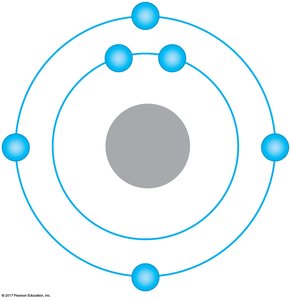
Electrons occupy specific energy levels called electron shells around the nucleus. The arrangement of electrons in these shells determines how atoms interact and bond with each other.
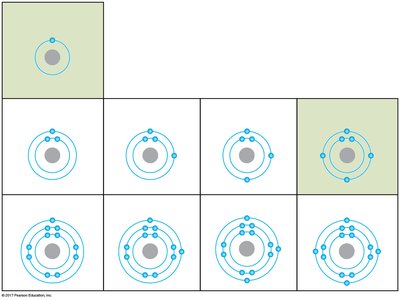
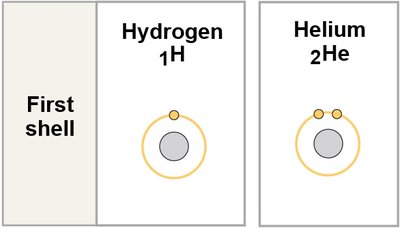
The first shell can hold up to 2 electrons; subsequent shells can hold up to 8 electrons.
The valence shell is the outermost electron shell, and electrons in this shell are called valence electrons.
Atoms are most stable when their valence shells are full. Atoms with incomplete valence shells tend to form chemical bonds to achieve stability.
Elements with a full valence shell (e.g., noble gases) are chemically inert.
Chemical Bonds
Chemical bonds are attractions that hold atoms together, allowing them to achieve stable electron configurations. There are three main types of chemical bonds: covalent, ionic, and hydrogen bonds.
Covalent bonds: Formed when two atoms share one or more pairs of valence electrons. These are the strongest type of chemical bond and result in the formation of molecules.
Ionic bonds: Formed when one atom transfers electrons to another, resulting in the formation of oppositely charged ions that attract each other.
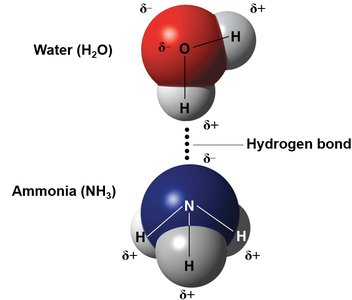
Hydrogen bonds: Weak attractions between a hydrogen atom (with a partial positive charge) in one molecule and an electronegative atom (such as oxygen or nitrogen) in another molecule.
Covalent Bonds
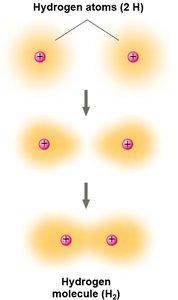
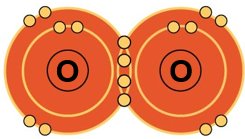
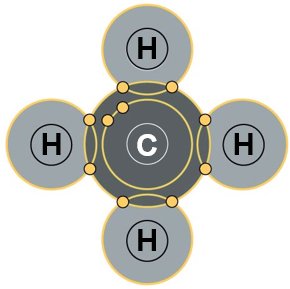
A covalent bond involves the sharing of valence electrons between two atoms. The shared electrons count as part of each atom's valence shell, allowing both atoms to achieve stability.
Single covalent bond: Sharing of one pair of electrons (e.g., H–H in H2).
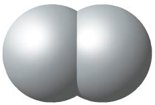
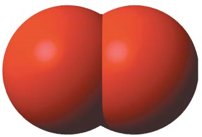
Double covalent bond: Sharing of two pairs of electrons (e.g., O=O in O2).
Covalent bonds can form between atoms of the same or different elements.
Structural formulas represent the arrangement of atoms and bonds (e.g., H–H), while molecular formulas show the types and numbers of atoms (e.g., H2).
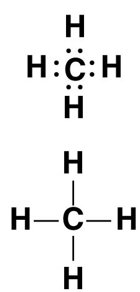
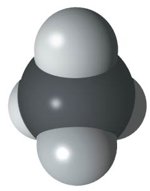
Nonpolar and Polar Covalent Bonds
Not all covalent bonds share electrons equally. The difference in electronegativity between atoms determines whether a bond is nonpolar or polar.
Nonpolar covalent bond: Electrons are shared equally between atoms (e.g., H–H). Both atoms remain neutral.
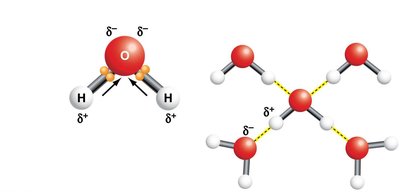
Polar covalent bond: Electrons are shared unequally, with one atom (more electronegative) pulling electrons closer, resulting in partial charges (e.g., O–H in water).
Polarity refers to the separation of electrical charges within a molecule, creating positive (δ+) and negative (δ–) poles.

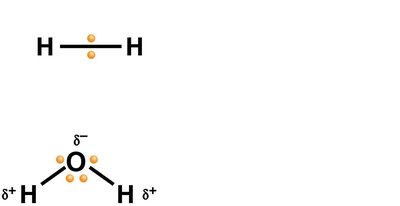
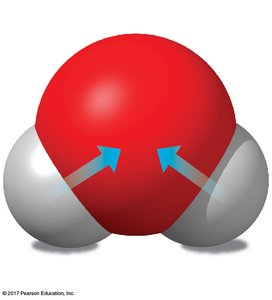
Hydrogen Bonds
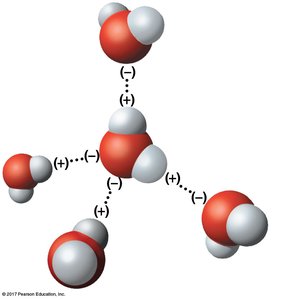
Hydrogen bonds are weak chemical interactions that occur between molecules. They are especially important in biological systems, such as holding water molecules together and stabilizing the structures of proteins and DNA.
Formed when a hydrogen atom covalently bonded to an electronegative atom (like oxygen or nitrogen) is attracted to another electronegative atom in a different molecule.
Hydrogen bonds are much weaker than covalent or ionic bonds, but their reversibility is advantageous for many biological processes.
Ionic Bonds
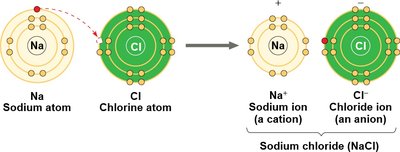
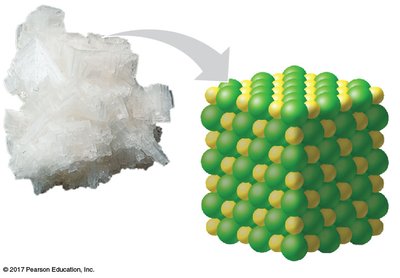
Ionic bonds are formed when one atom donates an electron to another, resulting in the formation of ions. The resulting oppositely charged ions attract each other, forming an ionic bond.
Cation: A positively charged ion (e.g., Na+).
Anion: A negatively charged ion (e.g., Cl–).
Ionic compounds (salts) are formed from the attraction between cations and anions (e.g., NaCl).
Chemical Reactions
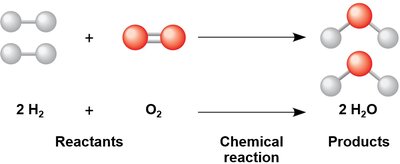
Chemical reactions involve the making and breaking of chemical bonds, resulting in the rearrangement of atoms to form new substances. The substances present at the start of a reaction are called reactants, and those formed are called products.
Chemical reactions do not create or destroy matter; they simply rearrange atoms.
All chemical reactions are reversible, indicated by double arrows ().
Summary Table: Types of Chemical Bonds
Bond Type | How Formed | Relative Strength | Example |
|---|---|---|---|
Covalent | Sharing of electrons | Strongest | H2, O2, CH4 |
Ionic | Transfer of electrons | Strong (but weaker than covalent in water) | NaCl |
Hydrogen | Attraction between partial charges | Weakest | Between water molecules |
Chapter 2 Big Ideas
Atoms are the smallest units of matter, composed of protons, neutrons, and electrons.
The number of protons defines the element.
Elements can combine to form compounds.
Neutrons contribute to atomic mass and create isotopes.
Electrons are responsible for chemical bonding.
Three main types of chemical bonds: covalent (strongest, can be polar or nonpolar), hydrogen (weakest), and ionic.
