 Back
BackChapter 2: The Chemical Context of Life: Elements, Atoms, and Chemical Bonds
Study Guide - Smart Notes
 Tailored notes based on your materials, expanded with key definitions, examples, and context.
Concept 2.1: Matter Consists of Chemical Elements in Pure Form and in Combinations Called Compounds
Organisms Are Composed of Matter
Matter is anything that takes up space and has mass. All living organisms are composed of matter, which exists in various forms and combinations.
Matter: Anything that occupies space and has mass.
Element: A substance that cannot be broken down to other substances by chemical reactions.
Compound: A substance consisting of two or more elements in a fixed ratio, exhibiting emergent properties distinct from its constituent elements.
Example: Table salt (NaCl) is a compound with properties different from sodium and chlorine.
The Elements of Life
Of the 92 naturally occurring elements, about 20–25% are essential for life. Four elements—carbon, hydrogen, oxygen, and nitrogen—make up 96% of living matter. The remaining 4% includes calcium, phosphorus, potassium, and sulfur, with trace elements required in minute quantities.
Essential elements: Required for organism survival and reproduction.
Trace elements: Needed in very small amounts but are vital for proper biological function.
Case Study: Evolution of Tolerance to Toxic Elements
Some elements can be toxic, but certain species have adapted to survive in environments containing these elements. For example, some plant communities thrive on serpentine soils, which are rich in heavy metals toxic to most plants.

Concept 2.2: An Element’s Properties Depend on the Structure of Its Atoms
Atoms and Subatomic Particles
An atom is the smallest unit of matter that retains the properties of an element. Atoms are composed of subatomic particles: neutrons (no charge), protons (positive charge), and electrons (negative charge).
Neutrons and protons form the atomic nucleus.
Electrons form a cloud around the nucleus.
Atomic mass is measured in daltons; electrons contribute negligibly to mass.
Atomic Number, Mass Number, and Isotopes
Atomic number: Number of protons in the nucleus.
Mass number: Sum of protons and neutrons.
Isotopes: Atoms of the same element with different numbers of neutrons.
Radioactive isotopes: Unstable isotopes that decay, emitting particles and energy.
Applications of Radioactive Isotopes
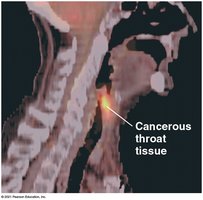
Radioactive isotopes are used as tracers in medicine to track atoms through metabolism and in imaging techniques such as PET scans, which can monitor cancer growth and metabolism.
Radiometric Dating
Radiometric dating uses the decay of radioactive isotopes to determine the age of rocks and fossils. The rate of decay is expressed as the isotope's half-life.
Half-life: Time required for half the atoms of a radioactive isotope to decay.
Energy Levels of Electrons
Electrons have potential energy based on their distance from the nucleus. They occupy electron shells, and changes in their energy occur in fixed steps. The distribution of electrons determines an atom’s chemical behavior.
Valence electrons: Electrons in the outermost shell, crucial for chemical reactivity.
Elements with a full valence shell are chemically inert.
Electron Orbitals
Orbitals are three-dimensional spaces where electrons are found 90% of the time. Each shell contains a specific number of orbitals, with no more than two electrons per orbital.
Concept 2.3: The Formation and Function of Molecules and Ionic Compounds Depend on Chemical Bonding Between Atoms
Covalent Bonds
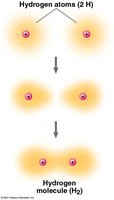
Covalent bonds involve the sharing of valence electrons between atoms. A molecule is formed when two or more atoms are held together by covalent bonds.
Single bond: Sharing of one pair of electrons.
Double bond: Sharing of two pairs of electrons.
Electronegativity: Atom’s attraction for shared electrons.
Nonpolar covalent bond: Electrons shared equally.
Polar covalent bond: Electrons shared unequally, creating partial charges.
Ionic Bonds
Ionic bonds form when electrons are transferred from one atom to another, resulting in oppositely charged ions (cations and anions) that attract each other. Ionic compounds, or salts, are often crystalline in structure and dissociate easily in water.
Weak Chemical Interactions
Weak bonds, such as hydrogen bonds and van der Waals interactions, play crucial roles in the structure and function of biological molecules. Their reversibility is advantageous for dynamic biological processes.
Hydrogen Bonds
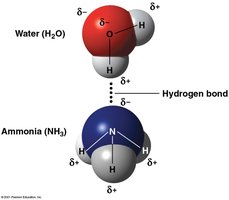
A hydrogen bond forms when a hydrogen atom covalently bonded to one electronegative atom is attracted to another electronegative atom, commonly oxygen or nitrogen in living cells.
Van der Waals Interactions
These are weak attractions between molecules or parts of molecules that result from transient local partial charges.
Molecular Shape and Function
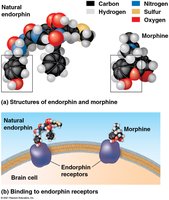
The shape of a molecule, determined by the positions of its atoms’ orbitals, is critical for its function. Molecular shape determines how biological molecules recognize and interact with each other. For example, morphine and endorphins have similar shapes and can bind to the same brain receptors, producing similar effects.
Concept 2.4: Chemical Reactions Make and Break Chemical Bonds
Chemical Reactions
Chemical reactions involve the making and breaking of chemical bonds. The starting substances are called reactants, and the resulting substances are products. All chemical reactions are reversible, and equilibrium is reached when the forward and reverse reactions occur at the same rate.
Example: Photosynthesis is a key chemical reaction in biology:
Reactants: and
Products: and
At chemical equilibrium, the concentrations of reactants and products remain constant.
Practice Questions
How many protons, neutrons, and electrons are in an isotope of titanium with atomic number 22 and mass number 48? Answer: 22 protons, 26 neutrons, 22 electrons.
What do elements with atomic numbers 6, 14, and 22 have in common? Answer: Same number of valence electrons and will form the same number of covalent bonds.
Which of the following food items is like a compound? Answer: A sandwich containing ham, lettuce, and tomato (contains multiple components in a fixed ratio, analogous to a compound).
