 Back
BackThe Endomembrane System: Structure and Function in Eukaryotic Cells
Study Guide - Smart Notes
 Tailored notes based on your materials, expanded with key definitions, examples, and context.
Concept 6.4: The Endomembrane System Regulates Protein Traffic and Performs Metabolic Functions
The endomembrane system is a network of membranes within eukaryotic cells that coordinates the synthesis, modification, transport, and degradation of cellular materials. It includes the nuclear envelope, endoplasmic reticulum (ER), Golgi apparatus, lysosomes, vesicles, vacuoles, and the plasma membrane. This system is essential for maintaining cellular organization and function.
The Endoplasmic Reticulum: Biosynthetic Factory
The endoplasmic reticulum (ER) is an extensive network of membranes, accounting for more than half of the total membrane in many eukaryotic cells. It consists of membranous tubules and sacs called cisternae, with the ER lumen separated from the cytosol by the ER membrane. The ER is continuous with the nuclear envelope, making the space between the nuclear envelope membranes continuous with the ER lumen.
Smooth ER: Lacks ribosomes on its surface. Functions in lipid synthesis, carbohydrate metabolism, detoxification of drugs and poisons, and calcium ion storage.
Rough ER: Studded with ribosomes on its surface. Involved in the synthesis of proteins destined for secretion, glycoprotein production, and membrane assembly.
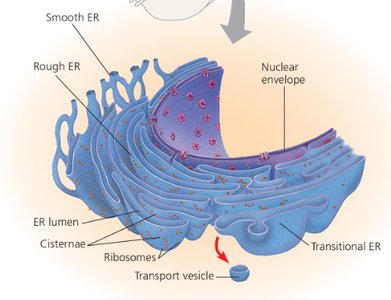
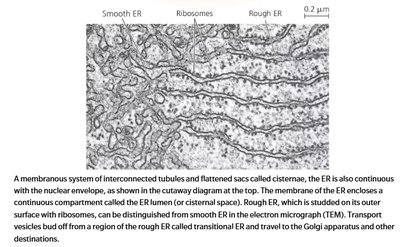
Key Functions of Smooth ER:
Synthesizes lipids (oils, steroids, phospholipids)
Detoxifies drugs by adding hydroxyl groups, making them more water-soluble
Stores calcium ions, which are released to trigger muscle contraction or other cellular responses
Key Functions of Rough ER:
Synthesizes secretory proteins (e.g., insulin)
Folds newly synthesized polypeptides into functional shapes in the ER lumen
Produces glycoproteins by attaching carbohydrates to proteins
Packages secretory proteins into transport vesicles
Adds membrane proteins and phospholipids to its own membrane, which can be transferred to other organelles
The Golgi Apparatus: Shipping and Receiving Center
The Golgi apparatus functions as a warehouse for receiving, sorting, shipping, and manufacturing products from the ER, such as proteins. It consists of flattened membranous sacs called cisternae, which are stacked and separated from the cytosol. The Golgi has a distinct structural directionality with a cis face (receiving side) near the ER and a trans face (shipping side) that sends vesicles to other locations.
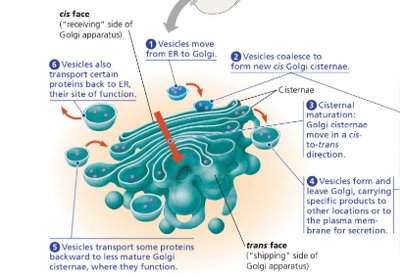
Vesicles transport materials between the ER, Golgi, and other cellular structures.
Products from the ER are modified as they move from the cis to the trans region of the Golgi (e.g., glycoproteins have their carbohydrates altered).
The Golgi manufactures some macromolecules, including polysaccharides like pectins in plant cells.
The cisternal maturation model suggests that cisternae move from the cis to the trans face, carrying and modifying cargo.
The Golgi sorts and targets products for various parts of the cell using molecular identification tags (e.g., phosphate groups).
Transport vesicles have external molecules that recognize docking sites on specific organelles or the plasma membrane, ensuring proper delivery.
Lysosomes: Digestive Compartments
Lysosomes are membranous sacs containing hydrolytic enzymes used to digest macromolecules in eukaryotic cells. Lysosomal enzymes function optimally in an acidic environment. Hydrolytic enzymes and lysosomal membranes are produced by the rough ER and processed in the Golgi apparatus.
Lysosomes perform intracellular digestion through phagocytosis, where cells engulf smaller organisms or food particles, forming a food vacuole that fuses with a lysosome for digestion.
Digestion products, such as simple sugars and amino acids, pass into the cytosol as nutrients.
Example: Macrophages, a type of white blood cell, use phagocytosis to engulf and destroy bacteria and other invaders.
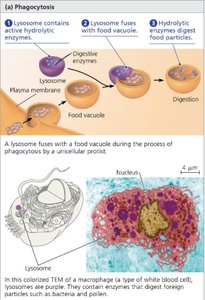
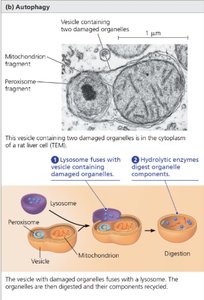
Lysosomes also recycle the cell’s own organic material through autophagy, where a damaged organelle or cytosol is surrounded by a double membrane and fused with a lysosome for digestion.
Autophagy helps cells renew themselves; for example, human liver cells recycle half of their macromolecules each week.
Inherited lysosomal storage diseases result from a lack of functioning hydrolytic enzymes, leading to the accumulation of indigestible material and interference with cellular activities.
Tay-Sachs disease is an example where a missing or inactive lipid-digesting enzyme causes lipid accumulation in brain cells, impairing brain function.
Vacuoles: Diverse Maintenance Compartments
Vacuoles are large vesicles derived from the endoplasmic reticulum and Golgi apparatus, forming part of the cell's endomembrane system. The vacuolar membrane is selective in transporting solutes, resulting in a different composition of the solution inside the vacuole compared to the cytosol.
Food vacuoles: Formed by phagocytosis.
Contractile vacuoles: Found in many unicellular protists living in fresh water; they pump excess water out of the cell to maintain ion and molecule concentration.
Hydrolytic vacuoles: In plants and fungi, these vacuoles carry out enzymatic hydrolysis, similar to lysosomes in animal cells.
Storage vacuoles: In plants, they store important organic compounds, such as proteins in seed storage cells.
Protective vacuoles: Store compounds that are poisonous or unpalatable to herbivores.
Pigment vacuoles: Contain pigments like red and blue pigments in petals to attract pollinating insects.
Central vacuole in mature plant cells: Develops from the coalescence of smaller vacuoles, contains cell sap (main repository of inorganic ions like potassium and chloride), and plays a major role in plant cell growth by absorbing water.
The Endomembrane System: A Review
The endomembrane system involves the flow of membrane lipids and proteins through various organelles, modifying their molecular composition and metabolic functions. The nuclear envelope is connected to the rough ER, which is continuous with the smooth ER. Membranes and proteins produced by the ER move to the Golgi apparatus via transport vesicles. The Golgi apparatus modifies and sorts these products, then pinches off vesicles that can become lysosomes, other specialized vesicles, or vacuoles. Lysosomes can fuse with other vesicles to digest their contents. Transport vesicles carry proteins to the plasma membrane for secretion, and the plasma membrane expands through vesicle fusion, allowing proteins to be secreted from the cell.
Concept Check 6.4: Key Comparisons and Pathways
Rough ER vs. Smooth ER: Rough ER has ribosomes on its surface, making it appear "rough," and is involved in protein synthesis and processing. Smooth ER lacks ribosomes, appears "smooth," and is involved in lipid synthesis, detoxification, and calcium ion storage.
Transport Vesicles and the Endomembrane System: Transport vesicles move materials between different compartments of the endomembrane system, including the ER, Golgi apparatus, lysosomes, and plasma membrane. They help maintain the flow of proteins and lipids through the cell.
Protein Pathway: The mRNA for the protein is transcribed in the nucleus and then transported to the cytoplasm. Ribosomes on the rough ER translate the mRNA into a protein, which enters the ER lumen. The protein is then packaged into a transport vesicle and sent to the Golgi apparatus for modification. After modification, it is transported back to the ER or to its final destination within the cell.
Organelle | Main Function | Key Features |
|---|---|---|
Rough ER | Protein synthesis and processing | Ribosomes on surface, produces glycoproteins, forms transport vesicles |
Smooth ER | Lipid synthesis, detoxification, calcium storage | No ribosomes, synthesizes lipids, detoxifies drugs |
Golgi Apparatus | Modification, sorting, and shipping of proteins and lipids | Cis and trans faces, cisternal maturation, molecular tagging |
Lysosome | Digestion of macromolecules, recycling | Hydrolytic enzymes, acidic environment, autophagy, phagocytosis |
Vacuole | Storage, waste disposal, growth, protection | Large vesicles, diverse functions in plants and protists |
