 Back
BackThermochemistry: Energy and Chemical Reactions
Study Guide - Smart Notes
 Tailored notes based on your materials, expanded with key definitions, examples, and context.
Theme 8: Energy and Chemical Reactions
Introduction to Thermochemistry
Thermochemistry is the study of energy changes, particularly heat, that accompany chemical reactions and physical changes. Understanding how energy is transferred and transformed is essential for predicting reaction behavior and for applications in biology, chemistry, and engineering.
Basic Principles of Energy
Definitions and Concepts
Energy: The capacity to do work or transfer heat.
Temperature: A measure of the average kinetic energy of particles in a substance, reported in °C, K, or °F.
Heat (q): Energy transferred between systems due to a temperature difference, measured in Joules (J).
Heat of Reaction: The energy flow to or from the surroundings as a result of a chemical reaction.
Note: Temperature (in K) is not the same as heat (in J).
First Law of Thermodynamics
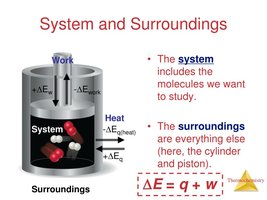
The first law states that energy cannot be created or destroyed, only transferred or transformed. The total energy of the universe remains constant.
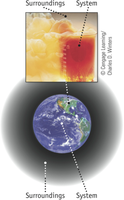
System: The part of the universe under study (e.g., the contents of a reaction flask).
Surroundings: Everything outside the system (e.g., air, container, lab bench).
Types of Systems
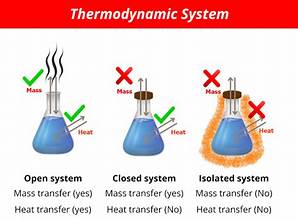
Open System: Exchanges both energy and matter with surroundings (e.g., hot soup in an open cup).
Closed System: Exchanges energy but not matter (e.g., soup in a cup with a lid).
Isolated System: Exchanges neither energy nor matter (e.g., soup in a perfectly insulated thermos).
Heat Transfer and Thermal Equilibrium
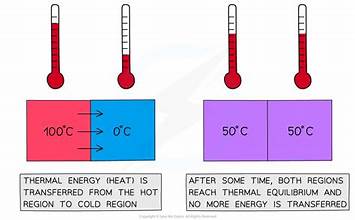
Heat flows spontaneously from a hotter object to a cooler one until thermal equilibrium is reached (no net heat flow).
Exothermic and Endothermic Processes
Definitions
Exothermic: Energy is released from the system to the surroundings (q < 0).
Endothermic: Energy is absorbed from the surroundings into the system (q > 0).
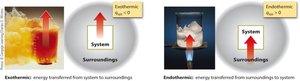
Units of Energy
1 calorie (cal) = heat required to raise the temperature of 1.00 g of H2O by 1.0°C.
1 cal = 4.184 J (Joules)
Food energy: 1 Calorie (Cal) = 1 kcal = 1000 cal
Heat Capacity and Specific Heat
Definitions
Heat Capacity (C): The amount of heat required to raise the temperature of an object by 1°C (J/°C).
Specific Heat Capacity (c): The amount of heat required to raise the temperature of 1 g of a substance by 1°C (J/g·K).
Molar Heat Capacity: The amount of heat required to raise the temperature of 1 mol of a substance by 1°C (J/mol·K).

Factors Affecting Heat Absorption
Mass of the substance (m)
Magnitude of temperature change (ΔT)
Specific heat capacity of the material (c)
The heat absorbed or released is calculated as:
Energy and Changes of State (Phase Changes)
Phase Changes
Energy is required for phase changes (e.g., melting, boiling) without a change in temperature. The amount of energy depends on the mass and the enthalpy of the phase change.
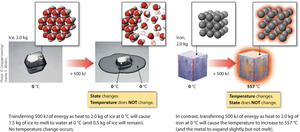
Example Calculation
To convert 500.0 g of water from liquid to gas at 100°C:
First Law of Thermodynamics (Internal Energy)
Internal Energy (U)
The sum of all kinetic and potential energies of the particles in a system.
Change in internal energy:
q = heat exchanged, w = work done
Sign Conventions
Energy Transferred As... | Sign Convention | Effect on Usystem |
|---|---|---|
Heat to the system (endothermic) | q > 0 (+) | U increases |
Heat from the system (exothermic) | q < 0 (−) | U decreases |
Work done on system | w > 0 (+) | U increases |
Work done by system | w < 0 (−) | U decreases |
Enthalpy Changes for Chemical Reactions
Enthalpy (H)
A state function representing heat content at constant pressure.
Change in enthalpy:
Depends on the amount, direction, and phase of substances.
Thermochemical Equations
Show the enthalpy change associated with a reaction.
Example:
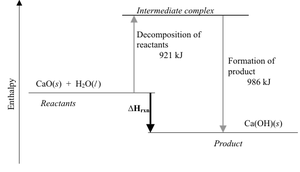
State Functions
Properties that depend only on the current state, not the path taken (e.g., T, P, V, H).
Calorimetry
Constant Pressure Calorimetry (Coffee-Cup Calorimeter)
Used to measure enthalpy changes at constant pressure.
Commonly used for reactions in solution.
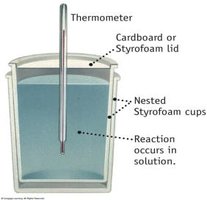
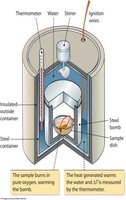
Constant Volume Calorimetry (Bomb Calorimeter)
Used to measure changes in internal energy at constant volume.
Suitable for combustion reactions.
Hess's Law
Principle
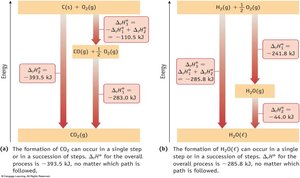
Hess's Law states that the total enthalpy change for a reaction is the same, regardless of the number of steps or the pathway taken, because enthalpy is a state function.
Allows calculation of enthalpy changes for reactions that cannot be measured directly.
Sum the enthalpy changes for individual steps to find the overall change.
Standard Enthalpy of Formation
The enthalpy change for the formation of 1 mole of a compound from its elements in their standard states.
Substance | Formula | ΔHf° (kJ/mol) |
|---|---|---|
Water (liquid) | H2O(l) | -285.8 |
Carbon dioxide (gas) | CO2(g) | -393.5 |
Ammonia (gas) | NH3(g) | -45.9 |
Methane (gas) | CH4(g) | -74.8 |
Glucose (solid) | C6H12O6(s) | -1273 |
Summary Table: Key Equations
Equation | Description |
|---|---|
Heat transfer for temperature change | |
First law of thermodynamics (internal energy change) | |
Enthalpy change for a reaction | |
Reaction enthalpy from standard enthalpies of formation |
Additional info: Some tables and examples have been expanded for clarity and completeness. All equations are provided in LaTeX format as required for academic use.
