 Back
BackVascular Plant Structure, Growth, and Adaptations: Study Notes
Study Guide - Smart Notes
 Tailored notes based on your materials, expanded with key definitions, examples, and context.
Vascular Plant Structure and Growth
Overview: Repetitive Patterns and Plant Development
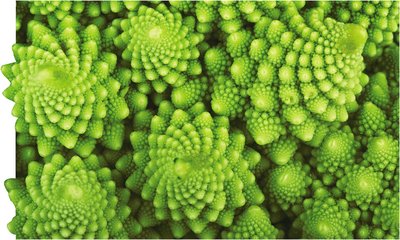
Vascular plants exhibit remarkable patterns of growth and organization, often visible in their external morphology. For example, the Romanesco broccoli displays a fractal pattern, where each bud resembles the entire structure, illustrating the genetic and developmental repetition in plant growth. These patterns are genetically determined but can be influenced by environmental factors, leading to diversity in plant forms.
Comparing Monocots and Eudicots
Key Structural Differences
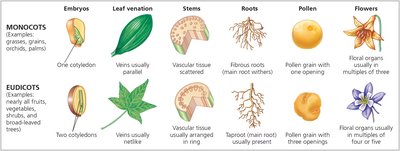
Angiosperms are divided into two major clades: monocots and eudicots. These groups differ in several anatomical features, which are summarized below:
Feature | Monocots | Eudicots |
|---|---|---|
Embryos | One cotyledon | Two cotyledons |
Leaf venation | Veins usually parallel | Veins usually netlike |
Stems | Vascular tissue scattered | Vascular tissue in a ring |
Roots | Fibrous roots (main root often absent) | Taproot (main root) usually present |
Pollen | Grain with one opening | Grain with three openings |
Flowers | Organs in multiples of three | Organs in multiples of four or five |
Plant Body Organization: Organs, Tissues, and Cells
Hierarchical Structure
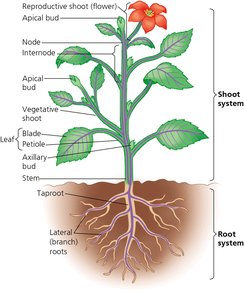
Plants are organized into a hierarchy of organs, tissues, and cells. The three basic plant organs are roots, stems, and leaves, which together form the root and shoot systems. Each organ is composed of three tissue types: dermal, vascular, and ground tissue.
Root system: Anchors the plant, absorbs water and minerals, and stores carbohydrates.
Shoot system: Includes stems and leaves, responsible for photosynthesis and reproduction.
Roots: Structure and Function
Roots anchor the plant, absorb water and minerals, and often store nutrients. There are two main types of root systems:
Taproot system: Characteristic of eudicots, with a main vertical root and lateral branches.
Fibrous root system: Common in monocots, with many thin roots spreading out below the surface.
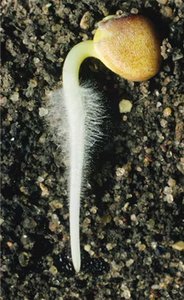
Root hairs, extensions of root epidermal cells, greatly increase the surface area for absorption.
Specialized Root Adaptations
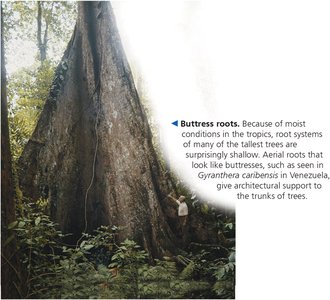
Some roots are modified for specialized functions such as support, storage, or gas exchange. For example, buttress roots provide architectural support in tropical trees.
Stems: Structure and Modifications
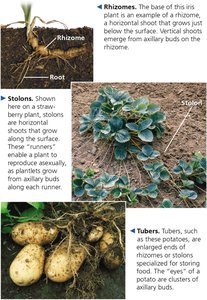
Stems support leaves and reproductive structures, and transport fluids between roots and shoots. Stems are composed of nodes (where leaves attach) and internodes (segments between nodes). Stems may be modified for storage or asexual reproduction:
Rhizomes: Horizontal underground stems.
Stolons: Horizontal shoots that grow along the surface.
Tubers: Enlarged ends of rhizomes or stolons for storage.
Leaves: Structure and Adaptations
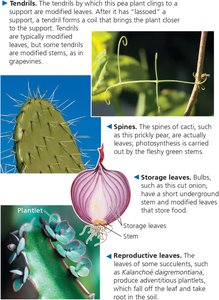
Leaves are the main organs of photosynthesis. They consist of a blade and a petiole (stalk). Leaf adaptations include:
Tendrils: Modified leaves for climbing.
Spines: Modified leaves for protection.
Storage leaves: Bulbs and succulents store nutrients or water.
Reproductive leaves: Some leaves produce plantlets for asexual reproduction.
Genetic and Environmental Influences on Leaf Morphology
Case Study: Red Maple Leaf "Toothiness"
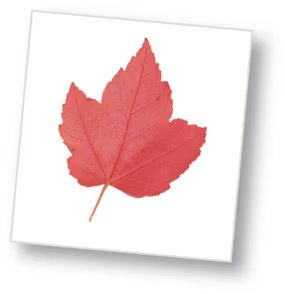
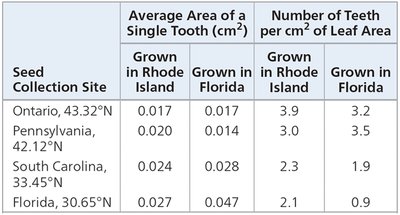
Leaf shape in Acer rubrum (red maple) varies with both genetic background and environmental conditions. Northern populations tend to have more and larger teeth on their leaves compared to southern populations. Experiments growing seeds from different latitudes in both northern and southern environments show that both genetics and environment (phenotypic plasticity) influence leaf morphology.
Seed Collection Site | Average Area of a Single Tooth (cm2) Grown in Rhode Island | Average Area of a Single Tooth (cm2) Grown in Florida | Number of Teeth per cm2 of Leaf Area Grown in Rhode Island | Number of Teeth per cm2 of Leaf Area Grown in Florida |
|---|---|---|---|---|
Ontario, 43.32°N | 0.017 | 0.017 | 3.9 | 3.2 |
Pennsylvania, 42.12°N | 0.020 | 0.014 | 3.0 | 3.5 |
South Carolina, 33.45°N | 0.024 | 0.028 | 2.3 | 1.9 |
Florida, 30.65°N | 0.027 | 0.047 | 2.1 | 0.9 |
Summary
Vascular plants have a hierarchical organization of organs, tissues, and cells.
Roots, stems, and leaves are the three basic organs, each with specialized functions and adaptations.
Monocots and eudicots differ in key anatomical features, including root systems, leaf venation, and floral structure.
Plant morphology is shaped by both genetic programs and environmental influences, as seen in leaf shape variation.
