 Back
BackWater and Biomolecules: Foundations of Life
Study Guide - Smart Notes
 Tailored notes based on your materials, expanded with key definitions, examples, and context.
Water: Essential Properties and Biological Importance
Key Properties of Water
Water is fundamental to life due to its unique physical and chemical properties. These properties enable water to support biological processes and maintain homeostasis in living organisms.
Excellent Solvent: Water dissolves a wide range of substances, facilitating biochemical reactions and transport of nutrients.
Liquid at Body Temperature: Water remains liquid within the physiological temperature range, supporting cellular functions.
Heat Absorption and Retention: Water can absorb and retain heat, helping regulate temperature in organisms.
Evaporation Uses Heat Energy: The evaporation of water cools surfaces, aiding in thermoregulation.
Participation in Chemical Reactions: Water is involved in hydrolysis and dehydration synthesis, essential for macromolecule metabolism.
Chemical Structure of Water
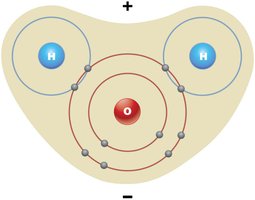
The water molecule (H2O) consists of two hydrogen atoms covalently bonded to an oxygen atom. Its polar nature results in partial positive and negative charges, enabling hydrogen bonding.
Types of Chemical Bonds in Biology
Chemical bonds are crucial for molecular structure and function. The three main types are covalent, ionic, and hydrogen bonds.
Type | Strength | Description | Examples |
|---|---|---|---|
Covalent bond | Strong | Sharing of electrons between atoms | Bond between hydrogen and oxygen in water |
Ionic bond | Moderate | Attraction between oppositely charged ions | Bond between Na+ and Cl- in salt |
Hydrogen bond | Weak | Attraction between partially charged regions of molecules | Bond between water molecules |

States of Water: Liquid, Solid, and Gas
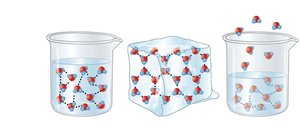
Water exists in three states: liquid, solid (ice), and gas (vapor). Hydrogen bonds are responsible for water's unique behavior in each state.
Liquid: Hydrogen bonds form and break rapidly, allowing fluidity.
Ice: Stable hydrogen bonds create a crystalline structure, making ice less dense than liquid water.
Vapor: Molecules escape hydrogen bonding, becoming gaseous.
Water as a Solvent
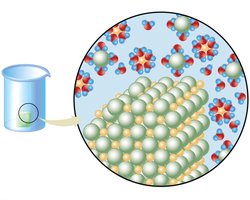
Water's polarity enables it to dissolve ionic and polar substances, such as salts and sugars, by surrounding and separating their ions or molecules.
pH and Acidity
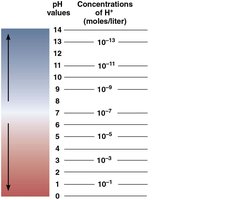
The pH scale measures the concentration of hydrogen ions (H+) in a solution, indicating its acidity or alkalinity. Biological fluids are tightly regulated to maintain optimal pH.
Acidic: pH < 7, high H+ concentration
Neutral: pH = 7
Alkaline (Basic): pH > 7, low H+ concentration
Buffers in Biological Systems
Buffers are substances that minimize changes in pH by absorbing or releasing H+ ions. The carbonic acid-bicarbonate system is a key buffer in blood.
Reaction:
If blood is too acidic:
If blood is too alkaline:
Macromolecules: Synthesis and Breakdown
Dehydration Synthesis and Hydrolysis
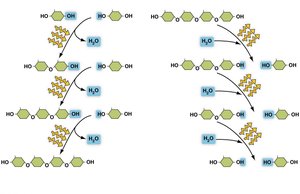
Macromolecules are assembled and disassembled through dehydration synthesis and hydrolysis reactions.
Dehydration Synthesis: Removes water to join subunits, requires energy.
Hydrolysis: Adds water to break bonds, releases energy.
These reactions are essential for metabolism and cellular function.
Carbohydrates: Structure and Function
Monosaccharides
Monosaccharides are simple sugars with the general formula Cn(H2O)n. They serve as energy sources and building blocks for larger carbohydrates.
Examples: Glucose, fructose, galactose, ribose, deoxyribose
Oligosaccharides and Disaccharides
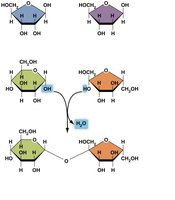
Oligosaccharides are composed of a few monosaccharides linked by dehydration synthesis. Disaccharides are two monosaccharides joined together.
Sucrose: Glucose + fructose
Maltose: Glucose + glucose
Lactose: Glucose + galactose
Polysaccharides
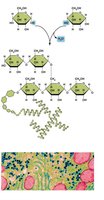
Polysaccharides are long chains of monosaccharides, used for energy storage and structural support.
Starch: Energy storage in plants
Glycogen: Energy storage in animals
Cellulose: Structural support in plants, indigestible by humans
Lipids: Structure and Function
Classes of Lipids
Lipids are hydrophobic molecules essential for energy storage, membrane structure, and signaling.
Triglycerides: Energy storage
Phospholipids: Cell membrane structure
Steroids: Hormones and membrane components
Triglycerides
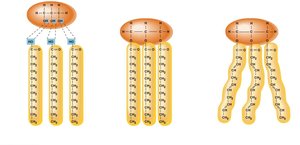
Triglycerides consist of glycerol and three fatty acids. Fatty acids can be saturated (single bonds) or unsaturated (double bonds).
Saturated: Straight tails, solid at room temperature
Unsaturated: Kinked tails, liquid at room temperature
Phospholipids
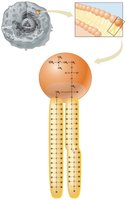
Phospholipids are the main component of cell membranes, with a hydrophilic head and hydrophobic tails.
Steroids
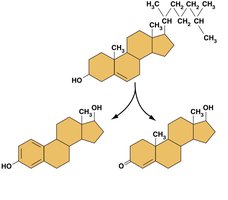
Steroids are composed of four carbon rings. Examples include cholesterol, estrogen, and testosterone.
Proteins: Structure and Function
Amino Acids and Peptide Bonds
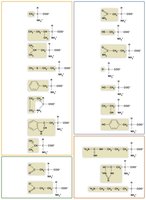
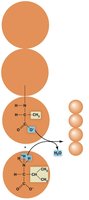
Proteins are polymers of amino acids, joined by peptide bonds formed through dehydration synthesis. There are 20 different amino acids, each with a unique R group.
Levels of Protein Structure
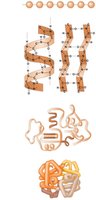
Proteins have four levels of structure:
Primary: Sequence of amino acids
Secondary: Local folding (alpha helix, beta sheet)
Tertiary: Three-dimensional shape
Quaternary: Association of multiple polypeptide chains
Enzymes
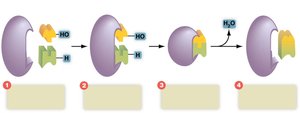
Enzymes are proteins that catalyze biochemical reactions, lowering activation energy and increasing reaction rates.
Nucleic Acids: DNA and RNA
Structure and Function
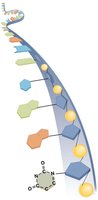
Nucleic acids are polymers of nucleotides, storing and transmitting genetic information. DNA encodes instructions for RNA synthesis; RNA directs protein synthesis.
DNA: Deoxyribonucleic acid
RNA: Ribonucleic acid
Nucleotide Structure
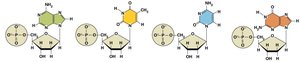
Each nucleotide consists of a five-carbon sugar (ribose or deoxyribose), a nitrogenous base, and a phosphate group.
DNA Structure
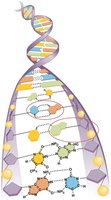
DNA is a double helix with complementary base pairing (A-T, C-G) held together by hydrogen bonds.
RNA Structure
RNA is typically single-stranded, with uracil replacing thymine as a nitrogenous base.
ATP: The Energy Currency of the Cell
Structure and Function of ATP
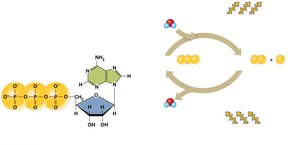
ATP (adenosine triphosphate) is the primary energy carrier in cells. Energy is released by hydrolysis of ATP to ADP and inorganic phosphate.
ATP Hydrolysis:
ATP Synthesis: Energy from food or stored macromolecules is used to regenerate ATP.
Additional info: These notes provide foundational knowledge for understanding cell structure, metabolism, and molecular biology, essential for further study in college-level biology.
