 Back
BackWater and Life: Properties, Structure, and Biological Importance
Study Guide - Smart Notes
 Tailored notes based on your materials, expanded with key definitions, examples, and context.
Water and Life
Overview: The Molecule That Supports All of Life
Water is the essential biological medium on Earth, making up 70–95% of most cells and surrounding them. Its abundance is a primary reason Earth is habitable, and it is unique in existing naturally in all three physical states: solid, liquid, and gas. All living organisms require water more than any other substance.
The Structure of Water Molecules
Polarity and Hydrogen Bonding
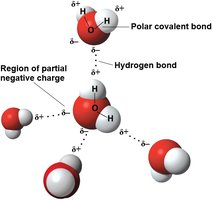
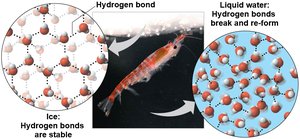
Water molecules are polar, meaning their opposite ends have opposite charges. This polarity enables water molecules to form hydrogen bonds with each other, which are weaker than covalent bonds but crucial for water's properties. Hydrogen bonds break and reform rapidly, giving water a higher organizational structure.
Polar covalent bonds within water molecules create regions of partial positive and negative charge.
Hydrogen bonds form between the hydrogen of one water molecule and the oxygen of another.
These interactions are responsible for water's unique properties.
Emergent Properties of Water
Four Properties That Facilitate Life
Water's structure gives rise to four emergent properties that are critical for life:
Cohesion and adhesion
Ability to moderate temperature
Expansion upon freezing
Versatility as a solvent
Cohesion and Adhesion
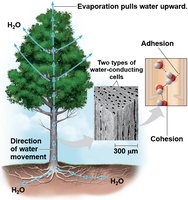
Cohesion refers to the attraction between water molecules due to hydrogen bonding, which helps transport water against gravity in plants. Adhesion is the attraction between water and other substances, such as plant cell walls or the meniscus in a graduated cylinder.
Cohesion enables water transport in plants.
Adhesion assists water movement along surfaces.
Heat and Temperature
Kinetic energy is the energy of motion, and heat is the total kinetic energy due to molecular motion. Temperature measures the intensity of heat, reflecting the average kinetic energy of molecules. Water absorbs and releases heat with minimal temperature change, moderating Earth's climate.
Calorie (cal): Heat required to raise 1 g of water by 1°C.
Joule (J): 1 J = 0.239 cal; 1 cal = 4.184 J.
Water’s High Specific Heat
The specific heat of water is 1 cal/g/°C, much higher than many substances (e.g., stainless steel: 0.11 cal/g/°C). This property is due to hydrogen bonding: heat is absorbed to break bonds and released when bonds form. Water's high specific heat stabilizes temperature, supporting life.
Evaporative Cooling
Evaporation transforms liquid to gas, requiring energy. The heat of vaporization for water is 580 cal/g at 25°C. As water evaporates, the surface cools, stabilizing temperatures in organisms and bodies of water (e.g., sweating).
Insulation by Floating Ice
Ice floats because hydrogen bonds in ice are more ordered, making it less dense than liquid water. Water reaches its greatest density at 4°C. If ice sank, bodies of water would freeze solid, threatening life.
Water as a Solvent
Solution, Solvent, and Solute
A solution is a homogeneous mixture of substances. The solvent is the dissolving agent, and the solute is the substance dissolved. An aqueous solution uses water as the solvent.
Versatility as a Solvent
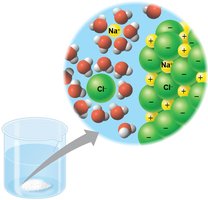
Water's polarity allows it to dissolve ionic compounds and polar molecules. When an ionic compound dissolves, each ion is surrounded by a hydration shell of water molecules.
Dissolving Nonionic Polar Molecules
Water can also dissolve nonionic polar molecules, including large molecules like proteins, if they have ionic and polar regions.
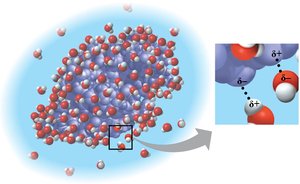
Hydrophilic and Hydrophobic Substances
A hydrophilic substance has an affinity for water, while a hydrophobic substance does not. Oil molecules are hydrophobic due to nonpolar bonds. A colloid is a stable suspension of fine particles in a liquid.
Solute Concentration in Aqueous Solutions
Most biochemical reactions occur in water, and their rates depend on solute concentration. Molarity (M) is the number of moles of solute per liter of solution.
1 mole (mol): 6.02 × 10²³ molecules (Avogadro’s number).
Molecular mass: Sum of all atomic masses in a molecule.
Acidic and Basic Conditions
Dissociation of Water
A hydrogen atom in a hydrogen bond can shift between water molecules, forming hydronium (H3O+) and hydroxide (OH–) ions. This dissociation, though rare, significantly affects biological systems.
pH and Its Effects
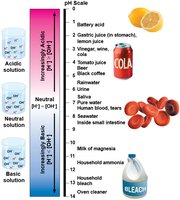
pH measures the concentration of H+ ions in solution. Changes in H+ and OH– concentrations can drastically affect cell chemistry. Acids increase H+ concentration; bases decrease it.
Acid: Increases H+ concentration (e.g., HCl → H+ + Cl–).
Base: Reduces H+ concentration (e.g., NaOH → Na+ + OH–).
The pH Scale
In aqueous solution at 25°C, the product of H+ and OH– concentrations is constant:
Neutral solution: , pH = 7
Acidic solutions have pH < 7; basic solutions have pH > 7. Most biological fluids have pH 6–8. Each pH unit represents a tenfold change in H+ concentration.
Buffers
Buffers minimize changes in H+ and OH– concentrations, maintaining pH near 7 in living cells. Most buffers consist of an acid-base pair that reversibly combines with H+ (e.g., carbonic acid system: ).
Example: Tums as a pH neutralizer.
