Pearson+ LogoPearson+ Logo
Ch. 3 - Is It Possible to Supplement Your Way to Better Performance and Health?
Belk, Maier - Biology: Science for Life 6th Edition
Belk, Maier6th EditionBiology: Science for LifeISBN: 9780135214084Not the one you use?Change textbook
Chapter 3, Problem 3

Macronutrients ________.
a. Include carbohydrates and vitamins.
b. Should make up a small percentage of a healthful diet.
c. Are essential in minute amounts to help enzymes function.
d. Include carbohydrates, fats, and proteins.
e. Are synthesized by cells and not necessary to obtain from the diet.

Verified step by step guidance
1
Step 1: Understand the term 'macronutrients.' Macronutrients are nutrients required in large amounts by the body to provide energy and support bodily functions. These include carbohydrates, fats, and proteins.
Step 2: Analyze the options provided in the question. Option (a) includes vitamins, which are not macronutrients but rather micronutrients. Option (b) states that macronutrients should make up a small percentage of the diet, which is incorrect as they are required in large amounts. Option (c) refers to micronutrients, which are needed in minute amounts to help enzymes function. Option (e) incorrectly states that macronutrients are synthesized by cells and not necessary to obtain from the diet.
Step 3: Focus on option (d), which states that macronutrients include carbohydrates, fats, and proteins. This aligns with the definition of macronutrients as they are the primary sources of energy and are required in large amounts.
Step 4: Eliminate the incorrect options based on the analysis above. Options (a), (b), (c), and (e) do not accurately describe macronutrients.
Step 5: Conclude that the correct answer is option (d), as it correctly identifies carbohydrates, fats, and proteins as macronutrients.

Verified video answer for a similar problem:

This video solution was recommended by our tutors as helpful for the problem above.
Video duration:
49s
Was this helpful?

Key Concepts

Here are the essential concepts you must grasp in order to answer the question correctly.

Macronutrients

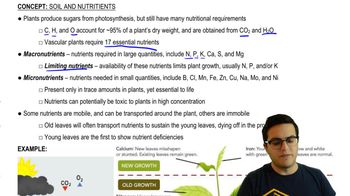
Macronutrients are the nutrients required by the body in large amounts to provide energy and support growth and metabolism. They primarily include carbohydrates, proteins, and fats, which serve as the main sources of energy and are essential for various bodily functions. Unlike micronutrients, which are needed in smaller quantities, macronutrients are crucial for overall health and must be consumed in appropriate proportions.
Recommended video:
Guided course
03:25
Soil Nutrients

Role of Carbohydrates, Fats, and Proteins

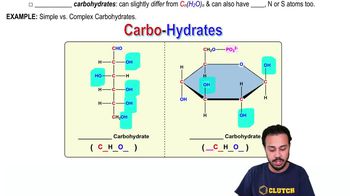
Carbohydrates are the body's primary energy source, while fats provide a concentrated source of energy and are vital for cell structure and hormone production. Proteins are essential for building and repairing tissues, as well as for the production of enzymes and hormones. Understanding the distinct roles of these macronutrients helps in formulating a balanced diet that meets the body's energy and nutritional needs.
Recommended video:
Guided course
04:53
Carbohydrates

Dietary Recommendations

Dietary recommendations suggest that macronutrients should make up a significant portion of daily caloric intake, with specific ratios varying based on individual health goals and activity levels. For a healthful diet, it is important to balance the intake of carbohydrates, fats, and proteins to ensure adequate energy supply and nutrient diversity. This balance supports optimal health and reduces the risk of chronic diseases.
Recommended video:
Guided course
04:26
Post-Translational Modification