Pearson+ LogoPearson+ Logo
Ch. 3 - Is It Possible to Supplement Your Way to Better Performance and Health?
Belk, Maier - Biology: Science for Life 6th Edition
Belk, Maier6th EditionBiology: Science for LifeISBN: 9780135214084Not the one you use?Change textbook
Chapter 3, Problem 6

The main constituents of the plasma membrane are ________.
a. Carbohydrates and lipids
b. Proteins and phospholipids
c. Fats and carbohydrates
d. Fatty acids and nucleic acids

Verified step by step guidance
1
Understand the structure of the plasma membrane: The plasma membrane is a selectively permeable barrier that surrounds the cell, controlling the movement of substances in and out of the cell.
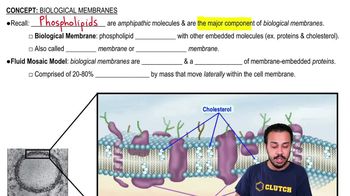
Recall the fluid mosaic model: This model describes the plasma membrane as a dynamic structure composed of various molecules, including lipids, proteins, and carbohydrates, arranged in a mosaic-like pattern.
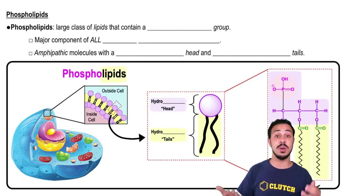
Identify the primary components: The main structural framework of the plasma membrane is formed by a bilayer of phospholipids. These phospholipids have hydrophilic (water-attracting) heads and hydrophobic (water-repelling) tails, which allow the membrane to form a stable barrier in an aqueous environment.
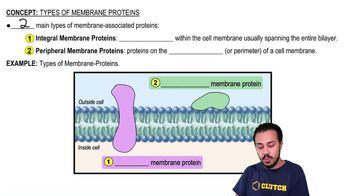
Recognize the role of proteins: Proteins are embedded within or associated with the phospholipid bilayer. They serve various functions, such as transport, signaling, and structural support.
Eliminate incorrect options: Carbohydrates are present in the plasma membrane but are not a primary structural component. Fats, fatty acids, and nucleic acids are not major constituents of the plasma membrane. Therefore, the correct answer is proteins and phospholipids.

Verified video answer for a similar problem:

This video solution was recommended by our tutors as helpful for the problem above.
Video duration:
3m
Was this helpful?

Key Concepts

Here are the essential concepts you must grasp in order to answer the question correctly.

Plasma Membrane Structure

The plasma membrane is a biological barrier that separates the interior of a cell from its external environment. It is primarily composed of a phospholipid bilayer, which provides fluidity and flexibility, allowing for the movement of substances in and out of the cell.
Recommended video:
Guided course
06:04
Biological Membranes

Phospholipids

Phospholipids are a type of lipid molecule that form the fundamental structure of the plasma membrane. Each phospholipid consists of a hydrophilic (water-attracting) 'head' and two hydrophobic (water-repelling) 'tails,' which arrange themselves in a bilayer, creating a semi-permeable membrane.
Recommended video:
Guided course
04:05
Phospholipids

Membrane Proteins

Membrane proteins are integral or peripheral proteins embedded in or associated with the plasma membrane. They play crucial roles in various functions, including transport, signaling, and maintaining the cell's shape, contributing to the overall functionality of the membrane.
Recommended video:
Guided course
02:35
Types of Membrane Proteins
Related Practice