
Pearson+ LogoPearson+ Logo
Ch. 35 Behavioral Adaptations to the Environment
Taylor - Campbell Biology: Concepts & Connections 10th Edition
Taylor, Simon, Dickey, Hogan10th EditionCampbell Biology: Concepts & ConnectionsISBN: 9780136538783Not the one you use?Change textbook
Chapter 35, Problem 8

A chorus of frogs fills the air on a spring evening. The frog calls are courtship signals.
What are the functions of courtship behaviors?
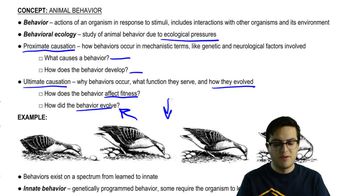
How might a behavioral ecologist explain the proximate cause of this behavior?
The ultimate cause?

Verified step by step guidance
1
Courtship behaviors, such as frog calls, serve the function of attracting mates and ensuring successful reproduction. These behaviors help individuals identify and select suitable partners, often based on specific traits or signals that indicate fitness or compatibility.
A behavioral ecologist would explain the proximate cause of frog calls by examining the immediate physiological or environmental triggers. For example, the proximate cause might involve the activation of vocal cords in response to hormonal changes during the breeding season or environmental cues such as temperature and daylight length.
To understand the ultimate cause, a behavioral ecologist would explore the evolutionary reasons behind the behavior. Frog calls likely evolved because they increase reproductive success by helping males attract mates, thereby passing on their genes to the next generation.
The behavioral ecologist might also study how frog calls are shaped by natural selection. For instance, louder or more complex calls might be favored if they are more effective at attracting mates, leading to greater reproductive success for individuals with those traits.
Finally, the ecologist could investigate how these behaviors contribute to the overall fitness of the species. By ensuring successful mating and reproduction, courtship behaviors like frog calls play a critical role in the survival and continuation of the species.

Verified video answer for a similar problem:

This video solution was recommended by our tutors as helpful for the problem above.
Video duration:
3m
Was this helpful?

Key Concepts

Here are the essential concepts you must grasp in order to answer the question correctly.

Courtship Behaviors

Courtship behaviors are specific actions performed by animals to attract mates. These behaviors can include vocalizations, displays, and physical movements that signal readiness to mate. In frogs, calls serve as a primary method of communication, allowing males to establish territory and attract females. Understanding these behaviors is crucial for studying reproductive strategies and species survival.
Recommended video:

Proximate Causes

Proximate causes refer to the immediate, mechanistic reasons behind a behavior. In the context of frog calls, a behavioral ecologist might explain that hormonal changes triggered by environmental cues, such as temperature and light, lead to increased vocal activity during the breeding season. This biological response is essential for understanding how specific stimuli influence behavior at a physiological level.
Recommended video:
Guided course
02:37
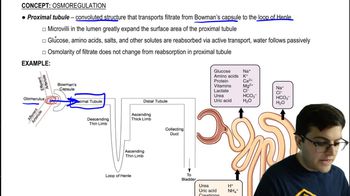
Proximal Tubule

Ultimate Causes

Ultimate causes address the evolutionary reasons behind a behavior, focusing on how it contributes to reproductive success and survival. For frog calls, the ultimate cause may involve attracting mates to ensure gene propagation and enhance genetic diversity. By examining these long-term benefits, ecologists can understand how certain behaviors have evolved and their significance in the context of natural selection.
Recommended video:
Guided course
07:48
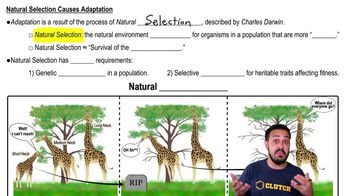
Natural Selection Causes Adaptation
Related Practice
Textbook Question

Some airports have attempted to scare geese off by playing goose alarm calls over loudspeakers. This tactic kept the geese away initially, but soon the geese ignored the alarm calls. How would you explain this outcome?

a. The alarm calls are a social signal that geese ignore unless they can see the other geese.

b. The geese became imprinted on the alarm calls.

c. The geese used spatial learning to navigate the environment of the airport.

d. The geese became habituated to the alarm calls when no danger was present.

813
views
Textbook Question
Almost all the behaviors of a housefly are innate. What are some advantages and disadvantages to the fly of innate behaviors compared with behaviors that are mainly learned?
833
views
Textbook Question
In Module 35.3, you learned that Norway rat offspring whose mothers don't interact much with them grow up to be fearful and anxious in new situations. Suggest a possible ultimate cause for this link between maternal behavior and stress response of offspring. (Hint: Under what circumstances might high reactivity to stress be more adaptive than being relaxed?)
1099
views
Textbook Question

Crows break the shells of certain molluscs before eating them by dropping them onto rocks. Hypothesizing that crows drop the molluscs from a height that gives the most food for the least effort (optimal foraging), a researcher dropped shells from different heights and counted the drops it took to break them. a. The researcher measured the average drop height for crows and found that it was 5.23 m. Does this support the researcher's hypothesis? Explain. b. Describe an experiment to determine whether dropping molluscs from an optimal height is learned or innate.

835
views
Textbook Question
Scientists studying scrub jays found that it is common for 'helpers' to assist mated pairs of birds in raising their young. The helpers lack territories and mates of their own. Instead, they help the territory owners gather food for their offspring. Propose a hypothesis to explain what advantage there might be for the helpers to engage in this behavior instead of seeking their own territories and mates. How would you test your hypothesis? If your hypothesis is correct, what kind of results would you expect your tests to yield?
1171
views
Textbook Question

Researchers are very interested in studying identical twins who were raised apart. Among other things, they hope to answer questions about the roles of inheritance and upbringing in human behavior.

Why do identical twins make such good subjects for this kind of research?

What do the results of such studies suggest to you? What are the potential pitfalls of this research?

What abuses might occur in the use of these data if the studies are not evaluated critically?

943
views