Pearson+ LogoPearson+ Logo
Ch. 35 Behavioral Adaptations to the Environment
Taylor - Campbell Biology: Concepts & Connections 10th Edition
Taylor, Simon, Dickey, Hogan10th EditionCampbell Biology: Concepts & ConnectionsISBN: 9780136538783Not the one you use?Change textbook
Chapter 35, Problem 6

Almost all the behaviors of a housefly are innate. What are some advantages and disadvantages to the fly of innate behaviors compared with behaviors that are mainly learned?

Verified step by step guidance
1
Identify the definition of innate behaviors, which are behaviors that are genetically hardwired and performed without prior experience or training.
Discuss the advantages of innate behaviors for a housefly, such as immediate functionality from birth, which is crucial for survival in their typically short lifespan.
Consider the reliability and predictability of innate behaviors, which ensure consistent responses to environmental stimuli, aiding in basic functions like feeding and escaping predators.
Examine the disadvantages of innate behaviors, including the lack of flexibility and adaptability to new or changing environments, which could be detrimental if the fly encounters unfamiliar threats or changes in its ecosystem.
Compare these innate behaviors with learned behaviors, which involve adaptation and changes based on experience, potentially offering more versatility but requiring time and energy to develop.

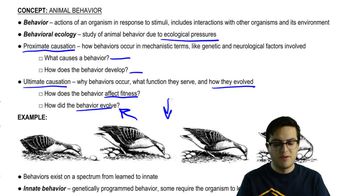
Verified video answer for a similar problem:

This video solution was recommended by our tutors as helpful for the problem above.
Video duration:
4m
Was this helpful?

Key Concepts

Here are the essential concepts you must grasp in order to answer the question correctly.

Innate Behaviors

Innate behaviors are instinctual actions that organisms are born with, requiring no prior experience or learning. These behaviors are typically hardwired in the nervous system and are crucial for survival, such as reflexes and mating rituals. For houseflies, innate behaviors allow for quick responses to environmental stimuli, enhancing their chances of survival in unpredictable situations.
Recommended video:

Learned Behaviors

Learned behaviors are actions acquired through experience and interaction with the environment. Unlike innate behaviors, these require practice and can be modified based on past outcomes. For houseflies, learned behaviors can include navigating complex environments or avoiding predators, which may provide advantages in adapting to changing conditions.
Recommended video:

Advantages and Disadvantages

The advantages of innate behaviors include speed and reliability, as they do not require prior experience, allowing for immediate responses to threats. However, the disadvantage is a lack of flexibility, as these behaviors may not adapt well to new or changing environments. In contrast, learned behaviors offer adaptability and problem-solving skills but require time and experience to develop, which can be a disadvantage in urgent situations.
Recommended video:
Guided course
03:29
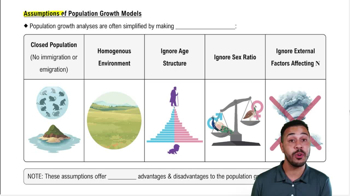
Assumptions of Population Growth Models
Related Practice
Textbook Question

Pheasants do not feed their chicks. Immediately after hatching, a pheasant chick starts pecking at seeds and insects on the ground. How might a behavioral ecologist explain the ultimate cause of this behavior?

a. Pecking is an innate behavior

b. Pheasants learned to peck, and their offspring inherited this behavior

c. Pecking by newly hatched chicks is the result of trial-and-error learning

d. Pecking is a result of imprinting during a sensitive period.

751
views
Textbook Question

A male redwing blackbird will chase predatory birds away from his breeding territory during nesting season. Which hypothesis best explains his behavior?

a. He is acting for the good of the species. He may die, but other birds of his species will be saved.

b. He knows this will increase his fitness, so he chases away the predator.

c. He carries a gene that causes fathers to protect their offspring, which increases inclusive fitness.

d. He has imprinted on the offspring in his nest, so he knows that they are his.

738
views
Textbook Question

Some airports have attempted to scare geese off by playing goose alarm calls over loudspeakers. This tactic kept the geese away initially, but soon the geese ignored the alarm calls. How would you explain this outcome?

a. The alarm calls are a social signal that geese ignore unless they can see the other geese.

b. The geese became imprinted on the alarm calls.

c. The geese used spatial learning to navigate the environment of the airport.

d. The geese became habituated to the alarm calls when no danger was present.

813
views
Textbook Question
In Module 35.3, you learned that Norway rat offspring whose mothers don't interact much with them grow up to be fearful and anxious in new situations. Suggest a possible ultimate cause for this link between maternal behavior and stress response of offspring. (Hint: Under what circumstances might high reactivity to stress be more adaptive than being relaxed?)
1099
views
Textbook Question

A chorus of frogs fills the air on a spring evening. The frog calls are courtship signals.

What are the functions of courtship behaviors?

How might a behavioral ecologist explain the proximate cause of this behavior?

The ultimate cause?

881
views
Textbook Question

Crows break the shells of certain molluscs before eating them by dropping them onto rocks. Hypothesizing that crows drop the molluscs from a height that gives the most food for the least effort (optimal foraging), a researcher dropped shells from different heights and counted the drops it took to break them. a. The researcher measured the average drop height for crows and found that it was 5.23 m. Does this support the researcher's hypothesis? Explain. b. Describe an experiment to determine whether dropping molluscs from an optimal height is learned or innate.

835
views