Pearson+ LogoPearson+ Logo
Ch. 34 The Biosphere: An Introduction to Earth's Diverse Environments
Taylor - Campbell Biology: Concepts & Connections 10th Edition
Taylor, Simon, Dickey, Hogan10th EditionCampbell Biology: Concepts & ConnectionsISBN: 9780136538783Not the one you use?Change textbook
Chapter 34, Problem 13

Phytoplankton are the major photosynthesizers in
a. The benthic realm of the ocean
b. The ocean photic zone
c. The intertidal zone
d. The aphotic zone of a lake

Verified step by step guidance
1
Understand the key terms in the question: Phytoplankton are microscopic organisms that perform photosynthesis, meaning they require sunlight to produce energy.
Recall the definition of the 'photic zone': It is the upper layer of a body of water where sunlight penetrates, allowing photosynthesis to occur. This is where phytoplankton thrive.
Review the options provided: (a) The benthic realm refers to the bottom of a body of water, which often lacks sufficient light for photosynthesis. (b) The ocean photic zone is the sunlit region of the ocean. (c) The intertidal zone is the area between high and low tide, which may not always be submerged in water. (d) The aphotic zone is the deep part of a body of water where sunlight does not reach, making photosynthesis impossible.
Eliminate incorrect options: Phytoplankton cannot survive in the benthic realm (a) or the aphotic zone (d) due to the lack of sunlight. The intertidal zone (c) is not a primary habitat for phytoplankton because it is not consistently submerged in water.
Conclude that the correct answer is (b) the ocean photic zone, as it provides the necessary sunlight for phytoplankton to perform photosynthesis.

Verified video answer for a similar problem:

This video solution was recommended by our tutors as helpful for the problem above.
Video duration:
2m
Was this helpful?

Key Concepts

Here are the essential concepts you must grasp in order to answer the question correctly.

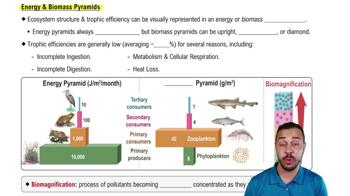
Phytoplankton

Phytoplankton are microscopic, photosynthetic organisms found in aquatic environments. They are crucial to the marine food web, serving as the primary producers that convert sunlight into energy through photosynthesis. This process not only supports the growth of phytoplankton but also produces oxygen and forms the base of the oceanic food chain.
Recommended video:
Guided course
05:41
Energy & Biomass Pyramids

Photic Zone

The photic zone is the upper layer of a body of water where sunlight penetrates, allowing photosynthesis to occur. Typically extending to about 200 meters deep in the ocean, this zone is vital for the growth of phytoplankton, as they require light to produce energy. The depth and clarity of water can affect the extent of the photic zone, influencing the distribution of marine life.
Recommended video:
04:38
Hybrid Zones

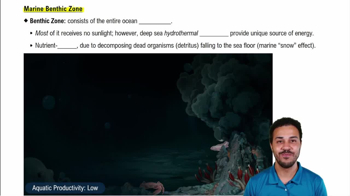
Benthic Realm

The benthic realm refers to the ecological region at the lowest level of a body of water, including the sediment surface and sub-surface layers. Unlike the photic zone, the benthic realm is often devoid of light, making it unsuitable for photosynthesis. Organisms in this zone primarily rely on detritus and other organic matter for energy, contrasting with the primary production that occurs in the photic zone.
Recommended video:
Guided course
01:47
Marine Benthic Zone