Pearson+ LogoPearson+ Logo
Ch. 25 Control of Body Temperature and Water Balance
Taylor - Campbell Biology: Concepts & Connections 10th Edition
Taylor, Simon, Dickey, Hogan10th EditionCampbell Biology: Concepts & ConnectionsISBN: 9780136538783Not the one you use?Change textbook
Chapter 25, Problem 21

For the experiment detailed in Module 25.3, describe the control and experimental groups, state the dependent variable being measured, and summarize the result.

Verified step by step guidance
1
Identify the control group: The control group in an experiment is the group that does not receive the experimental treatment or is exposed to standard conditions. Review the details of Module 25.3 to determine which group serves as the baseline for comparison.
Identify the experimental group: The experimental group is the group that receives the treatment or condition being tested. Look for the group in Module 25.3 that is exposed to the variable being manipulated.
Determine the dependent variable: The dependent variable is the factor being measured or observed in the experiment. Examine the experiment's design in Module 25.3 to identify what outcome is being recorded as a result of the treatment.
Summarize the result: Review the findings of the experiment in Module 25.3 and summarize the key outcome, focusing on how the dependent variable differed between the control and experimental groups.
Ensure clarity in the explanation: Clearly distinguish between the control and experimental groups, explicitly state the dependent variable, and provide a concise summary of the result to ensure a comprehensive understanding of the experiment.

Verified video answer for a similar problem:

This video solution was recommended by our tutors as helpful for the problem above.
Video duration:
34s
Was this helpful?

Key Concepts

Here are the essential concepts you must grasp in order to answer the question correctly.

Control and Experimental Groups

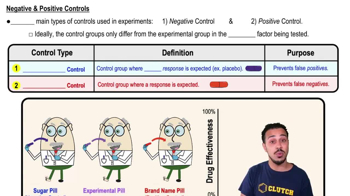
In scientific experiments, the control group serves as a baseline, remaining unchanged to compare against the experimental group, which is subjected to the variable being tested. This distinction is crucial for isolating the effects of the independent variable, allowing researchers to draw valid conclusions about the relationship between the variable and the observed outcomes.
Recommended video:
Guided course
07:42
Negative & Positive Controls

Dependent Variable

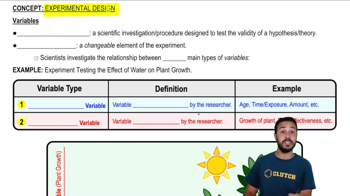
The dependent variable is the outcome that researchers measure in an experiment to assess the effect of the independent variable. It is dependent on the changes made to the independent variable, and identifying it is essential for understanding what the experiment aims to evaluate, as it provides the data needed to support or refute the hypothesis.
Recommended video:

Summarizing Results

Summarizing results involves clearly articulating the findings of an experiment, including any trends, patterns, or significant differences observed between the control and experimental groups. This step is vital for interpreting the data, drawing conclusions, and communicating the implications of the research, which can inform future studies or practical applications.
Recommended video:
Guided course
00:43
Population Demography
Related Practice
Textbook Question
Two endothermic animals are the same size, but one is a carnivore and the other is an herbivore. Predict which of these animals would produce the greatest amount of nitrogenous wastes. Explain.
968
views
Textbook Question
Some diuretics are on a list of substances that the International Olympic Committee has banned for use by athletes. What do diuretics do? Propose an explanation for how diuretic use could be an unfair advantage for a competitor in a sport like wrestling, in which weight classes are part of the competition.
813
views
Textbook Question
You are studying a large tropical reptile that has a high and relatively stable body temperature. How would you determine whether this animal is an endotherm or an ectotherm?
950
views
Textbook Question
Dolphins have an insulating layer of blubber that protects them from cold water, but their flippers are not insulated. Propose a hypothesis to explain why dolphin flippers do not freeze. Describe an experiment you could do to test your hypothesis. (You may assume you have equipment for measuring temperatures in dolphin flippers.) What results would you expect if your hypothesis is correct?
910
views
Textbook Question
In 1847, the German biologist Christian Bergmann noted that mammals and birds living at higher latitudes (farther from the equator) are on average larger and bulkier than related species living at lower latitudes. Suggest an evolutionary hypothesis to explain this observation.
859
views
Textbook Question
Kidneys were the first organs to be transplanted successfully. A donor can live a normal life with a single kidney, making it possible for individuals to donate a kidney to an ailing relative or even an unrelated individual. In some countries, poor people sell kidneys to transplant recipients through organ brokers. What are the pros and cons associated with organ commerce?
809
views