Pearson+ LogoPearson+ Logo
Ch. 6 How Cells Harvest Chemical Energy
Taylor - Campbell Biology: Concepts & Connections 10th Edition
Taylor, Simon, Dickey, Hogan10th EditionCampbell Biology: Concepts & ConnectionsISBN: 9780136538783Not the one you use?Change textbook
Chapter 6, Problem 2

A biochemist wanted to study how various substances were used in cellular respiration. In one experiment, she allowed a mouse to breathe air containing O₂ 'labeled' by a particular isotope. In the mouse, the labeled oxygen first showed up in
a. ATP
b. NADH
c. CO₂
d. H₂O

Verified step by step guidance
1
Step 1: Begin by understanding the process of cellular respiration. Cellular respiration is the process by which cells convert glucose and oxygen into energy (ATP), carbon dioxide (CO2), and water (H2O). It involves several stages: glycolysis, the citric acid cycle (Krebs cycle), and oxidative phosphorylation.
Step 2: Focus on the role of oxygen (O2) in cellular respiration. Oxygen is primarily used in the final stage, oxidative phosphorylation, where it acts as the terminal electron acceptor in the electron transport chain. This process occurs in the mitochondria.
Step 3: Analyze what happens to oxygen during oxidative phosphorylation. Oxygen combines with electrons and protons (H+) to form water (H2O). This is a critical step in maintaining the flow of electrons through the electron transport chain and enabling ATP production.
Step 4: Consider the labeled oxygen isotope. If the mouse breathes air containing labeled oxygen, the isotope will be incorporated into the water molecules produced during oxidative phosphorylation, as oxygen is directly involved in forming H2O.
Step 5: Eliminate the other options. ATP is synthesized during cellular respiration but does not directly incorporate oxygen. NADH is an electron carrier and does not involve oxygen incorporation. CO2 is produced during the citric acid cycle but originates from the carbon in glucose, not oxygen. Therefore, the labeled oxygen will first appear in H2O.

Verified video answer for a similar problem:

This video solution was recommended by our tutors as helpful for the problem above.
Video duration:
33s
Was this helpful?

Key Concepts

Here are the essential concepts you must grasp in order to answer the question correctly.

Cellular Respiration

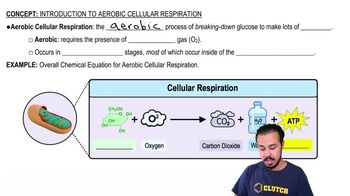
Cellular respiration is a metabolic process that converts biochemical energy from nutrients into adenosine triphosphate (ATP), and releases waste products. It involves several stages, including glycolysis, the citric acid cycle, and oxidative phosphorylation, where oxygen plays a crucial role as the final electron acceptor in the electron transport chain.
Recommended video:
Guided course
03:39
Introduction to Cellular Respiration

Isotopes in Biological Research

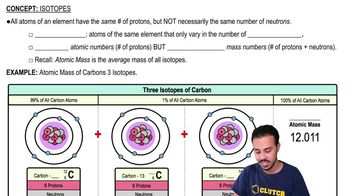
Isotopes are variants of a particular chemical element that have the same number of protons but different numbers of neutrons. In biological research, isotopes can be used as tracers to study metabolic processes, as they allow scientists to track the movement and transformation of substances within living organisms, such as the labeled oxygen in this experiment.
Recommended video:

Products of Cellular Respiration

The main products of cellular respiration include ATP, carbon dioxide (CO2), and water (H2O). During the process, glucose is oxidized, and oxygen is reduced, leading to the formation of CO2 and H2O as byproducts. Understanding these products is essential for determining how labeled oxygen would appear in the metabolic pathways of the mouse.
Recommended video:
Guided course
03:39
Introduction to Cellular Respiration