Pearson+ LogoPearson+ Logo
Ch. 6 How Cells Harvest Chemical Energy
Taylor - Campbell Biology: Concepts & Connections 10th Edition
Taylor, Simon, Dickey, Hogan10th EditionCampbell Biology: Concepts & ConnectionsISBN: 9780136538783Not the one you use?Change textbook
Chapter 6, Problem 4

Most of the CO₂ from cellular respiration is released during
a. Stage 1: Glycolysis
b. Stage 2: Pyruvate oxidation
c. Stage 2: The citric acid cycle
d. Stage 3: Oxidative phosphorylation

Verified step by step guidance
1
Understand the stages of cellular respiration: Cellular respiration consists of three main stages: glycolysis, pyruvate oxidation (including the citric acid cycle), and oxidative phosphorylation. Each stage has distinct roles in energy production and carbon dioxide release.
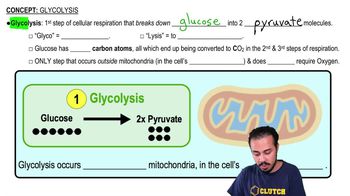
Recall the role of glycolysis: Glycolysis occurs in the cytoplasm and breaks down glucose into two molecules of pyruvate. This process does not release CO2 because glucose is only partially oxidized.
Examine pyruvate oxidation: Pyruvate oxidation occurs in the mitochondria, where pyruvate is converted into acetyl-CoA. During this process, one molecule of CO2 is released per pyruvate molecule, but this is not the primary stage where most CO2 is released.
Analyze the citric acid cycle: The citric acid cycle (also known as the Krebs cycle) occurs in the mitochondrial matrix. Acetyl-CoA is fully oxidized, releasing two molecules of CO2 per cycle. This is the stage where most of the CO2 from cellular respiration is released.
Consider oxidative phosphorylation: Oxidative phosphorylation involves the electron transport chain and chemiosmosis, which generate ATP. This stage does not release CO2, as it focuses on energy production rather than carbon oxidation.

Verified video answer for a similar problem:

This video solution was recommended by our tutors as helpful for the problem above.
Video duration:
4m
Was this helpful?

Key Concepts

Here are the essential concepts you must grasp in order to answer the question correctly.

Cellular Respiration

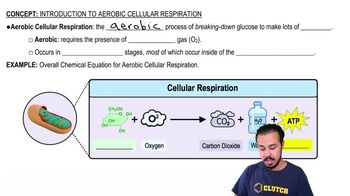
Cellular respiration is the metabolic process by which cells convert glucose and oxygen into energy, carbon dioxide, and water. It consists of several stages, including glycolysis, pyruvate oxidation, the citric acid cycle, and oxidative phosphorylation. Understanding this process is crucial for identifying where CO2 is produced and released.
Recommended video:
Guided course
03:39
Introduction to Cellular Respiration

Citric Acid Cycle

The citric acid cycle, also known as the Krebs cycle, is a key component of cellular respiration that occurs in the mitochondria. It processes acetyl-CoA derived from pyruvate and generates high-energy electron carriers, while releasing CO2 as a byproduct. This cycle is significant for understanding the main source of CO2 during cellular respiration.
Recommended video:

Glycolysis

Glycolysis is the first stage of cellular respiration, occurring in the cytoplasm, where glucose is broken down into pyruvate, producing a small amount of ATP and NADH. Importantly, glycolysis does not produce CO2; thus, it is essential to differentiate it from later stages where CO2 is released.
Recommended video:
Related Practice
Textbook Question

Fill in the blanks in this summary map to help you review the key concepts of cellular respiration.

<IMAGE>

2516
views
Textbook Question

A biochemist wanted to study how various substances were used in cellular respiration. In one experiment, she allowed a mouse to breathe air containing O₂ 'labeled' by a particular isotope. In the mouse, the labeled oxygen first showed up in

a. ATP

b. NADH

c. CO₂

d. H₂O

1807
views
Textbook Question

In glycolysis, ________ is oxidized and ________ is reduced.

a. NAD+ ... glucose

b. Glucose ... oxygen

c. ATP ... ADP

d. Glucose ... NAD+

3017
views
Textbook Question

Which of the following is the most immediate source of energy for making most of the ATP in your cells?

a. The transfer of from intermediate substrates to ADP

b. The movement of H⁺ across a membrane down its concentration gradient

c. The splitting of glucose into two molecules of pyruvate

d. Electrons moving through the electron transport chain

1532
views
Textbook Question

Which of the following is a distinction between cellular respiration and fermentation?

a. The transfer of from intermediate substrates to ADP

b. The movement of H+ across a membrane down its concentration gradient

c. The splitting of glucose into two molecules of pyruvate

d. Electrons moving through the electron transport chain

1287
views
Textbook Question

The poison cyanide binds to an electron carrier within the electron transport chain and blocks the movement of electrons. When this happens, glycolysis and the citric acid cycle soon grind to a halt as well. Why do you think these other two stages of cellular respiration stop? (Explain your answer.)

a. They run out of ATP

b. Unused O₂ interferes with cellular respiration

c. They run out of NAD+ and FAD

d. Electrons are no longer available

6154
views