Pearson+ LogoPearson+ Logo
Ch. 6 How Cells Harvest Chemical Energy
Taylor - Campbell Biology: Concepts & Connections 10th Edition
Taylor, Simon, Dickey, Hogan10th EditionCampbell Biology: Concepts & ConnectionsISBN: 9780136538783Not the one you use?Change textbook
Chapter 6, Problem 16

ATP synthase enzymes are found in the prokaryotic plasma membrane and in the inner membrane of a mitochondrion.
What does this suggest about the evolutionary relationship of this eukaryotic organelle to prokaryotes?

Verified step by step guidance
1
Understand the role of ATP synthase: ATP synthase is an enzyme responsible for synthesizing ATP (adenosine triphosphate), the primary energy currency of the cell, using a proton gradient across a membrane.
Recognize the locations of ATP synthase: In prokaryotes, ATP synthase is located in the plasma membrane, while in eukaryotes, it is found in the inner membrane of mitochondria. This suggests a functional similarity between the two systems.
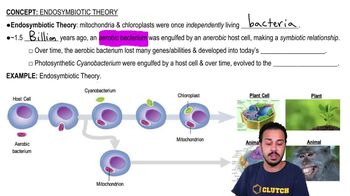
Consider the endosymbiotic theory: The presence of ATP synthase in the inner mitochondrial membrane supports the idea that mitochondria evolved from an ancestral prokaryotic cell that was engulfed by a larger host cell. This theory explains the evolutionary relationship between mitochondria and prokaryotes.
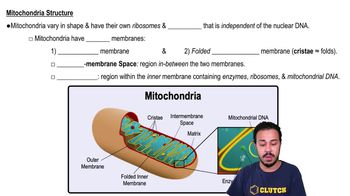
Analyze structural and functional similarities: Mitochondria share several features with prokaryotes, such as their double membrane structure, circular DNA, and ribosomes, which further support the evolutionary link suggested by the presence of ATP synthase.
Conclude the evolutionary implication: The presence of ATP synthase in both prokaryotes and mitochondria indicates that mitochondria likely originated from a prokaryotic ancestor, reinforcing the idea that eukaryotic cells evolved through symbiosis with prokaryotic organisms.

Verified video answer for a similar problem:

This video solution was recommended by our tutors as helpful for the problem above.
Video duration:
2m
Was this helpful?

Key Concepts

Here are the essential concepts you must grasp in order to answer the question correctly.

Endosymbiotic Theory

The endosymbiotic theory posits that eukaryotic cells evolved through a symbiotic relationship between early prokaryotic cells. It suggests that mitochondria, which have their own DNA and replicate independently, originated from free-living prokaryotes that were engulfed by ancestral eukaryotic cells, leading to a mutually beneficial relationship.
Recommended video:
Guided course
06:58
Endosymbiotic Theory

ATP Synthase Function

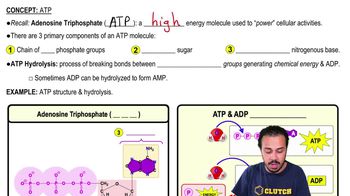
ATP synthase is an enzyme that plays a critical role in cellular respiration and photosynthesis by synthesizing adenosine triphosphate (ATP), the primary energy currency of the cell. Its presence in both prokaryotic plasma membranes and eukaryotic mitochondria indicates a shared evolutionary mechanism for energy production, highlighting the functional similarities between these organisms.
Recommended video:

Mitochondrial DNA

Mitochondrial DNA (mtDNA) is distinct from nuclear DNA and is inherited maternally. The presence of mtDNA in mitochondria supports the idea of their prokaryotic origins, as it resembles bacterial DNA in structure and replication. This genetic evidence reinforces the evolutionary link between mitochondria and prokaryotes, suggesting a common ancestry.
Recommended video:
Guided course
04:45
Mitochondria Structure
Related Practice
Textbook Question

Your body makes NAD+ and FAD from two B vitamins, niacin and riboflavin. The Recommended Dietary Allowance is 20 mg for niacin and 1.7 mg for riboflavin. These amounts are thousands of times less than the amount of glucose your body needs each day to fuel its energy needs.

Why is the daily requirement for these vitamins so small?

2814
views
Textbook Question

Oxidative phosphorylation involves the flow of both electrons and H+. Explain the roles of these movements in the synthesis of ATP.

1726
views
Textbook Question

In the citric acid cycle, an enzyme oxidizes malate to oxaloacetate, with the production of NADH and the release of H+. You are studying this reaction using a suspension of bean cell mitochondria and a blue dye that loses its color as it takes up H+. You set up reaction mixtures with mitochondria, dye, and three different concentrations of malate (0.1 mg/L, 0.2 mg/L, and 0.3 mg/L).

Which of the following graphs represents the results you would expect, and why?


1812
views
Textbook Question

Several studies have found a correlation between the activity levels of brown fat tissue in research participants following exposure to cold and their percentage of body fat. Devise a graph that would present the results from such a study, labeling the axes and drawing a line to show whether the results show a positive or negative correlation between the variables. Propose two hypotheses that could explain these results.

1028
views
Textbook Question

For a short time in the 1930s, some physicians prescribed low doses of a compound called dinitrophenol (DNP) to help patients lose weight. This unsafe method was abandoned after some patients died. DNP uncouples the chemiosmotic machinery by making the inner mitochondrial membrane leaky to H+.

Explain how this drug could cause profuse sweating, weight loss, and possibly death.

2045
views