Pearson+ LogoPearson+ Logo
Ch. 6 How Cells Harvest Chemical Energy
Taylor - Campbell Biology: Concepts & Connections 10th Edition
Taylor, Simon, Dickey, Hogan10th EditionCampbell Biology: Concepts & ConnectionsISBN: 9780136538783Not the one you use?Change textbook
Chapter 6, Problem 14

Oxidative phosphorylation involves the flow of both electrons and H+. Explain the roles of these movements in the synthesis of ATP.

Verified step by step guidance
1
Understand the concept of oxidative phosphorylation: It is the final stage of cellular respiration, occurring in the inner mitochondrial membrane, where ATP is synthesized using energy derived from the movement of electrons and protons (H+).
Describe the electron transport chain (ETC): Electrons are transferred through a series of protein complexes (Complex I, II, III, and IV) embedded in the inner mitochondrial membrane. These electrons originate from NADH and FADH₂, which are produced during earlier stages of cellular respiration.
Explain the role of electron movement: As electrons flow through the ETC, they release energy at each step. This energy is used to pump H+ ions from the mitochondrial matrix into the intermembrane space, creating a proton gradient (high concentration of H+ in the intermembrane space and low concentration in the matrix).
Discuss the proton gradient and chemiosmosis: The proton gradient creates potential energy, referred to as the proton motive force. H+ ions flow back into the mitochondrial matrix through ATP synthase, a protein complex that acts as a channel and enzyme. This movement of H+ drives the synthesis of ATP from ADP and inorganic phosphate (Pi).
Summarize the coupling of electron and proton movements: The flow of electrons through the ETC provides the energy to establish the proton gradient, and the flow of H+ through ATP synthase directly powers the production of ATP. This process is an example of energy coupling in cellular respiration.

Verified video answer for a similar problem:

This video solution was recommended by our tutors as helpful for the problem above.
Video duration:
4m
Was this helpful?

Key Concepts

Here are the essential concepts you must grasp in order to answer the question correctly.

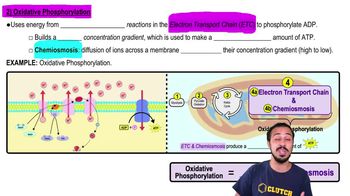
Oxidative Phosphorylation

Oxidative phosphorylation is a metabolic pathway that occurs in the mitochondria, where ATP is produced as a result of the transfer of electrons through the electron transport chain. This process is coupled with the movement of protons (H+) across the inner mitochondrial membrane, creating a proton gradient that drives ATP synthesis.
Recommended video:
Guided course
06:27
Oxidative Phosphorylation

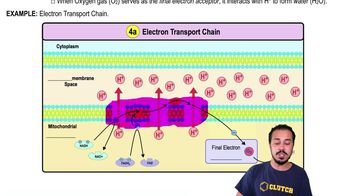
Electron Transport Chain

The electron transport chain (ETC) is a series of protein complexes located in the inner mitochondrial membrane that facilitate the transfer of electrons derived from NADH and FADH2. As electrons move through the chain, they release energy, which is used to pump protons from the mitochondrial matrix into the intermembrane space, establishing a proton gradient essential for ATP production.
Recommended video:
Guided course
07:41
Electron Transport Chain

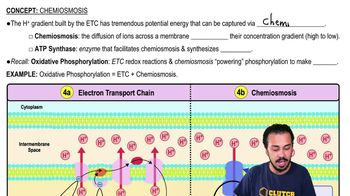
Chemiosmosis

Chemiosmosis refers to the process by which ATP is synthesized in mitochondria, driven by the flow of protons back into the mitochondrial matrix through ATP synthase. This enzyme harnesses the energy from the proton gradient created by the electron transport chain to convert ADP and inorganic phosphate into ATP, effectively linking the movement of electrons and protons to energy production.
Recommended video:
Related Practice
Textbook Question

Explain how your body can convert excess carbohydrates in the diet to fats.

Can excess carbohydrates be converted to protein?

What else must be supplied?

2155
views
Textbook Question

An average adult human requires 2,200 kcal of energy per day. Suppose your diet provides an average of 2,300 kcal per day. How many hours per week would you have to walk to burn off the extra calories? Swim? Run? (See Figure 6.4.)

<IMAGE>

1436
views
Textbook Question

Your body makes NAD+ and FAD from two B vitamins, niacin and riboflavin. The Recommended Dietary Allowance is 20 mg for niacin and 1.7 mg for riboflavin. These amounts are thousands of times less than the amount of glucose your body needs each day to fuel its energy needs.

Why is the daily requirement for these vitamins so small?

2814
views
Textbook Question

In the citric acid cycle, an enzyme oxidizes malate to oxaloacetate, with the production of NADH and the release of H+. You are studying this reaction using a suspension of bean cell mitochondria and a blue dye that loses its color as it takes up H+. You set up reaction mixtures with mitochondria, dye, and three different concentrations of malate (0.1 mg/L, 0.2 mg/L, and 0.3 mg/L).

Which of the following graphs represents the results you would expect, and why?


1812
views
Textbook Question

ATP synthase enzymes are found in the prokaryotic plasma membrane and in the inner membrane of a mitochondrion.

What does this suggest about the evolutionary relationship of this eukaryotic organelle to prokaryotes?

2127
views
Textbook Question

Several studies have found a correlation between the activity levels of brown fat tissue in research participants following exposure to cold and their percentage of body fat. Devise a graph that would present the results from such a study, labeling the axes and drawing a line to show whether the results show a positive or negative correlation between the variables. Propose two hypotheses that could explain these results.

1028
views