

Pearson+ LogoPearson+ Logo
Ch. 38 Conservation Biology
Taylor - Campbell Biology: Concepts & Connections 10th Edition
Taylor, Simon, Dickey, Hogan10th EditionCampbell Biology: Concepts & ConnectionsISBN: 9780136538783Not the one you use?Change textbook
Chapter 38, Problem 10

What are 'greenhouse gases'? Why are they important to life on Earth?

Verified step by step guidance
1
Understand that greenhouse gases are gases in Earth's atmosphere that trap heat. They let sunlight in but prevent some of the heat that the sunlight brings from leaving the atmosphere.
Identify the main greenhouse gases which include carbon dioxide (CO2), methane (CH4), nitrous oxide (N2O), and water vapor (H2O). These gases are naturally occurring but can be increased by human activities such as burning fossil fuels and deforestation.
Recognize the role of greenhouse gases in the greenhouse effect, which is a natural process that warms the Earth’s surface. Without these gases, Earth's surface would be on average about 33 degrees Celsius cooler, making it difficult for current life forms to survive.
Discuss the importance of greenhouse gases in maintaining a stable climate and temperature range that supports life on Earth. They help to keep the temperatures on Earth within a range that is suitable for ecosystems to thrive and for life to exist.
Consider the impact of increased greenhouse gas concentrations due to human activities, leading to enhanced greenhouse effect and global warming. This can lead to climate change, which can disrupt ecosystems and human societies.

Verified video answer for a similar problem:

This video solution was recommended by our tutors as helpful for the problem above.
Video duration:
1m
Was this helpful?

Key Concepts

Here are the essential concepts you must grasp in order to answer the question correctly.

Greenhouse Gases

Greenhouse gases are atmospheric gases that trap heat from the Earth's surface, preventing it from escaping into space. The primary greenhouse gases include carbon dioxide (CO2), methane (CH4), and nitrous oxide (N2O). These gases are crucial for maintaining the Earth's temperature, creating a stable climate that supports life.
Recommended video:
Guided course
07:48
Diffusion of Gases

Greenhouse Effect

The greenhouse effect is the process by which greenhouse gases absorb and re-radiate infrared radiation, leading to an increase in the Earth's surface temperature. This natural phenomenon is essential for life, as it keeps the planet warm enough to sustain ecosystems. However, human activities have intensified this effect, contributing to global warming.
Recommended video:
Guided course
04:52
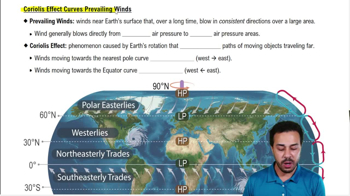
Coriolis Effect Curves Prevailing Winds

Climate Change

Climate change refers to significant alterations in temperature, precipitation, and other atmospheric conditions over extended periods. The increase in greenhouse gases due to human activities, such as burning fossil fuels and deforestation, has accelerated climate change, leading to severe environmental impacts, including extreme weather events and habitat loss, which threaten biodiversity and human life.
Recommended video:
Guided course
03:36
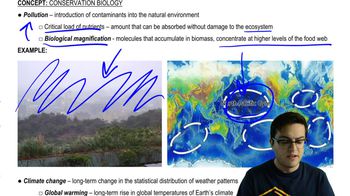
Pollution and Climate Change
Related Practice
Textbook Question

With limited resources, conservation biologists need to prioritize their efforts. Of the following choices, which should receive the greatest attention for the goal of conserving biodiversity?

a. A commercially important species

b. All endangered vertebrate species

c. A declining keystone species in a community

d. All endangered species

1317
views
Textbook Question
Which of the following statements about protected areas is not correct?a. We now protect 25% of the land areas of the planet.b. National parks are only one type of protected area.c. Most reserves are smaller in size than the ranges of some of the species they are meant to protect.d. Management of protected areas must coordinate with the management of lands outside the protected zone.
965
views
Textbook Question
What are the three levels of biological diversity? Explain how human activities threaten each of these levels.
1601
views
Textbook Question

What are the causes and possible consequences of climate change?

Why is international cooperation necessary if we are to solve this problem?

1962
views
Textbook Question

The human-generated increase in greenhouse gases (see Module 38.3) provides many opportunities to study the effects of climate change. For example, snowshoe hares are adapted to the climate of their habitat in the taiga of the high mountains and northern regions of North America. One adaptation is seasonal changes in fur color—a white winter coat that turns brown in the spring—that camouflage hares from a long list of predators. These color changes are triggered by day length. As increasing spring temperatures cause earlier snowmelt in the taiga, biologists have observed many white hares sitting on brown earth. Suggest how this natural experiment could be used to investigate the effects of climate change on populations and communities in the taiga ecosystem (assume historical data are available).

927
views
Textbook Question

Researchers studied active and abandoned pika colonies at two sites (one in southeast Oregon and one in northwest Nevada) to understand how elevation might influence pika range (see Module 38.0 and Module 38.11). Sites were classified as old (no longer occupied) or current. How would you summarize the findings?

Does this study support the hypothesis that pika ranges are shifting to higher elevations due to climate change?

What are some limitations to describing patterns in nature as compared to doing a controlled experiment?

782
views