Pearson+ LogoPearson+ Logo
Ch. 33 Control Systems in Plants
Taylor - Campbell Biology: Concepts & Connections 10th Edition
Taylor, Simon, Dickey, Hogan10th EditionCampbell Biology: Concepts & ConnectionsISBN: 9780136538783Not the one you use?Change textbook
Chapter 33, Problem 1

Test your knowledge of the five major classes of plant hormones (auxins, cytokinins, gibberellins, abscisic acid, ethylene) by matching one hormone to each lettered box. (Note that some hormones will match up to more than one box.) Diagram illustrating plant hormone effects on growth and development.
Flowchart matching plant hormones to their effects on growth and dormancy.

Verified step by step guidance
1
Identify the five major classes of plant hormones: auxins, cytokinins, gibberellins, abscisic acid, and ethylene.
Analyze the diagram to understand the effects of each hormone on different plant processes such as cell elongation, axillary bud growth, leaf abscission, and seed dormancy.
Match the hormone that stimulates cell elongation (likely auxins or gibberellins) to box (a).
Match the hormone that inhibits axillary bud growth (likely auxins) to box (c).
Match the hormone that inhibits leaf abscission (likely auxins) to box (e).

Verified video answer for a similar problem:

This video solution was recommended by our tutors as helpful for the problem above.
Video duration:
1m
Was this helpful?

Key Concepts

Here are the essential concepts you must grasp in order to answer the question correctly.

Auxins

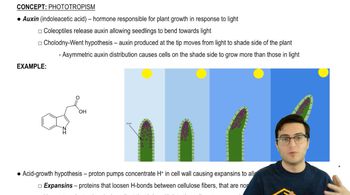
Auxins are a class of plant hormones that play a crucial role in regulating plant growth and development. They are primarily involved in cell elongation, apical dominance, and the formation of roots. Auxins promote the growth of stems while inhibiting the growth of lateral buds, which helps maintain the plant's structure and directs energy towards upward growth.
Recommended video:

Gibberellins

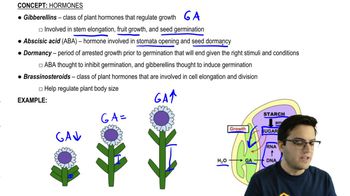
Gibberellins are a group of plant hormones that stimulate growth and influence various developmental processes, including seed germination, stem elongation, and flowering. They promote the breakdown of seed dormancy and are essential for the transition from vegetative to reproductive growth. Gibberellins are particularly important in plants that require specific environmental cues to flower.
Recommended video:
Guided course
08:18
Plant Hormones and Senescence

Abscisic Acid (ABA)

Abscisic acid is a plant hormone that primarily functions as a growth inhibitor and plays a key role in stress responses. It helps regulate stomatal closure during drought conditions, thereby reducing water loss. ABA also promotes seed dormancy and inhibits germination, ensuring that seeds only sprout under favorable conditions, which is vital for plant survival.
Recommended video: