
Pearson+ LogoPearson+ Logo
Ch. 33 Control Systems in Plants
Taylor - Campbell Biology: Concepts & Connections 10th Edition
Taylor, Simon, Dickey, Hogan10th EditionCampbell Biology: Concepts & ConnectionsISBN: 9780136538783Not the one you use?Change textbook
Chapter 33, Problem 2

During winter or periods of drought, which one of the following plant hormones inhibits growth and seed germination?
a. Ethylene
b. Abscisic acid
c. Gibberellin
d. Auxin

Verified step by step guidance
1
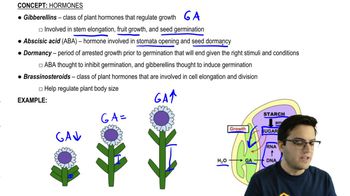
Understand the role of plant hormones: Each plant hormone has specific functions. Ethylene is involved in fruit ripening and stress responses, gibberellin promotes growth and seed germination, auxin regulates cell elongation and growth, and abscisic acid is known for its role in inhibiting growth and promoting dormancy during unfavorable conditions.
Focus on the environmental context: The problem mentions winter or drought, which are stressful conditions for plants. During such times, plants often enter a state of dormancy to conserve energy and resources.
Identify the hormone associated with dormancy: Abscisic acid (ABA) is the hormone responsible for inducing dormancy, inhibiting growth, and preventing seed germination under stressful conditions like drought or cold temperatures.
Compare the options: Ethylene, gibberellin, and auxin are not primarily associated with dormancy or growth inhibition during stress. Abscisic acid is the correct hormone for this function.
Conclude the reasoning: Based on the functions of the hormones and the environmental context provided, abscisic acid is the hormone that inhibits growth and seed germination during winter or drought.

Verified video answer for a similar problem:

This video solution was recommended by our tutors as helpful for the problem above.
Video duration:
1m
Was this helpful?

Key Concepts

Here are the essential concepts you must grasp in order to answer the question correctly.

Plant Hormones

Plant hormones, or phytohormones, are chemical messengers that regulate various physiological processes in plants, including growth, development, and responses to environmental stimuli. They play crucial roles in processes such as seed germination, flowering, and fruit ripening, influencing how plants adapt to their surroundings.
Recommended video:
Guided course
08:18
Plant Hormones and Senescence

Abscisic Acid (ABA)

Abscisic acid is a plant hormone primarily involved in stress responses, particularly during drought or unfavorable conditions. It inhibits growth and promotes seed dormancy, helping plants conserve resources and survive periods of environmental stress by preventing germination until conditions improve.
Recommended video:

Seed Germination

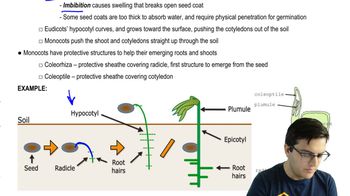
Seed germination is the process by which a seed develops into a new plant, requiring specific environmental conditions such as moisture, temperature, and light. Hormones like gibberellins promote germination, while abscisic acid acts as an inhibitor, ensuring that seeds do not germinate prematurely during adverse conditions.
Recommended video: