Pearson+ LogoPearson+ Logo
Ch. 24 The Immune System
Taylor - Campbell Biology: Concepts & Connections 10th Edition
Taylor, Simon, Dickey, Hogan10th EditionCampbell Biology: Concepts & ConnectionsISBN: 9780136538783Not the one you use?Change textbook
Chapter 24, Problem 2

Foreign molecules that elicit an immune response are called
a. Major histocompatibility complex (MHC) molecules.
b. Antibodies.
c. Histamines.
d. Antigens.

Verified step by step guidance
1
Understand the question: The problem is asking for the term used to describe foreign molecules that trigger an immune response. This requires knowledge of the immune system and its components.
Review the definitions of the options provided: a) Major histocompatibility complex (MHC) molecules are proteins on cell surfaces that help the immune system recognize self from non-self. b) Antibodies are proteins produced by B cells that bind to specific antigens. c) Histamines are chemicals released by immune cells during allergic reactions or inflammation. d) Antigens are foreign molecules that provoke an immune response.
Identify the correct term: Based on the definitions, the term that describes foreign molecules that elicit an immune response is 'antigens.'
Eliminate incorrect options: MHC molecules are involved in presenting antigens to immune cells but are not foreign molecules themselves. Antibodies are part of the immune response but are not the foreign molecules. Histamines are involved in inflammation, not in directly eliciting an immune response to foreign molecules.
Conclude: The correct answer is d) antigens, as they are the foreign molecules that trigger the immune system to respond.

Verified video answer for a similar problem:

This video solution was recommended by our tutors as helpful for the problem above.
Video duration:
1m
Was this helpful?

Key Concepts

Here are the essential concepts you must grasp in order to answer the question correctly.

Antigens

Antigens are foreign molecules, often proteins or polysaccharides, that trigger an immune response when detected by the body. They can originate from pathogens like bacteria and viruses, or from non-infectious sources such as pollen or transplanted tissues. The immune system recognizes these molecules as non-self, leading to the activation of immune cells and the production of antibodies.
Recommended video:
Guided course
03:50
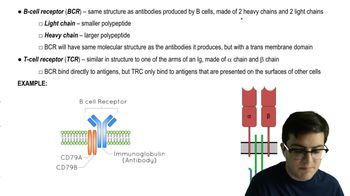
Antigen Receptors

Immune Response

The immune response is the body's defense mechanism against foreign invaders, including pathogens and antigens. It involves the recognition of antigens by immune cells, which then activate various pathways to eliminate the threat. This response can be innate (immediate and non-specific) or adaptive (specific and slower, involving memory cells for future protection).
Recommended video:
Guided course
05:20
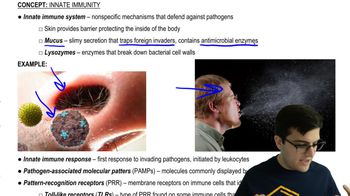
Innate Immune Response

Major Histocompatibility Complex (MHC)

The Major Histocompatibility Complex (MHC) is a set of molecules displayed on cell surfaces that play a crucial role in the immune system's ability to recognize foreign substances. MHC molecules present peptide fragments from proteins, including antigens, to T cells, facilitating the activation of the adaptive immune response. There are two main classes of MHC molecules: Class I, which presents to CD8+ T cells, and Class II, which presents to CD4+ T cells.
Recommended video:
Guided course
04:04
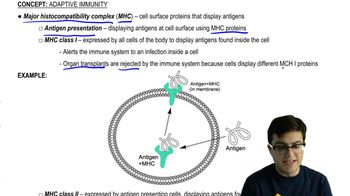
Major Histocompatibility Complex