Pearson+ LogoPearson+ Logo
Ch. 24 The Immune System
Taylor - Campbell Biology: Concepts & Connections 10th Edition
Taylor, Simon, Dickey, Hogan10th EditionCampbell Biology: Concepts & ConnectionsISBN: 9780136538783Not the one you use?Change textbook
Chapter 24, Problem 4

Which of the following best describes the difference in the way B cells and cytotoxic T cells deal with invaders?
a. B cells confer active immunity; T cells confer passive immunity.
b. B cells send out antibodies to attack; certain T cells can do the attacking themselves.
c. T cells handle the primary immune response; B cells handle the secondary response.
d. B cells are responsible for the cell-mediated immune response; T cells are responsible for the humoral immune response.

Verified step by step guidance
1
Understand the roles of B cells and T cells in the immune system. B cells are part of the humoral immune response and produce antibodies to target pathogens. Cytotoxic T cells, on the other hand, are part of the cell-mediated immune response and directly attack infected or abnormal cells.
Analyze the options provided in the question. Option (a) is incorrect because active and passive immunity are not directly related to the roles of B cells and T cells. Active immunity involves the body's own immune response, while passive immunity involves receiving antibodies from another source.
Evaluate option (b). This option states that B cells send out antibodies to attack, while certain T cells can do the attacking themselves. This aligns with the known functions of B cells (antibody production) and cytotoxic T cells (directly attacking infected cells).
Consider option (c). This option is incorrect because both B cells and T cells are involved in both primary and secondary immune responses, depending on the context of the infection.
Review option (d). This option is incorrect because it reverses the roles of B cells and T cells. B cells are responsible for the humoral immune response, while T cells are responsible for the cell-mediated immune response.

Verified video answer for a similar problem:

This video solution was recommended by our tutors as helpful for the problem above.
Video duration:
3m
Was this helpful?

Key Concepts

Here are the essential concepts you must grasp in order to answer the question correctly.

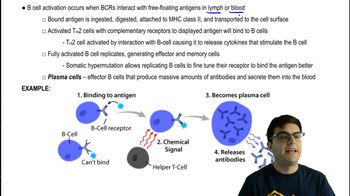
B Cells and Humoral Immunity

B cells are a type of white blood cell that play a crucial role in the humoral immune response. They produce antibodies that specifically target and neutralize pathogens such as bacteria and viruses. When activated by an antigen, B cells can differentiate into plasma cells, which secrete large quantities of antibodies into the bloodstream, providing a means to eliminate invaders.
Recommended video:
Guided course
04:06
Helper T Cells and B Cells

Cytotoxic T Cells and Cell-Mediated Immunity

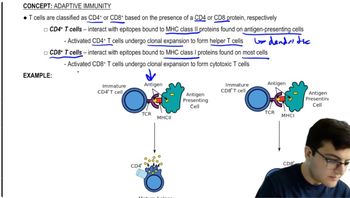
Cytotoxic T cells, also known as CD8+ T cells, are essential for the cell-mediated immune response. They directly attack and destroy infected or cancerous cells by recognizing specific antigens presented on the surface of these cells. This mechanism is vital for controlling intracellular pathogens, such as viruses, that hide within host cells.
Recommended video:
Guided course
03:43
Antigen Presentation and Cytotoxic T Cells

Active vs. Passive Immunity

Active immunity occurs when the immune system is stimulated to produce its own antibodies in response to an infection or vaccination, leading to long-lasting protection. In contrast, passive immunity involves the transfer of antibodies from one individual to another, providing immediate but temporary protection. Understanding this distinction is key to differentiating the roles of B cells and T cells in immune responses.
Recommended video:
Guided course
04:18
Passive vs. Active Transport