
Pearson+ LogoPearson+ Logo
Ch. 28 Nervous Systems
Taylor - Campbell Biology: Concepts & Connections 10th Edition
Taylor, Simon, Dickey, Hogan10th EditionCampbell Biology: Concepts & ConnectionsISBN: 9780136538783Not the one you use?Change textbook
Chapter 28, Problem 10

Design an experiment with a group of taxi drivers in a new city to examine the role of neuroplasticity on learning. Assume you have the ability to image their brains to measure changes in the volume of gray matter.

Verified step by step guidance
1
Identify a suitable group of taxi drivers who are new to the city and willing to participate in the study. Ensure that they have varying levels of experience driving in other cities to control for prior navigation experience.
Establish a baseline measurement of the gray matter volume in the hippocampus of each participant using neuroimaging techniques such as MRI (Magnetic Resonance Imaging) before they start navigating the new city.
Design a training program for these taxi drivers that involves learning and memorizing the city's layout, major routes, landmarks, and traffic regulations over a specific period. This training should be standardized to ensure that all participants receive the same amount of information and practice time.
After the training period, perform another round of MRI scans to measure any changes in the volume of gray matter in the hippocampus. Compare these post-training measurements to the baseline measurements taken at the start of the experiment.
Analyze the data to determine if there is a significant increase in the volume of gray matter in the hippocampus, which would suggest neuroplasticity as a result of learning new spatial and navigational skills. Consider factors such as age, previous driving experience, and learning rates in your analysis.

Verified video answer for a similar problem:

This video solution was recommended by our tutors as helpful for the problem above.
Video duration:
1m
Was this helpful?

Key Concepts

Here are the essential concepts you must grasp in order to answer the question correctly.

Neuroplasticity

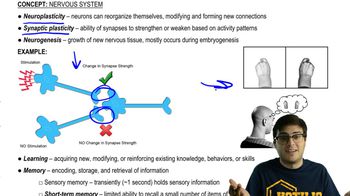
Neuroplasticity refers to the brain's ability to reorganize itself by forming new neural connections throughout life. This process allows the brain to adapt to new experiences, learn new information, and recover from injuries. In the context of learning, neuroplasticity is crucial as it underlies the changes in brain structure and function that occur when individuals acquire new skills or knowledge.
Recommended video:
Guided course
07:41
Neuroplasticity, Learning, and Memory

Gray Matter

Gray matter is a major component of the central nervous system, consisting primarily of neuronal cell bodies, dendrites, and unmyelinated axons. It plays a key role in processing information and is involved in muscle control, sensory perception, and decision-making. Changes in the volume of gray matter can indicate neuroplastic changes in response to learning or environmental demands, making it a critical measure in studies of brain adaptation.
Recommended video:
Guided course
05:05
Atoms- Smallest Unit of Matter

Experimental Design

Experimental design is the process of planning an experiment to ensure that it effectively tests a hypothesis while controlling for variables. In this context, it involves selecting appropriate methods for measuring neuroplasticity, such as brain imaging techniques, and determining how to assess the learning outcomes of taxi drivers in a new city. A well-structured experimental design is essential for drawing valid conclusions about the relationship between neuroplasticity and learning.
Recommended video:
Guided course
02:50
Experimental Design Example 1