Pearson+ LogoPearson+ Logo
Ch. 28 Nervous Systems
Taylor - Campbell Biology: Concepts & Connections 10th Edition
Taylor, Simon, Dickey, Hogan10th EditionCampbell Biology: Concepts & ConnectionsISBN: 9780136538783Not the one you use?Change textbook
Chapter 28, Problem 1

Test your understanding of the nervous system by matching the following labels with their corresponding letters: CNS, effector cells, interneuron, motor neuron, PNS, sensory neuron, sensory receptor, spinal cord, synapse. Diagram illustrating neurons and action potentials in the nervous system.

Verified step by step guidance
1
Identify the sensory receptor (a) which detects the stimulus.
Trace the pathway from the sensory receptor to the sensory neuron (b) which transmits the signal to the central nervous system (CNS).
Locate the interneuron (c) within the spinal cord (e) that processes the information and forms a response.
Follow the pathway from the interneuron to the motor neuron (d) which carries the response signal to the effector cells (f).
Identify the synapse (g) where the motor neuron communicates with the effector cells to produce a response.

Verified video answer for a similar problem:

This video solution was recommended by our tutors as helpful for the problem above.
Video duration:
51s
Was this helpful?

Key Concepts

Here are the essential concepts you must grasp in order to answer the question correctly.

Central Nervous System (CNS)

The Central Nervous System consists of the brain and spinal cord, serving as the main control center for processing information and coordinating responses. It integrates sensory data and sends out commands to the body, playing a crucial role in reflex actions and higher cognitive functions.
Recommended video:
Guided course
06:26
Peripheral Nervous System

Neurons and Synapses

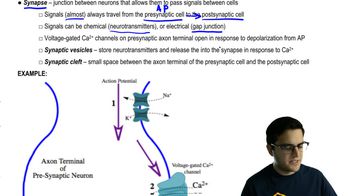
Neurons are specialized cells that transmit nerve impulses throughout the nervous system. They communicate with each other at synapses, where neurotransmitters are released to relay signals. This process is essential for reflex actions and the overall functioning of the nervous system.
Recommended video:

Peripheral Nervous System (PNS)

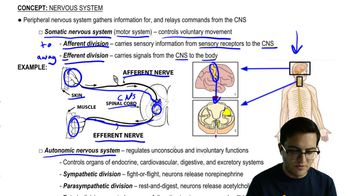
The Peripheral Nervous System includes all the nerves outside the CNS, connecting the brain and spinal cord to the rest of the body. It is divided into sensory neurons, which carry information to the CNS, and motor neurons, which transmit commands from the CNS to effector cells, such as muscles and glands.
Recommended video:
Guided course
06:26
Peripheral Nervous System