Pearson+ LogoPearson+ Logo
Ch. 21 Nutrition and Digestion
Taylor - Campbell Biology: Concepts & Connections 10th Edition
Taylor, Simon, Dickey, Hogan10th EditionCampbell Biology: Concepts & ConnectionsISBN: 9780136538783Not the one you use?Change textbook
Chapter 21, Problem 8

A peanut butter and jelly sandwich contains carbohydrates, proteins, and fats. Describe what happens to the sandwich when you eat it. Discuss ingestion, digestion, absorption, and elimination.

Verified step by step guidance
1
Ingestion: This is the first step where you physically eat the sandwich. You use your teeth and saliva to break down the food into smaller, manageable pieces. This makes it easier for your body to process the different nutrients.
Digestion: Once swallowed, the sandwich moves to your stomach and then to the intestines. Here, enzymes and other digestive juices further break down the carbohydrates into simple sugars, proteins into amino acids, and fats into fatty acids and glycerol.
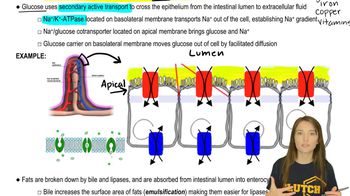
Absorption: This process occurs primarily in the small intestine. The digested nutrients (simple sugars, amino acids, and fatty acids) are absorbed through the intestinal walls into the bloodstream. From there, they are transported to various cells in the body where they are used for energy, growth, and repair.
Metabolism: After absorption, the nutrients that have been taken up by the cells undergo metabolic processes to either provide energy immediately or get stored for later use. For example, glucose can be used directly for energy or can be stored as glycogen in the liver and muscles.
Elimination: Any indigestible parts of the sandwich, such as some forms of fiber, continue through the digestive system and are eventually excreted from the body as waste through the process of elimination.

Verified video answer for a similar problem:

This video solution was recommended by our tutors as helpful for the problem above.
Video duration:
1m
Was this helpful?

Key Concepts

Here are the essential concepts you must grasp in order to answer the question correctly.

Ingestion

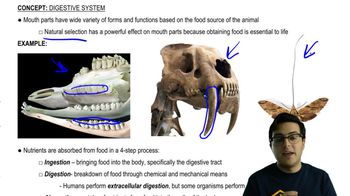
Ingestion is the process of taking food into the body through the mouth. It involves the mechanical breakdown of food by chewing and mixing it with saliva, which contains enzymes that begin the digestion of carbohydrates. This initial step is crucial as it prepares the food for further breakdown in the digestive system.
Recommended video:
Guided course
05:11
Digestion and Digestive Tracts

Digestion

Digestion refers to the biochemical process of breaking down food into smaller, absorbable components. It occurs in two stages: mechanical digestion, which involves physical breakdown, and chemical digestion, where enzymes further decompose macromolecules like carbohydrates, proteins, and fats into simpler molecules such as sugars, amino acids, and fatty acids.
Recommended video:
Guided course
05:11
Digestion and Digestive Tracts

Absorption and Elimination

Absorption is the process by which the small intestine takes up the nutrients released during digestion into the bloodstream. Once nutrients are absorbed, the remaining indigestible parts of the food move into the large intestine, where water is reabsorbed, and waste is formed. Elimination is the final step, where undigested material is expelled from the body as feces.
Recommended video:
Guided course
19:59
Nutrient Absorption
Related Practice
Textbook Question

Which of the following vitamins is mismatched with the disease that results from its underconsumption?

a. Vitamin B6—Beriberi

b. Vitamin C—Scurvy

c. Vitamin A—Vision loss

d. Vitamin D—Rickets

871
views
Textbook Question

Which of the following statements is false?

a. A healthy human has enough stored fat to supply calories for several weeks.

b. An increase in leptin levels leads to an increase in appetite and weight gain.

c. The interconversion of glucose and glycogen takes place in the liver.

d. After glycogen stores are filled, excessive calories are stored as fat, regardless of their original food source.

993
views
Textbook Question

Why is it necessary for healthy vegetarians to combine different plant foods or eat some eggs or milk products?

a. To make sure they obtain sufficient calories

b. To provide sufficient vitamins

c. To make sure they ingest all essential fatty acids

d. To provide all essential amino acids for protein synthesis

1285
views
Textbook Question

Use the Nutrition Facts label to the right to answer these questions: What percentage of the recommended daily value of fat is found in a 1-cup serving?

1005
views
Textbook Question

Use the Nutrition Facts label to the right to answer these questions: Is this product a good source of vitamin D and calcium? Explain.

792
views
Textbook Question

Use the Nutrition Facts label to the right to answer these questions: Each gram of fat supplies 9 Calories. Based on the grams of saturated fat and its % Daily Value, calculate the upper limit of saturated fat (in grams and Calories) that an individual on a 2,000-Calorie/day diet should consume.

1022
views