
Pearson+ LogoPearson+ Logo
Ch. 14 The Origin of Species
Taylor - Campbell Biology: Concepts & Connections 10th Edition
Taylor, Simon, Dickey, Hogan10th EditionCampbell Biology: Concepts & ConnectionsISBN: 9780136538783Not the one you use?Change textbook
Chapter 14, Problem 14

Explain why allopatric speciation would be less likely on an island close to a mainland than on a more isolated island.

Verified step by step guidance
1
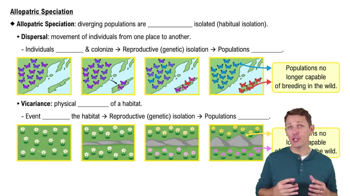
Understand the concept of allopatric speciation: Allopatric speciation occurs when populations of a species become geographically isolated from each other, preventing gene flow between them. Over time, genetic differences accumulate, leading to the emergence of new species.
Consider the geographical proximity of the island to the mainland: An island close to a mainland allows for easier and more frequent opportunities for individuals to migrate between the island and the mainland. This migration can maintain gene flow between the populations.
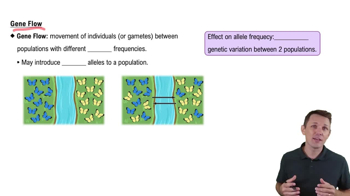
Analyze the impact of gene flow on speciation: Continuous gene flow between the island and mainland populations can hinder the genetic divergence necessary for speciation. The genetic mixing keeps the populations similar, reducing the likelihood of developing distinct characteristics that define separate species.
Compare with a more isolated island: On a more isolated island, the geographical barrier is greater, making migration and gene flow between the island and any other landmass much less likely. This isolation helps in accumulating genetic differences without being diluted by incoming genes from other populations.
Conclude the influence of isolation on speciation: Greater isolation (as seen in more distant islands) typically increases the likelihood of allopatric speciation because it effectively prevents gene flow, allowing populations to diverge genetically and eventually form new species.

Verified video answer for a similar problem:

This video solution was recommended by our tutors as helpful for the problem above.
Video duration:
49s
Was this helpful?

Key Concepts

Here are the essential concepts you must grasp in order to answer the question correctly.

Allopatric Speciation

Allopatric speciation occurs when populations of a species become geographically isolated, leading to reproductive isolation and the eventual emergence of new species. This process is driven by the accumulation of genetic differences due to natural selection, genetic drift, and mutation in the separated populations over time.
Recommended video:
03:53
Allopatric Speciation

Geographic Isolation

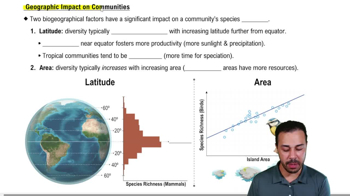
Geographic isolation refers to the physical separation of populations by barriers such as water, mountains, or distance. In the context of islands, a more isolated island would have fewer opportunities for species to migrate back and forth, enhancing the likelihood of divergent evolution compared to an island close to the mainland, where species can easily disperse.
Recommended video:
Guided course
03:35
Geographic Impact on Communities

Gene Flow

Gene flow is the transfer of genetic material between populations through migration and interbreeding. On an island close to the mainland, increased gene flow can occur as individuals from the mainland can easily reach the island, which can counteract the effects of speciation by maintaining genetic similarities between populations, thus reducing the likelihood of allopatric speciation.
Recommended video:
01:43
Gene Flow
Related Practice
Textbook Question

When hybrids produced in a hybrid zone can breed with each other and with both parent species, and they survive and reproduce as well as members of the parent species, one would predict that

a. The hybrid zone would be stable.

b. Sympatric speciation would occur.

c. Reinforcement of reproductive barriers would keep the parent species separate.

d. Reproductive barriers would lessen and the two parent species would fuse.

1670
views
Textbook Question

Which of the following factors would not contribute to allopatric speciation?

a. A population becomes geographically isolated from the parent population.

b. The separated population is small, and genetic drift occurs.

c. The isolated population is exposed to different selection pressures than the parent population.

d. Gene flow between the two populations continues to occur.

1437
views
Textbook Question
Explain how each of the following makes it difficult to clearly define a species: variation within a species, geographically isolated populations, asexual species, fossil organisms.
1268
views
Textbook Question
What does the term punctuated equilibria describe?
952
views
Textbook Question
Can factors that cause sympatric speciation also cause allopatric speciation? Explain.
1602
views
Textbook Question
Cultivated American cotton plants have a total of 52 chromosomes (2n = 52). In each cell, there are 13 pairs of large chromosomes and 13 pairs of smaller chromosomes. Old World cotton plants have 26 chromosomes (2n = 26), all large. Wild American cotton plants have 26 chromosomes, all small. Propose a testable hypothesis to explain how cultivated American cotton probably originated.
1290
views