Pearson+ LogoPearson+ Logo
Ch. 7 Photosynthesis: Using Light to Make Food
Taylor - Campbell Biology: Concepts & Connections 10th Edition
Taylor, Simon, Dickey, Hogan10th EditionCampbell Biology: Concepts & ConnectionsISBN: 9780136538783Not the one you use?Change textbook
Chapter 7, Problem 1

Complete this summary map of photosynthesis.
<IMAGE>

Verified step by step guidance
1
Step 1: Photosynthesis begins with the conversion of light energy (a) into chemical energy. This process occurs in the chloroplasts.
Step 2: Photosynthesis includes two main stages: the light reactions (b) and the Calvin cycle (c). The light reactions occur in the thylakoid membranes, while the Calvin cycle occurs in the stroma.
Step 3: During the light reactions, water (H2O) is split, releasing oxygen (O2) as a byproduct (d). This process also generates electrons and protons.
Step 4: Light-excited electrons of chlorophyll are passed down the electron transport chain (e), reducing NADP⁺ to NADPH (f). This electron transport also drives the production of ATP through chemiosmosis.
Step 5: In the Calvin cycle, carbon dioxide (CO2) is fixed to RuBP, forming a 3-carbon molecule that is reduced using ATP and NADPH (g). This process ultimately produces glucose or other carbohydrates (h).

Verified video answer for a similar problem:

This video solution was recommended by our tutors as helpful for the problem above.
Video duration:
59s
Was this helpful?

Key Concepts

Here are the essential concepts you must grasp in order to answer the question correctly.

Photosynthesis

Photosynthesis is the biochemical process by which green plants, algae, and some bacteria convert light energy into chemical energy. This process primarily occurs in the chloroplasts of plant cells, where chlorophyll captures sunlight to transform carbon dioxide and water into glucose and oxygen. The overall equation for photosynthesis can be summarized as 6CO2 + 6H2O + light energy → C6H12O6 + 6O2.
Recommended video:
Guided course
05:58
Pigments of Photosynthesis

Chlorophyll

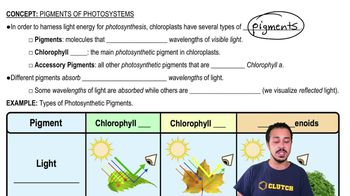
Chlorophyll is the green pigment found in the chloroplasts of plants, essential for photosynthesis. It absorbs light most efficiently in the blue and red wavelengths, reflecting green light, which is why plants appear green. Chlorophyll plays a crucial role in converting solar energy into chemical energy by facilitating the light-dependent reactions of photosynthesis.
Recommended video:
Guided course
05:58
Pigments of Photosynthesis

Light-dependent and Light-independent Reactions

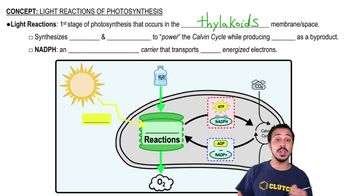
Photosynthesis consists of two main stages: light-dependent reactions and light-independent reactions (Calvin cycle). Light-dependent reactions occur in the thylakoid membranes and require sunlight to produce ATP and NADPH, while releasing oxygen as a byproduct. The light-independent reactions, occurring in the stroma, use ATP and NADPH to convert carbon dioxide into glucose, completing the photosynthetic process.
Recommended video:
Guided course
04:06
Light Reactions of Photosynthesis