Pearson+ LogoPearson+ Logo
Ch. 7 Photosynthesis: Using Light to Make Food
Taylor - Campbell Biology: Concepts & Connections 10th Edition
Taylor, Simon, Dickey, Hogan10th EditionCampbell Biology: Concepts & ConnectionsISBN: 9780136538783Not the one you use?Change textbook
Chapter 7, Problem 2

In photosynthesis, _________ is oxidized and _________ is reduced.
a. Water . . . Oxygen
b. Carbon dioxide . . . Water
c. Water . . . Carbon dioxide
d. Glucose . . . Carbon dioxide

Verified step by step guidance
1
Understand the concept of oxidation and reduction: Oxidation involves the loss of electrons, while reduction involves the gain of electrons. In photosynthesis, these processes occur during the light-dependent and light-independent reactions.
Recall the overall chemical equation for photosynthesis: 6CO2 + 6H2O + light energy → C6H12O6 + 6O2. This equation shows the transformation of carbon dioxide and water into glucose and oxygen.
Identify the molecule that is oxidized: In photosynthesis, water (H2O) is split during the light-dependent reactions, releasing oxygen (O2) and losing electrons. This is an oxidation process.
Identify the molecule that is reduced: Carbon dioxide (CO2) is reduced during the Calvin cycle (light-independent reactions) to form glucose (C6H12O6). This involves the gain of electrons.
Match the correct answer choice based on the oxidation and reduction processes: Water is oxidized, and carbon dioxide is reduced. Therefore, the correct answer is c. water . . . carbon dioxide.

Verified video answer for a similar problem:

This video solution was recommended by our tutors as helpful for the problem above.
Video duration:
1m
Was this helpful?

Key Concepts

Here are the essential concepts you must grasp in order to answer the question correctly.

Photosynthesis

Photosynthesis is the biochemical process by which green plants, algae, and some bacteria convert light energy into chemical energy, specifically glucose. This process occurs primarily in the chloroplasts of plant cells and involves two main stages: the light-dependent reactions and the Calvin cycle. During photosynthesis, carbon dioxide and water are used to produce glucose and oxygen, highlighting the transformation of energy and matter in ecosystems.
Recommended video:
Guided course
05:58
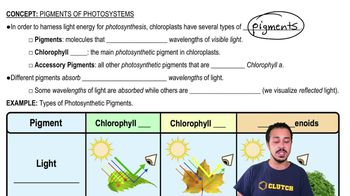
Pigments of Photosynthesis

Oxidation and Reduction

Oxidation and reduction are chemical processes that involve the transfer of electrons between substances. Oxidation refers to the loss of electrons, while reduction refers to the gain of electrons. In the context of photosynthesis, water is oxidized to release oxygen, and carbon dioxide is reduced to form glucose, illustrating how energy is captured and stored in organic molecules.
Recommended video:
Guided course
04:38
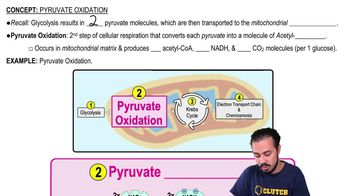
Pyruvate Oxidation

Role of Water and Carbon Dioxide

Water and carbon dioxide are essential reactants in the photosynthetic process. Water provides the electrons needed for the light-dependent reactions and is split to release oxygen as a byproduct. Carbon dioxide, on the other hand, is fixed during the Calvin cycle to produce glucose, serving as a carbon source for the synthesis of organic compounds that fuel plant growth and energy needs.
Recommended video: