Pearson+ LogoPearson+ Logo
Ch. 7 Photosynthesis: Using Light to Make Food
Taylor - Campbell Biology: Concepts & Connections 10th Edition
Taylor, Simon, Dickey, Hogan10th EditionCampbell Biology: Concepts & ConnectionsISBN: 9780136538783Not the one you use?Change textbook
Chapter 7, Problem 14

The following diagram compares the chemiosmotic synthesis of ATP in mitochondria and chloroplasts. Identify the components that are shared by both organelles and indicate which side of the membrane has the higher H+ concentration. Then label on the right the locations within the chloroplast.
<IMAGE>

Verified step by step guidance
1
Step 1: Identify the shared components between mitochondria and chloroplasts. Both organelles use a membrane-bound ATP synthase enzyme to synthesize ATP, and both rely on a proton gradient (H+ concentration difference) across a membrane to drive this process.
Step 2: Determine which side of the membrane has the higher H+ concentration. In mitochondria, the intermembrane space has a higher H+ concentration compared to the matrix. In chloroplasts, the thylakoid lumen has a higher H+ concentration compared to the stroma.
Step 3: Label the components on the right side of the diagram for the chloroplast. 'c' corresponds to the thylakoid lumen, 'd' corresponds to the thylakoid membrane, and 'e' corresponds to the stroma.
Step 4: Understand the movement of protons. In both organelles, protons move down their concentration gradient through ATP synthase, from the side with higher H+ concentration to the side with lower H+ concentration, driving ATP synthesis.
Step 5: Relate the energy source for creating the proton gradient. In mitochondria, the energy comes from the electron transport chain powered by cellular respiration. In chloroplasts, the energy comes from the light-driven electron transport chain during photosynthesis.

Verified video answer for a similar problem:

This video solution was recommended by our tutors as helpful for the problem above.
Video duration:
1m
Was this helpful?

Key Concepts

Here are the essential concepts you must grasp in order to answer the question correctly.

Chemiosmosis

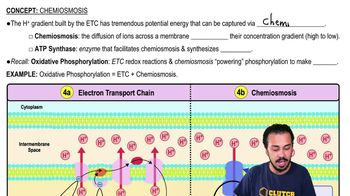
Chemiosmosis is the process by which ATP is produced in both mitochondria and chloroplasts through the movement of protons (H+) across a membrane. This movement occurs via ATP synthase, an enzyme that harnesses the energy from the proton gradient created by electron transport chains. The flow of protons back into the mitochondrial matrix or chloroplast stroma drives the conversion of ADP and inorganic phosphate into ATP.
Recommended video:

Proton Gradient

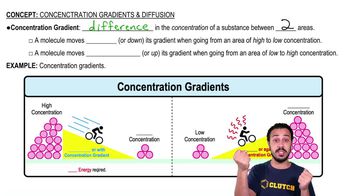
A proton gradient is established when there is a difference in H+ ion concentration across a membrane. In mitochondria, this gradient is created during cellular respiration, while in chloroplasts, it occurs during photosynthesis. The side of the membrane with a higher concentration of H+ ions is crucial for ATP synthesis, as it drives protons through ATP synthase, facilitating ATP production.
Recommended video:
Guided course
04:51
Concentration Gradients and Diffusion

Organellar Structures

Mitochondria and chloroplasts have distinct structures that facilitate their functions. Mitochondria have an inner membrane where the electron transport chain is located, while chloroplasts contain thylakoid membranes where light-dependent reactions occur. Understanding these structures is essential for identifying where ATP synthesis takes place and how the components of each organelle contribute to the overall process of energy conversion.
Recommended video:
Guided course
04:25
Community Structure